
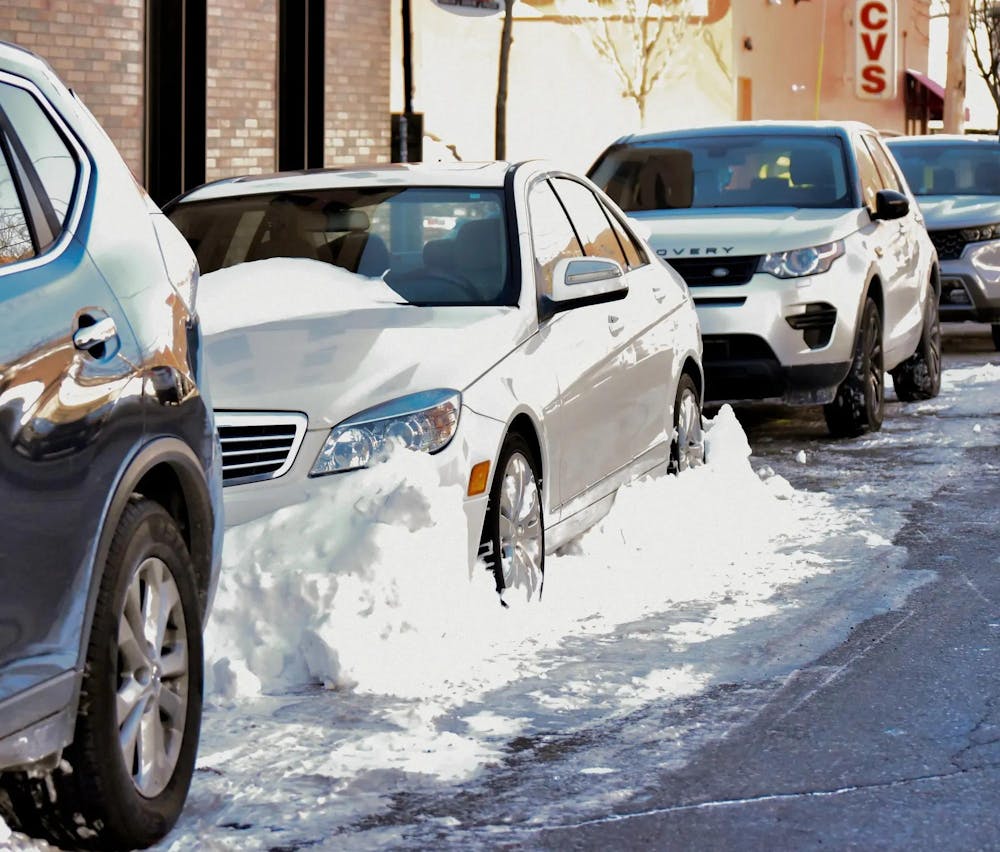
On Jan. 25, Providence was hit by a major winter storm that left about a foot of snow in its wake. Almost two weeks later, the Department of Public Works is still digging out the streets, raising questions among residents and city councilors over the city’s storm preparedness.
Since the storm, “snow plowed from streets has accumulated on residential sidewalks, driveways and yards,” City Councilor and Committee on Public Works Chairman Oscar Vargas (Ward-15) wrote in a statement shared with The Herald. “Over a week later, it remains unsafe to travel on many streets throughout Providence, and pedestrian access has been severely limited.”
The City of Providence started planning for the snow several months ago, according to City spokesperson Josh Estrella. The DPW began recruiting private plow contractors early last year, and trained crews on plowing routes and salt application techniques in the fall, Estrella wrote in an email to The Herald.
Crews set out to salt the roads at 5 a.m. on Jan. 25, hours before the storm began, said DPW Director Patricia Coyne-Fague at the City Council’s Committee on Public Works meeting on Feb. 3. According to Estrella, over 80 personnel and over 30 contracted vendors worked to clear snow in Providence.
The crews “carried out non-stop clean-up efforts for over 36 hours straight,” he wrote. These clean-up efforts cost over $500,000 as of Feb. 3, he added.
Amid rising public pressure, city council members introduced a resolution on Thursday requesting a formal report from the DPW detailing their response plan for the snowstorm on Jan. 25 and 26.
A shortage of plow drivers posed a challenge for clearing snow after the storm, Estrella wrote. Despite relatively high hourly rates for plow drivers in Providence, Estrella wrote, the “wear and tear” that comes with plowing in the urban area has deterred a large number of plow drivers from the job. As a result, pick-up trucks have constituted the majority of the clean-up force, Coyne-Fague said.
“And to clear a city this size using pick-up trucks is a real challenge,” Coyne-Fague added.
Additional plows are still needed to complete the city’s fleet, but six large snow plows ordered over a year ago are not expected to arrive until October, she noted.
Because of low temperatures, the snow never melted, “increasing the need for salt or other snow-removal materials” that many retailers in Providence have run out of, according to the statement from Vargas.
In Providence, a parking ban was implemented before the snow storm began to allow for the streets to be plowed.
Estrella wrote that Mayor Brett Smiley expanded the parking ban during the storm, “enabling our crews to clear the streets more efficiently.” But not all residents abided by the ban, and the City had reached their limits on enforcement after 300 cars were towed and an additional 100 tickets were issued, Coyne-Fague said at the meeting.
State Representative David Morales (D-Providence) felt that the parking ban was lifted prematurely on the morning of Tuesday Jan. 27, before streets were plowed “from curb to curb.”
David Salzillo Jr., a student at the Roger Williams University School of Law, was met with “horrendous” traffic when he tried to take the bus after the storm, he told The Herald. “Everything was all clogged up because the pathways are just too narrow,” he said.
“There weren’t any pathways to the street at all,” Nina Stone, an employee at Ben and Jerry’s and a student at Johnson and Wales University, said in an interview with The Herald. “I literally had to step in shin-high snow just to get through.”
Confusion over who holds responsibility for sidewalk plowing has compounded the issue.
Coyne-Fague said that “there hasn’t been a good list” of which sidewalks the City is responsible for clearing. In the days after the storm, she worked with her staff to assemble a list of sidewalks around City-owned property.
City ordinance mandates that home and business owners must clear their own adjacent sidewalks within eight hours after snow stops.
The snowed-in alley behind Ben and Jerry’s resulted in a pile-up of trash, Stone said. She said she wasn’t sure “whether it’s supposed to be plowed by the City or by the property manager.”
“The sidewalk clearance is merely an issue of enforcement, since the law requires homeowners and businesses in Providence to clear their walks,” wrote Amy Glidden, co-coordinator of Rhode Island Transit Riders, a transportation advocacy group. This rule “is not being enforced with teeth in most areas.” The City did not respond to a request for comment about enforcement of the law.
RIPTA is “only able to shovel 300 out of the over 3,000 stops in the state” due to funding and staffing limitations, Glidden wrote. Even though some businesses shovel away the snow from bus stops in front of their properties, “ultimately riders and pedestrians are left at the mercy of businesses and homeowners.”
In an email to the Herald, RIPTA Communications Director Cristy Raposo Perry acknowledged the agency’s collaboration with “local businesses, municipalities and property owners to clear the stops.” Raposo Perry did not specifically respond to a question about how many stops RIPTA can shovel.
After the snow is cleared off the streets, the work still is not done. Finding a place to dump the over 1,200 truckloads of snow poses even more challenges.
Trucks no longer dump collected snow in water bodies such as the Narragansett Bay due to an environmental policy change in 2011 to prevent contamination, said Leon Ly, an environmental engineering associate at the Rhode Island Department of Environmental Management.
“We’ve gotten a few calls from people asking if they can dump, but usually we tell them to find somewhere else,” he said.
Rhode Island Department of Transportation Communications Director Charles St. Martin wrote that for them, this was “one of the most successful cleanups ever recorded in RIDOT history.”
“It is also important to note that most roads in Providence are not state roads; they are the responsibility of the city,” he wrote, adding that RIDOT has “provided assistance” to Providence in clearing some service roads.
At Brown, snow is being carted to the Brown Stadium, according to Assistant Vice President of Facilities Operations Paul Armas. There, it will be left to melt.
Ava Rahman is a senior staff writer covering housing, infrastructure and transportation.


