
As attendees poured into MacMillan Hall for student-led tech collaborative Emergent’s panel on artificial intelligence this Monday, they were greeted by three prompts about the value of AI art and its impact on the creative field.
Based on the responses to the first survey prompt, the majority of attendees believed that AI art was inherently less valuable than human-generated work. After each prompt, four expert panelists’ responses were compared to the attendees. For the first, most of the panelists offered a different perspective from the audience.
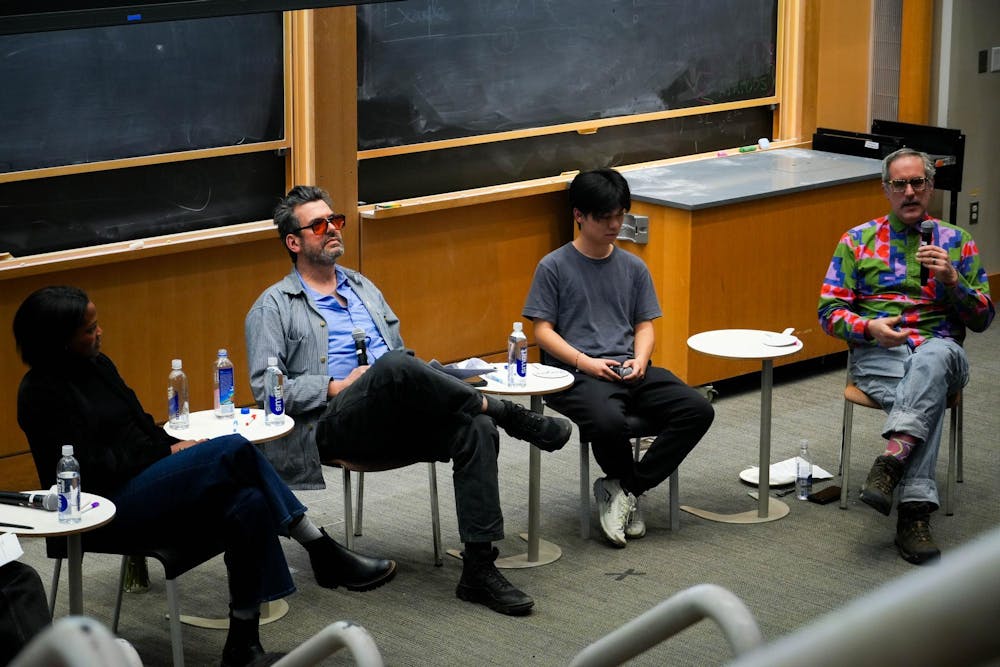
The panel featured Tamar Nisbett, who works in monetization at character.ai; Jonny Belt, who has served as an executive producer for Nickelodeon projects; Jack Xu ’27, a software engineer at AI music startup Suno; and Jim Drain, an artist and critic at RISD.
Of the four speakers, only Xu said he believed that manmade art was intrinsically more valuable than AI-generated work.
“We want to … facilitate a conversation between art people and AI people,” said Sami Nourji ’26, co-president of Emergent. While the two fields may seem polarized, “there’s a possibility to have a conversation where we’re coming together and finding a middle ground,” he added.
A large talking point for the panelists was AI’s ability to perform tasks common in entry-level art jobs, which could potentially hurt the job prospects of upcoming college graduates.
Most attendees agreed or strongly agreed that “AI will replace some artists.” But Xu argued that the value of human-generated art will allow the field to persist without being taken over by AI.
Belt and Nisbett offered a nuanced perspective, saying that high-level artists would not be safe from AI replacement but that entry-level artist positions may be at risk.
Event attendee Nikki Juen, a RISD alum and former RISD professor, is an artist and designer who researches AI. She agreed with the panelists that the loss of jobs to AI is an important problem that needs to be addressed. “There are a lot of artists and designers down the hill at RISD that are really, really concerned” about AI’s impact on entry-level roles, she said in an interview after the panel.
When asked whether “AI has had a net positive impact on artists” in the third prompt, most attendees were neutral or slightly disagreed with the idea that AI has benefited artistic professionals.
Belt and Nisbett noted that AI would increase productivity and allow access to complex or expensive art forms, like animation, that people might not otherwise have.
Nisbett also stressed the importance of how AI and creativity can go hand-in-hand instead of being pitted against each other. “It’s really important that we put them in conversation with each other and understand how they can actually be forces for positivity for each other,” she said in an interview after the panel.
“I think there was more consensus than debate eventually,” Xu said in an interview after the event. But, Xu viewed that consensus as unfortunately “pessimistic towards the future of how humans and AI would coexist,” especially in terms of AI’s economic impact on artists.
Still, the panel was able to provide a place for productive conversation between often disconnected fields and to challenge peoples’ pre-existing worldviews, Nourji said. “Polarization comes from a lack of knowledge.”
Jeremiah Farr is a senior staff writer covering university hall and higher education.


