As measles cases continue to rise, the United States is at risk of losing its measles elimination status.
According to a spokesperson from the Pan American Health Organization, which will oversee the review of the United State’s measles elimination status on April 13, the “reestablishment of endemic transmission would be defined as a continuous chain of transmission lasting through or beyond” Jan. 20.
The Herald spoke to experts at Brown to better understand measles, its potential threats and the possibility of the United States losing its elimination status.
The spread of Measles in the United States is largely due to “falling immunization rates,” according to Interim Associate Dean of Education at the School of Public Health Scott Rivkees. “Because measles is so contagious, you really have to have 95% of the population vaccinated to stop spread.”
Currently, the United States has around a 92% vaccination rate against the disease, he added.
Elimination status is assessed by the PAHO’s independent Regional Monitoring and Re-Verification Commission. The PAHO serves as the World Health Organization Regional Office for the Americas, but the two organizations remain legally distinct. This means that the United States’s recent withdrawal from the WHO does not affect the country’s PAHO membership.
Losing elimination status “does not carry formal sanctions,” according to a PAHO spokesperson, but it does illustrate a country’s “gaps in vaccination coverage, surveillance, outbreak response or access to health services.”
Rivkees attributes falling vaccination rates in parts of the United States to “growing expansion of exemptions” for immunization and the “erosion of vaccine confidence,” a belief he says increased in popularity during the COVID-19 pandemic.
“In addition to the pushback against COVID-19 vaccines, there was a spillover into routine childhood vaccines,” Rivkees added.
Children typically receive the vaccine for measles, mumps and rubella at one year of age, and a second dose between the ages of four and six, according to Professor of Pediatrics Michael Koster, who is also director for the Division of Pediatric Infectious Diseases at Hasbro Children’s Hospital.
“Unfortunately, there’s no antiviral for measles, the way there are for things like flu or COVID-19,” Koster said. Doctors can only provide “supportive care,” he added.
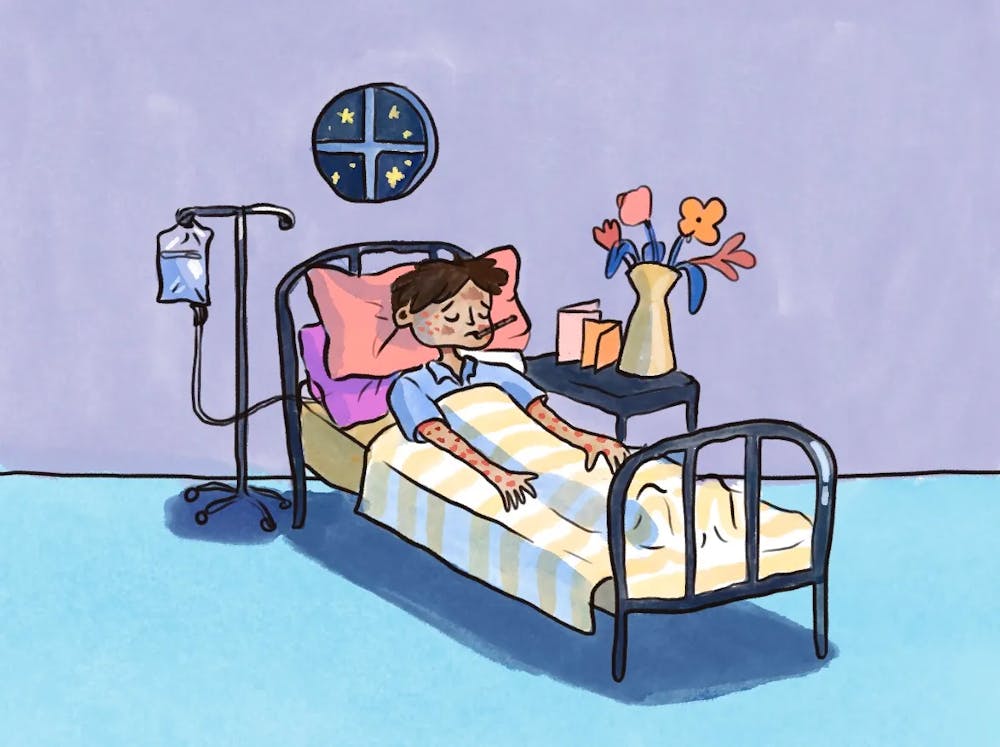
“If a child has measles, there’s about a 20 to 30% chance that child will have to be hospitalized for pneumonia,” Rivkees said. “About one in 500 children will get measles encephalitis, which can lead to permanent brain damage. Up to 10% of children who have measles will end up having permanent hearing loss.”
“To be clear, we’re never going to be able to stop vaccinating against measles,” said Jennifer Nuzzo, the director of Brown’s Pandemic Center. “Measles elimination is more about driving the incidence, meaning the number of new cases that occur to a very low number of theoretically, domestically speaking, zero.”
Rhode Island has only reported one measles case since 2013, The Herald previously reported.
The United States received their elimination status in 2000 and nearly lost it in 2019 after outbreaks in New York persisted for nearly a year. Last year, Texas experienced an outbreak of measles that lasted from January to August. An outbreak in South Carolina, which began October 2025, has reported 847 total cases as of Jan. 30.
In an effort to avoid the loss of elimination status, the United States may argue that the measles outbreaks in Texas and South Carolina are not related.
For Nuzzo, trying to disapprove this connection is like “trying to be graded on a curve,” she said. “It’s contrary to the whole spirit of what the point of measles elimination as a goal was, which is to protect people from measles, and we’re clearly, by no measure … doing a good job of that.”