
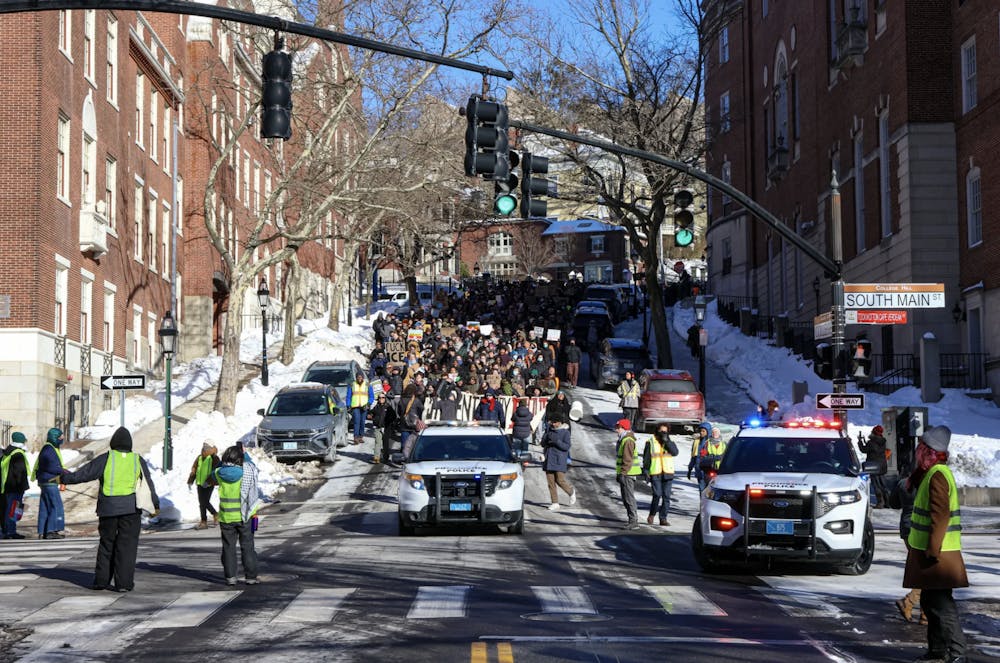
On Jan. 30, over 1,000 Brown students chanted in front of the John D. Rockefeller Jr. Library steps in protest of U.S. Immigration and Customs Enforcement. One of the groups behind the walkout was Brown Rise Up, a student activist organization that previously organized a protest against the Trump administration’s compact, and has since shifted its focus to protesting the actions of immigration enforcement officials.
Dakota Pippins ’29, the press liaison for BRU, said that the killing of Renee Good and Alex Pretti by immigration officials in Minneapolis inspired the group’s shift to activism against ICE.
“There was this call from the Somali Student Association and the Black Student Union of the University of (Minnesota) for a general strike nationwide,” he said. “What that call meant in our context was to hold a strike in the city and a student strike at Brown.”
Pippins added that he has noticed an increased presence of ICE in Providence, pointing to the attempted detainment of a 16 year-old intern in November in front of the Rhode Island Superior Court.
“They’re at the courthouses basically every single week, multiple times a week,” Pippins said.
On campus, BRU is advocating for “an official policy that federal law enforcement, ICE, cannot enter campus buildings without a judicial warrant,” said BRU Co-President Simon Aron ’28. He added that he and others from the group met with President Christina Paxson P’19 P’MD’20 to discuss the matter last semester.
Pippins said he believes that students can be a “critical” part of protesting against the agency.
“We’re younger, we have a certain amount of flexibility that a lot of Americans don’t have, and we’re also in an environment that’s encouraging us to learn and to think critically and to put that knowledge into action,” he said.
In addition to organizing protests, BRU Narrative Team Co-Coordinator Raya Gupta ’29 wrote in a text to The Herald that members of BRU and the Deportation Defense Network “have been doing regular ICE watch shifts since last semester.”
“Both BRU and DDN are part of the same struggle, and we’ve started to build real student power together,” Gupta added.
Aron recently traveled to Minneapolis to assist high schoolers organizing in response to increased ICE activity in the city. “If they can do it, we can do it,” he said, noting that he was inspired by the students’ mutual support and energy in mobilizing.
He added that the community he saw in Minneapolis was similar to the community he had seen at Brown in the wake of “someone dying unexpectedly because of gun violence.”
“I think that everything changed right after, after the shooting, and we’re, frankly, still resting with what that means for activism on campus,” Aron said. But he feels confident that if “we’re under threat again,” that students will be able to “rise up.”
“I really do feel like the tightness of this community has just increased,” he added, noting that he and others are trying to check in and take care of one another.
“It can feel daunting, but social movements have been able to overcome immense odds in the past,” Gupta said. “When people come together to fight for it, our possibilities open up into a radically better future.”

Zarina Hamilton is a university news editor covering activism and affinity & identity. She is sophomore from near Baltimore, Maryland and is studying mechanical engineering. In her free time, you can find her reading, journaling, or doing the NYT mini crossword.
Marat Basaria is a senior staff writer covering activism.


