
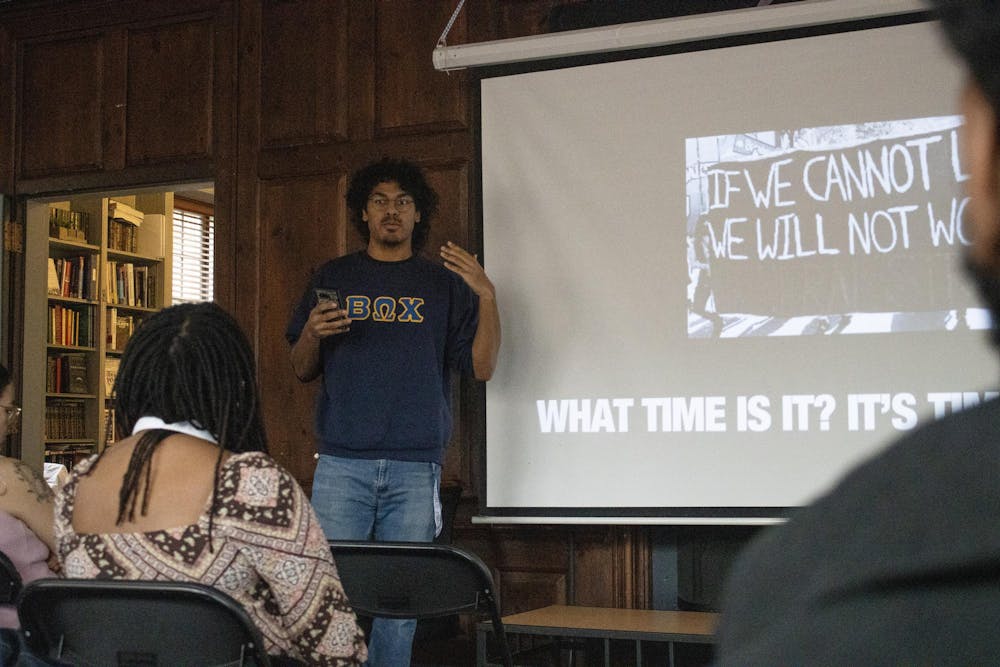
On Sunday, the Black Student Union, the fraternity Beta Omega Chi and the Party for Socialism and Liberation in Rhode Island held a joint teach-in at Olney House. Organizers sought to draw connections between Black, labor and immigrant liberation movements.
Speakers emphasized how learning about historical resistance can empower people to take action today, including challenging recent actions of the U.S. Immigration and Customs Enforcement Agency, which many have criticized as inhumane and unlawful.
According to Laurence Nunes ’27, a member of BOX, the two primary goals of the teach-in were to educate students about the importance of unity in national struggles and to promote the anti-ICE general strike led by Black student groups at the University of Minnesota.
“We’re in a place where many people have forgotten what forms of resistance can look like, and that makes it seem less feasible,” Nunes said. He added that “remembering our history” will help inspire more people to take action.
Matisse Doucet ’27, BOX member and an organizer of the teach-in, said he hoped to contextualize ICE’s actions in Minnesota with the historical oppression of Black Americans.
“This teach-in is really trying to make those links clear,” Doucet said, drawing connections between today’s resistance against ICE and “the struggle against police violence.” According to Doucet, these current issues connect to the history of slave patrols, which he referred to as the first police and first immigration enforcement agency.
Doucet added that the Brown community has recently brought forth a strong culture of resistance, citing the Jan. 30 anti-ICE walkout. In part, he finds the teach-in important in encouraging students to keep “building on the legacy of protest.”
“I think there’s a lot to be scared of, and that shut down was kind of a glimmer of hope,” Doucet said. “I think the question we’re really trying to interrogate this event is: What comes next?”
The teach-in included a group chant calling for a national strike and an analysis of multiple quotes written by notable black liberation activists, including Frederick Douglass and W.E.B. Du Bois. Towards the end of the teach-in, attendees split into three discussion groups to brainstorm strategies to promote the general strike to R.I. businesses and community members. They also discussed the importance of Brown students giving back to the community.
According to Nunes, one of the goals of the teach-in was to emphasize coalition building as a key movement strategy.
Black resistance movements such as the Civil Rights movements have always had Black leaders, “but it’s been people of all ethnicities coming together to actually make it happen,” Nunes said.
“Part of why we’re doing this event is recognizing that both Black people and non-Black people kind of need to be fighting for the black struggle and also fighting for the immigrant rights struggle and linking all these struggles together,” Doucet said.
Franklyn Yang ’29, who attended the teach-in, told The Herald that one of his main takeaways was the connection between Black liberation, labor organizing and the contemporary political atmosphere.
“They’re very deeply intertwined,” Yang said. “I’m really glad that they emphasized how Black organizing was at the forefront of a lot of these movements.”
Marat Basaria is a senior staff writer covering activism.


