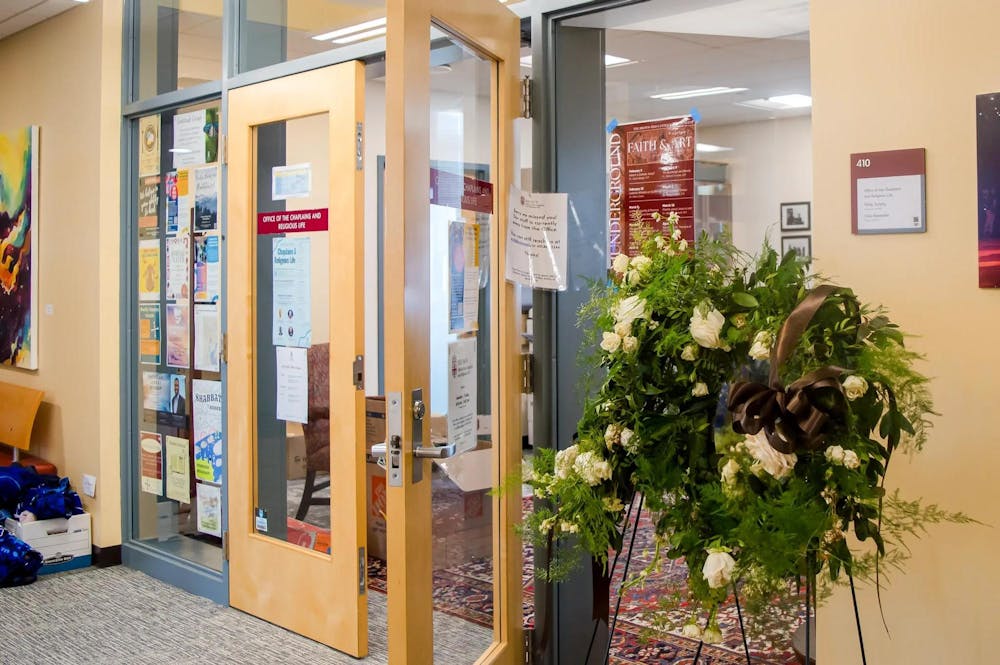
Whether crowding around the Shabbat table, joining in prayer at a Sunday Mass or meeting one-on-one with pastors, some students have been turning to religious spaces on College Hill to find community and support after the Dec. 13 shooting.
Campus religious leaders who spoke with The Herald said they have seen increased student involvement as they aim to support community members through routine and opportunities for connection.
Staff at Brown-RISD Hillel began planning how to welcome the Brown community back to campus shortly after students left in December, said Rabbi Josh Bolton, interim associate chaplain of the University for the Jewish Community and executive director of Brown-RISD Hillel.
“We understood that part of our role was going to be helping set the tone of the opening chapter of the semester,” he said. He added leaders at Brown-RISD Hillel knew they needed to “create opportunities for reflection and mourning,” as well as spaces for “joy and celebration.”
Before the spring semester began, Brown-RISD Hillel staff met with a specialist in trauma care, Bolton said. This helped staff learn how to use the “right language” and know what to do once students returned to campus.
Father Justin Bolger, associate chaplain of the University for the Catholic Community, said that his goal during this time is to be “consistent and present.” The day after the shooting, the Catholic community leadership did not reschedule Mass so students could have something familiar to “fall back on,” he said.
In the following days, the Brown-RISD Catholic Community provided “fresh, warm” meals for students still on campus, according to Alexa Barbosa ’28, co-coordinator of the Pastoral Council for the BRCC. She said that this support exemplified “the kind of place (the BRCC) is to people on campus.”
“Its doors are always open for everybody,” she said.
Christopher Egg-Krings MD’29, a student leader for College Hill Buddhists for Peace, described College Hill Buddhists for Peace as a “very strong community,” and said that connecting with people within the group has been “therapeutic” and “healing.”
When planning this semester, the group’s “first thought was not programming but presence,” Alvin Huang, assistant professor of molecular biology, cell biology and biochemistry who also serves as the faculty advisor and religious life affiliate for College Hill Buddhists for Peace, wrote in an email to The Herald.
“We asked: What do students need most right now?” Huang wrote. “The answer seemed to be safe spaces, listening and calm.”
Reverend Delphain Demosthenes, associate chaplain of the University for the Protestant community, said that while community programming has remained relatively consistent compared to last semester, religious leaders aim to “pay attention to the fact that folks are coming in with additional” questions and needs, and encourage students “to care for themselves and find joy wherever they” can.
“In moments of tragedy, people are asking deep, existential questions that religious communities are familiar with,” he said. He said he sees religious communities “as great assets” when it comes to these conversations.
Leaders across religious groups have been working to increase programming and support for students and community members.
Bolger said the Catholic community has expanded opportunities for community prayer this semester, including praying a rosary for hope every Tuesday night. The center has also increased the presence of staff on campus, such as providing coffee and hot chocolate to people on the Main Green, according to Bolger.
Barbosa emphasized that BRCC community members and staff have been great for “checking in, making sure you’re okay, for being there with you, praying with you,” adding that a faith community can serve as “reminders of love” during a tragic time.
To start the semester, Brown-RISD Hillel held an increased number of events to create “as many opportunities and landing pads for students as possible,” Bolton said. Recently, the organization has provided additional pastoral support and availability, as well as events like bagel brunches and a Shuk night with Brown Students for Israel.
“The most important medicine in times of difficulty is the ability to be together with friends and to share experiences and to console one another,” he said. “I hope that (the Brown-RISD Hillel) can be that place for many, many students on campus, Jewish or otherwise.”
College Hill Buddhists for Peace holds monthly meetings offering meditation and discussion, Huang told The Herald. The first few meetings of the semester were virtual but the group plans to return to meeting fully in-person in March, he said.
“Healing takes time and looks different for everyone. If (the College Hill Buddhists for Peace) can be a place where students feel safe, heard and a little more hopeful after they leave than when they arrived, then we’re doing our job,” Huang wrote.
Demosthenes added that leaders in the Protestant community have increased their hours of availability for “one-on-one time” with students.
Gatherings within the Protestant community are “open and accessible to all,” Demosthenes said.
The Herald reached out to other religious communities who did not respond or declined to comment.
Across many of the religious groups on campus, leaders have observed a shift in how students are engaging with faith and community following the shooting.
Bolton shared he has noticed an increase in student engagement so far this semester, noting “huge crowds” at the weekly Shabbat dinners. Both Bolger and Demosthenes also noted higher attendance at gatherings.
“People are searching for meaning; they’re searching for points of connection,” Bolton said.
Huang noted that he has observed different trends of involvement within College Hill Buddhists for Peace. “Some students are more hesitant and protective of their time and energy,” he wrote, while “others are seeking community more intentionally.”
“We could hold on to our own particular beliefs. But more importantly, we can transcend those to build a community with one another, and then use that one unifier, which is love,” Demosthenes said.
Rachel Wicker is a senior staff writer covering affinity and identity. She is from Athens, Georgia and plans on concentrating in English on the nonfiction track and International and Public Affairs. Outside of writing, she enjoys reading books of any genre and doing yoga.