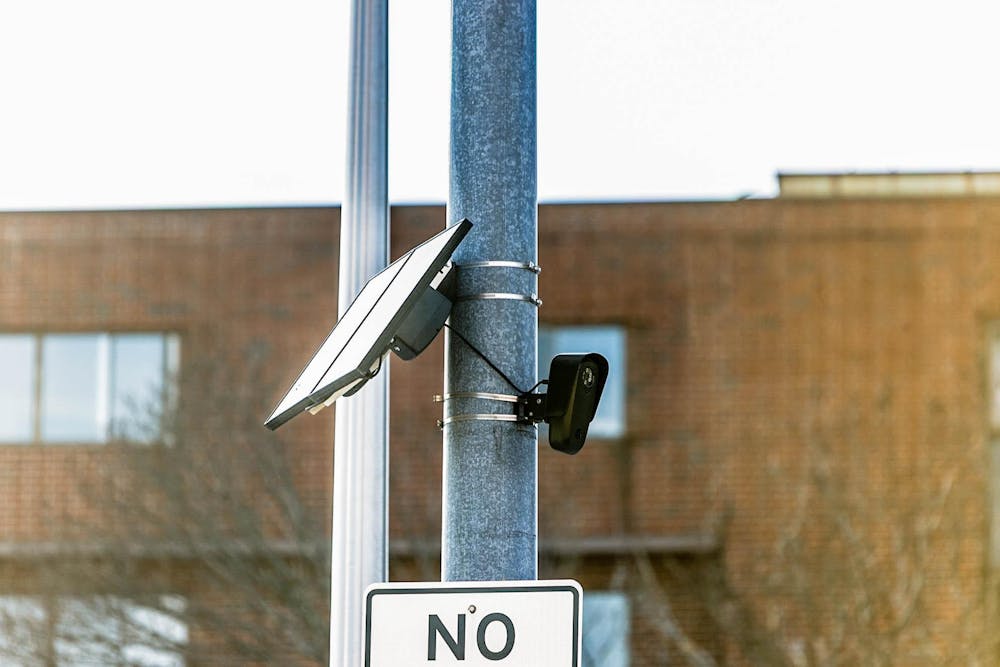
On Dec. 12, a camera on North Main Street captured a picture of a grey rental car. The renter of the car was Claudio Neves Valente, the suspect in the Dec. 13 mass shooting at Barus and Holley.
That picture of Valente’s license plate was “instrumental” in the ensuing police investigation, according to Kristy dosReis, Providence’s chief public information officer for public safety.
The image was captured by one of Rhode Island’s Flock cameras — automated license plate readers designed to record the make, model, colors and other details of passing cars. According to the American Civil Liberties Union of Rhode Island, there are at least 193 cameras in the state.
Law enforcement agencies have access to a database that stores the information collected by the cameras. This data has been used for investigating crimes such as missing persons cases and vehicle thefts according to dosReis.
In addition to fostering efficient and responsive policing, Flock cameras could serve as a deterrent for would-be criminals “considering committing crimes using vehicles,” dosReis wrote in an email to The Herald.
But some advocates and researchers are wary about the implications of Flock camera’s extensive data collection.
The ACLU of R.I. has opposed the installation of Flock cameras since 2021. According to Madalyn McGunagle — a policy associate at the ACLU of R.I. — camera data in other states has been shared with immigration enforcement officials and used to track down people suspected of crossing state lines to seek reproductive care.
Flock does not have a contract with ICE or any sub-agency of the Department of Homeland Safety, according to Paris Lewbel, the public relations manager for the company. “Non-customers cannot directly access the Flock platform,” he added.
While the cameras can be useful in targeted police investigations, the “larger issue with these cameras is that their use is not targeted, as the cameras take a photo of any car that happens to pass by,” McGunagle wrote in an email to The Herald.
DosReis wrote that cameras “are installed only in public spaces where there is no reasonable expectation of privacy.”
The cameras were first installed in Woonsocket, Cranston and Pawtucket in 2021, according to the ACLU of R.I. They were then introduced in Providence in 2022 for a one-year free trial program.
After a few months, Providence officials approved the installation of 60 additional cameras. Each camera costs approximately $2,500 per year, according to the Flock website.
Timothy Edgar, professor of the practice of computer science who helped launch Brown’s cybersecurity master’s program, said that the Flock trial period is the “best time” for government officials to determine if the safety benefits are worth the potential harms caused by increased surveillance.
Late last year, the R.I. State Police urged 22 municipalities to approve the installation of 39 more cameras across the state. A federal grant awarded to the state police designated nearly $600,000 to the cameras. Nineteen municipalities approved the request without hearing the request publicly, according to the ACLU of RI.
The Providence City Council voted to prohibit the use of Flock data to aid in federal immigration enforcement in October. But there are no other legislative frameworks regulating the usage of Flock data, McGunagle wrote.
“Flock never sells data. Our customers own 100% of their data,” Lewbel wrote in an email to The Herald. Current privacy protections listed on Flock’s webpage also include data encryption, sharing restrictions and deletion of data after 30 days.
The Warren Town Council voted against the installation of Flock cameras in December and Portsmouth followed suit last Tuesday. Their respective police departments are currently not on the list of police departments granted access to Providence’s Flock data.
The councils of Warren and Portsmouth declined to comment.
Jessica Katzenstein MA’16 PhD’22, an assistant professor at the School of Social Transformation at Arizona State University, noted that “centralized, cross-jurisdictional data sharing” is a “central value proposition for customers” of Flock.
Katzenstein warned that photos could be used to identify individuals in protests. “Harms from mass surveillance will always fall disproportionately on specific groups, including immigrants and people of color,” she said.
Legislation “reigning in” the use of automated license plate readers has been introduced and defeated in the last four legislative sessions, according to McGunagle. She emphasized that nothing in these bills would have hindered or changed the Brown shooting investigation.

Kelly Ding is a senior staff writer for the community and culture beat. She is from College Station, TX and plans to concentrate in IAPA on the policy and governance track. In her free time, she loves to explore new coffee shops, curl up with a good book, and be a gym rat.