
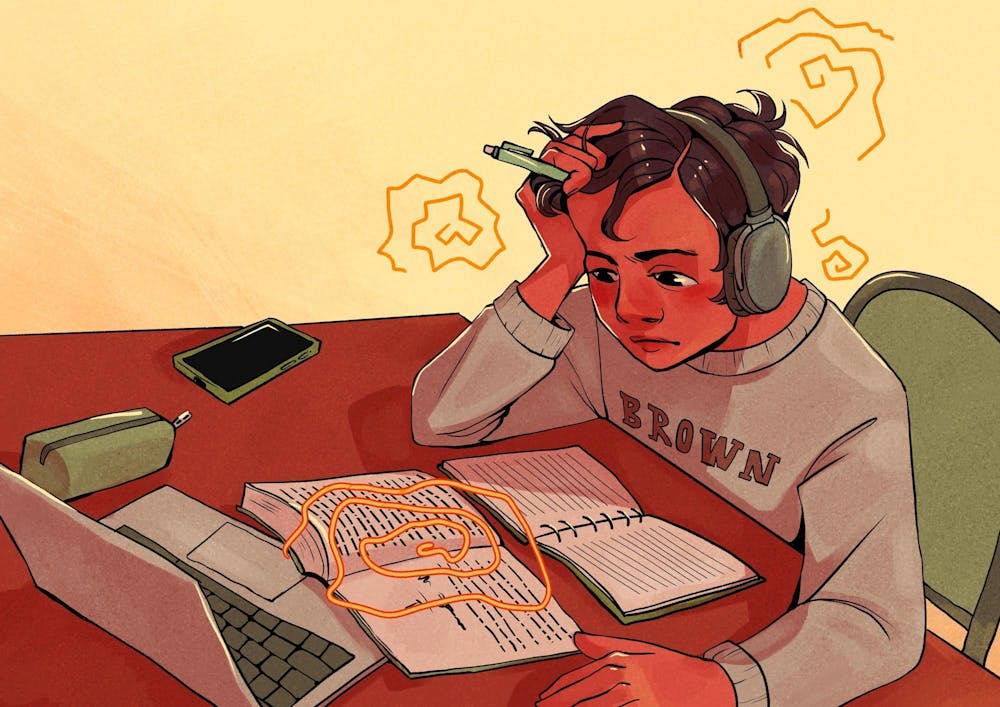
Rapidly developing technology has pushed some professors, including Assistant Professor of Entrepreneurship and Education Saloni Gupta, to adapt their pedagogy. Now, when she assigns readings, she also offers students podcasts and video lectures — formats that she believes students are more comfortable with. She also gives students the option to use tools like ChatGPT to analyze their readings.
But she has not lowered expectations in her classes. “I actually increased them,” she wrote in an email to The Herald. “I assigned more readings, and more advanced ones, because the scaffolding made that possible.”
Gupta added that she thinks students are reading less in the wake of new technological advancements. “Books are slow and dense compared to the attention-grabbing tools this generation has grown up with — TikTok, reels, video essays,” she wrote.
The Herald spoke with various faculty members and students to discuss how readings are assigned at Brown.
Like Gupta, Luiz Valente PhD’83, a professor of Portuguese and Brazilian studies and comparative literature, has incorporated new exercises into his courses, such as small-group discussions and producing podcasts.
Valente said that while he is aware of the growing debate surrounding a decline in student reading, his experience in the classroom suggests a different reality.
“I do assign long texts, and the impression I get from the discussions … (is that) students have read the texts and are engaging with the text,” Valente said.
In his courses, Valente emphasizes flexibility and intentional pacing. He often assigns long novels — sometimes around 600 pages — but spreads the reading out over several weeks. “Sometimes less is more,” he said. “Making sure that people actually read the text is much more useful than simply assigning long texts.”
Valente explained that he doesn’t think there is a “magic number of pages” to assign. “I think it depends on the difficulty of the texts and the kinds of texts you’re reading,” he said.
In Valente’s first-year seminar COLT 0710N: “A Comparative Introduction to the Literatures of the Americas,” students read William Faulkner’s novel “As I Lay Dying” over multiple class sessions. “Students were extremely engaged, and they knew what they had read,” Valente said.
Emily Hipchen, a teaching professor of English and director of the nonfiction writing program, said that her students “tend to come to class having read,” noting that her classes are often small and discussion-based.
She said that in one of her classes, ENGL 1050X: “Making a Scene,” students’ high levels of engagement with the readings may be a result of the fact that she doesn’t assign longer texts. But she noted that the texts she assigns are complicated and her students “handle it beautifully.”
She noted that she has made no changes to the amount of assigned reading in her nonfiction writing courses over the past two decades.
“I am not alarmed at all about the amount of reading my students do — they read as much or more than I did at their age, and breathtakingly widely when they can see that they have made connections that are meaningful to them,” Hipchen wrote in an email to The Herald.
Assistant Professor of History Benjamin Hein said he has noticed that students might have “a little bit less willingness to read things that are not immediately relevant.”
When students are navigating an abundance of information, there is “quite a bit of pre-selection happening in terms of what one should spend time with and what one shouldn’t,” Hein said.
“Motivation is a really important part,” he said. “It’s more about that than about ability.”
Enrolled in several humanities classes, Roark Petermann ’29, a first-year student planning to concentrate in international and public affairs and literary arts, said he is expected to read about one book a week for each of his classes, so he has “several hundreds of pages of reading every week.”
“It is hard, but it’s manageable because of how much I love it,” Petermann added.
For Grace Talusan, an assistant teaching professor of English, the students in her courses consistently demonstrate engagement with course readings.
At Brown, “we’re in a very particular population, especially the population that I get in my classes,” she said. “They love to read and write — they’re not going to show up in my class unless they love to read.”
Miriam Davison is a Senior Staff Writer for University News covering Academics & Advising. She is a first-year from Los Angeles, CA and plans to study tentatively the realm of International & Public Affairs and English, though her interests span from linguistics to history to music. In her free time, she plays on one of Brown's ultimate frisbee teams and likes writing silly poems.


