Not all high-achieving high school students see college as a realistic pathway for them. New research seeks to understand why.
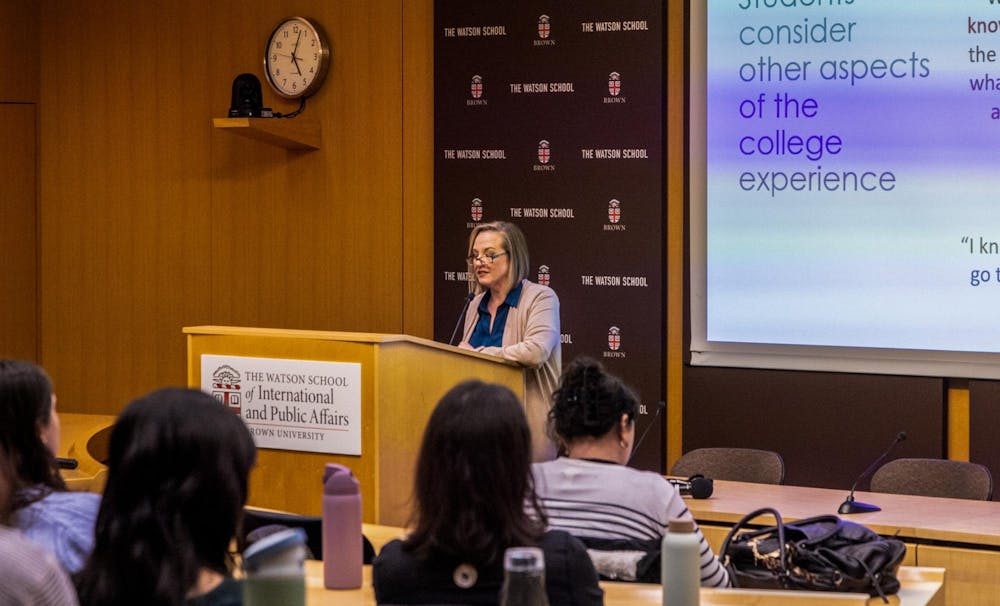
During a Wednesday talk at Brown, Stefanie DeLuca, a professor of sociology and social policy at Johns Hopkins University, discussed her research, which seeks to answer the question of why fewer low-income, high-achieving students attend college — specifically focusing on selective colleges.
DeLuca, in collaboration with other researchers, conducted a study on the University of Michigan’s “High Achieving Involved Leader” Scholarship, a financial aid opportunity that guarantees free tuition for some students. Eligible students — high-achieving Michigan high schoolers who come from households below a certain income level — received a letter offering them the scholarship before their college applications were due.
The HAIL Scholarship doubled application and matriculation rates among low-income, high-achieving students, DeLuca told the audience.
DeLuca and her team study how to “leverage the decision making that young people engage in” as they transition to adulthood to “understand why (the HAIL Scholarship) was so much more successful than other financial aid interventions,” she explained.
The students in the study were largely first-generation college students from rural locations who received free or reduced lunch plans from their high schools. White rural students were oversampled for the study because they were most responsive to the financial aid intervention, DeLuca said.
When DeLuca asked students about their plans after high school and what they were thinking about college, she found that in 90% of interviews, cost was a factor on students’ minds.
Students in the treatment group were offered the HAIL Scholarship and were assessed in comparison to the control group students, who did not receive the scholarship before applying. “Students in the control group really don’t consider Michigan nearly at the same rate as the treatment group,” she said. “They rule it out right away.”
Additionally, many students felt they could not ask for help from support systems, so if something went wrong during college, the students would bear the burden of the risk on their own, DeLuca said. “They don't want to burden overburdened parents and siblings and family members.”
Participants also voiced concerns about failing, what types of jobs they would be able to get post-college and how their post-secondary decisions would impact their families.
DeLuca noticed that HAIL Scholarship recipients felt more worthy and reached out to their parents and counselors for support more frequently than those who did not receive the scholarship.
Attendee Guadalupe Herrera ’26 told The Herald she was specifically intrigued by the language used in the HAIL Scholarship’s notification letters and how it made students realize, “‘Wow, they actually really do care about me, they do think I’m worthy enough or good enough,’” she said.
Even when students received the HAIL Scholarship, their fears about college did not entirely subside, DeLuca and her team were surprised to learn. While concerns over debt did lessen, they found that other concerns, such as worrying about “struggling academically, not fitting in and not being admitted,” were heightened, DeLuca said. These same fears did not arise as frequently in the group that did not receive the scholarship before applying.
Despite these worries, two thirds of the students who received the HAIL Scholarship offer did apply to the University of Michigan, DeLuca said. This group also began thinking about some of the more fun aspects of college, such as living in dorms, meeting new people and attending football games — topics that were rarely discussed among the control students.
Chiara Affatigato, a research associate at the Annenberg Institute, told The Herald that DeLuca’s talk hit close to home for her. She said she is always interested in studies on rural students because she thinks they are “often overlooked in education research.”
Maria Camacho ’27 told The Herald that she decided to go to the event because she studies education and is doing research about the intersection of race and class in higher education outcomes.
Camacho was particularly interested in DeLuca’s approach to how “class shapes how you view your worthiness and outcomes of education.”
Ali Schapiro is a senior staff writer for University News, covering admissions and financial aid. She is a freshman from New York City and plans to concentrate in English. In her free time, she enjoys vintage shopping, playing tennis, and doing New York Times crossword puzzles.