As the college admissions landscape evolves each year, the complexities of the process have long garnered national attention from prospective applicants and anxious parents alike. In the months leading up to the submission of a college application, high school students might spend months perfecting their essays and resumes, but once they submit their applications, few are aware of how admissions officers review each file.
With the release of regular decision results just over a month away, the Office of College Admission — which sits on the 14th floor of the Sciences Library — is currently facing its busiest time of the year.
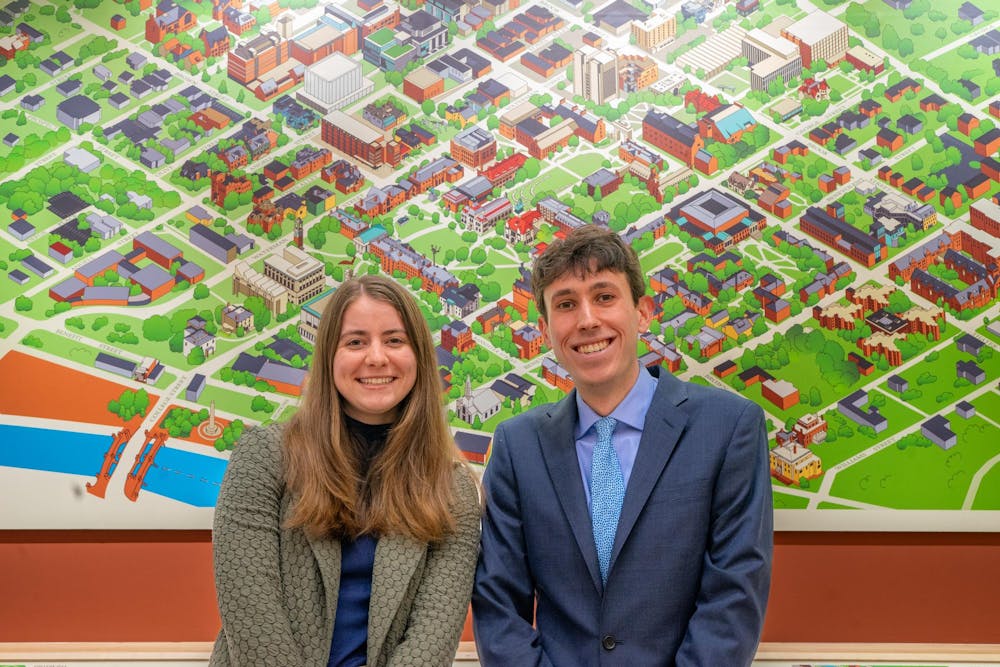
To learn about what happens behind the closed doors of the admissions office, The Herald sat down with two Brown University admissions officers, Emily Wagg ’24 and Aidan Berman ’25, to get a glimpse into the process of selecting future Brunonians.
Each admissions officer is responsible for reviewing over 1,000 applications per year. For the class of 2029, Brown received 37,710 regular decision applicants.
Despite the large volume of files, the team “will read an application for as long as it takes, honestly, to get a full sense on who the student is,” Wagg said.
For each application file, Berman typically starts with the counselor’s recommendation so he can understand the applicant’s background and find out what opportunities were available to them at their school and in their community.
Wagg, on the other hand, tends to start her review with the school report, a document that schools send to help admissions officers better understand the types of classes and clubs they have available.
“Especially if it’s a school that I don’t know as well, it’s really, really helpful for me to get that initial context,” she said.
Wagg concludes her review by watching the applicant’s optional video introduction, as she thinks it can be a fun way to round out her perspective on a student.
According to Wagg and Berman, there is never just one person who decides the final yes or no on an application. Generally, applications are read by an officer who specializes in the geographic region that the applicant is from before the candidate is discussed by a broader admissions committee. Conversations among the broader group tend to be longer for students they are considering admitting, Wagg said.
Prospective students frequently ask Berman what makes someone a strong applicant to Brown, but there is no single quality in every successful admit, he said.
“Frankly, I think Brown would be a boring place if we were looking for one set of criteria from each applicant,” Berman said. But the admissions office hopes to “set students up to be academically successful at Brown,” so they try to admit students who will be able to handle the rigorous course load, he added.
Admissions officers also look for students who are engaged with their communities and will get involved with the Brown community in a variety of disciplines, from performing arts to athletics to comedy, Berman said.
Another key aspect the admissions committee considers is how prospective students will fit in with Brown’s Open Curriculum, and excel with “flexibility and choice,” Berman added.
The admissions committee does not use artificial intelligence to sort through any of the applications, no matter a student’s academic standing, Wagg said. “I think that surprises a lot of people when we say that we are reading every single page of every application that comes to us,” she added.
Both Berman and Wagg’s favorite part of the application to review is the supplemental question that asks students to write about something that brings them joy.
According to Berman, the supplement speaks to the University’s “human-centered approach to admissions,” complementing the first question that focuses more on academics.
There is no difference in the review process for early decision and regular decision applications, aside from knowing that Brown is the number one choice of students who apply early. The expectations of an applicant being a “good community member” and a successful student at Brown do not change, Wagg said.
When an application is deferred, the office is “never doing it simply to postpone a decision,” Berman said. “We’re doing it because these are very competitive and compelling candidates that we simply want to look at again, within our broader pool in regular decision,” Berman explained. He noted that Brown ends up admitting a “sizable amount” of deferred applicants.
“This responsibility in helping to shape future generations of classes at Brown is one we don't take lightly,” Berman said.
Wagg added that being an admissions officer is a fun and rewarding job, noting that those in the Office of College Admission are “genuinely so excited” to meet students in person at A Day on College Hill after getting to know them through their Common Application. “Then getting to see their trajectory at Brown is so wonderfully rewarding,” she added.
Ali Schapiro is a senior staff writer for University News, covering admissions and financial aid. She is a freshman from New York City and plans to concentrate in English. In her free time, she enjoys vintage shopping, playing tennis, and doing New York Times crossword puzzles.