
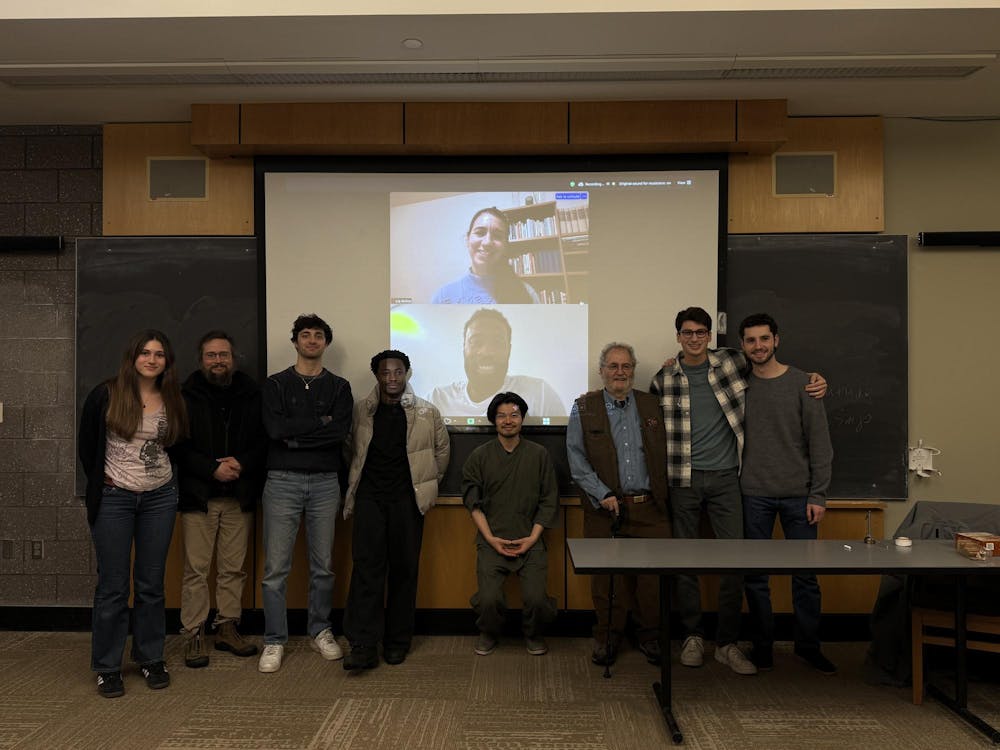
For students in COST 0100: “Introduction to Contemplative Studies,” class begins and ends with meditation every Wednesday afternoon.
The course, which aims to introduce students to the contemplative studies field, is part of a larger program that blends the humanities and sciences with a variety of contemplative practices such as meditation, tai chi and yoga.
Approved as a formal concentration in 2014, the contemplative studies program aims to help students learn not only through reading and analysis, but also through direct experience with contemplative practices. While the concentration offers a distinctive approach to education, some faculty members report some financial struggles.
Learning through experience
Harold Roth, a professor of religious studies and East Asian studies and the founding director of the contemplative studies initiative, describes the concentration as an effort to have students study contemplative traditions hands-on.
According to Roth, students often double-concentrate with other fields, such as neuroscience.
The concentration is divided into humanities and sciences tracks, though the two can often overlap, according to Josh Gerber ’26, a contemplative studies concentrator on the science track.
“As a sciences concentrator, I’m required to take a larger number of science courses that could be in neuroscience, psychology, biology (and) public health,” alongside a number of humanities classes, Gerber said.
Gerber said the program allowed him to connect meditation practices with research on emotional states of meditators through work in the lab of Professor of Behavioral and Social Sciences and Psychiatry and Human Behavior Judson Brewer, director of research and innovation at the Mindfulness Center.
“I’d be a very different person without the program,” Gerber said. “It’s certainly influenced the trajectory of my life” and his career goals of pursuing a path in research.
The emphasis on firsthand experience distinguishes the concentration from traditional academic fields, according to Justina Michaels ’27, a health and human biology and contemplative studies double-concentrator. Michaels, who is on the humanities track, said contemplative studies “embrace the power of introspection and subjective experience as a form of knowledge.” She noted that academic essays often integrate personal reflection alongside analysis.
Courses in the concentration typically combine discussions with structured practice sessions. For Michaels, this structure is another way to learn and understand readings. “You can’t study a certain contemplative tradition without trying it out for yourself,” she said.
A tight-knit community
Students frequently describe the program’s close environment as one of its strengths.
Contemplative studies concentrator Isaac McDonald ’27 said the “experience of understanding your own mind” in classes helps build meaningful relationships that make students feel “so much more grounded, so much happier, so much kinder.”
“The small community that we have right now is just one of the most beautiful things,” he added.
Larson DiFiori, a visiting assistant professor of religious studies and associate director of undergraduate studies for contemplative studies, said the program’s small size allows for individualized advising.
“I meet personally with all of our concentrators, oftentimes a couple times a semester, and we go over their plan, starting from when they first show an interest in contemplative studies all the way through,” he said.
Students “really developed a sense of community,” Roth said. “We’re small enough of a concentration … we meditate together.”
Institutional challenges
Because the contemplative studies concentration is not housed under a department, the program relies heavily on visiting professors and donor support, Roth said.
The program isn’t able to directly hire professors, so it has “to go through other departments to hire them,” DiFiori said. According to the website, every faculty member associated with the contemplative studies program is also affiliated with another department.
Students and faculty said those limitations can affect course offerings and staffing stability.
As Roth approaches retirement, he hopes that professorships will be secured for visiting professors in the concentration.
“We’ve made a real impact,” he said, noting the influence the concentration has had on student and intellectual life. He added that the program has also had an impact on the broader Providence community: “50% of the people who attend our events are from the community,” Roth said.
Anne Heyrman-Hart, the concentration’s program and financial coordinator, told The Herald that the program’s financial challenges mirror broader trends affecting humanities fields nationwide. “We soldier on because we believe in what we’re doing,” she said.
Looking to the future
DiFiori believes contemplative studies is part of a broader educational shift beyond simply teaching “a set of skills.” Rather, he said, it goes back to “the roots of education” — “just improving who we are as human beings.”
Michael Kennedy, a professor of sociology and international and public affairs, plans to introduce a new course on cultural and contemplative sociology after he returns from his sabbatical, where he focused on pilgrimage, martial arts and global contemplative practices. He wrote that interest in contemplative approaches has grown amid social crises and technological changes.
Despite the relatively small number of concentrators, “concentration number is only one indicator” of interest in contemplative studies, Kennedy wrote. “My martial arts and yoga sociology class is always oversubscribed in the last few years,” he added.
Contemplative studies is a “small concentration but with (a) tremendously ambitious and interesting agenda,” Heyrman-Hart said.
Miriam Davison is a Senior Staff Writer for University News covering Academics & Advising. She is a first-year from Los Angeles, CA and plans to study tentatively the realm of International & Public Affairs and English, though her interests span from linguistics to history to music. In her free time, she plays on one of Brown's ultimate frisbee teams and likes writing silly poems.


