Green crabs have resided in New England waters for hundreds of years, but a new law — effective at the beginning of this year — is aiming to reduce the presence of the invasive species.
The law authorizes the Rhode Island Department of Environmental Management to offer $10 commercial licenses to harvest green crabs. The law hopes to “control” the invasive species, sponsor of the bill Rep. Kathleen Fogarty (D-South Kingstown) said in a press release.
Previously, harvesting and selling the crabs required two separate licenses — which cost a total of about $250.
RIDEM has already seen excitement around the $10 licenses, according to John Lake, a supervising marine biologist at RIDEM. Applications for the licenses will close at the end of February.
“This legislation is a win-win for the state,” Fogarty said in a press release.
Green crabs are “aggressive and insatiable predators” that “have spread considerably from their original introduction points,” according to Liam Healy, a research assistant at Green Lab.
Native to northwestern Europe, the crabs have few predators in the U.S. and outcompete native species for food, according to NOAA Fisheries’ website. This makes it difficult to manage and eliminate them.
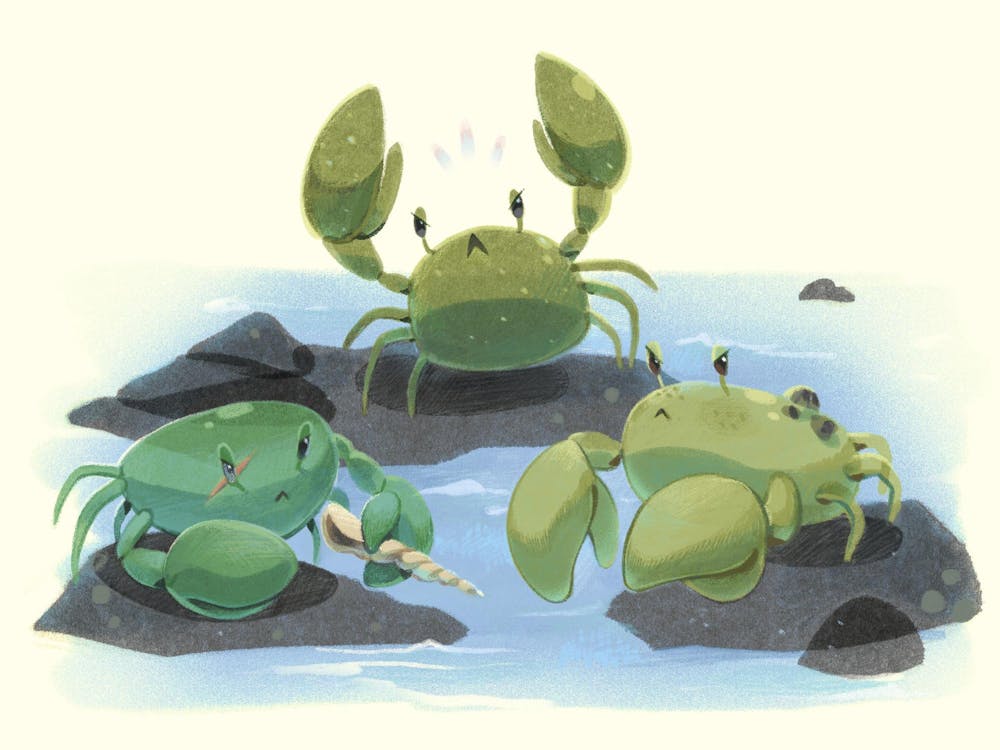
“I can tell you from experience that they are incredibly angry and mean animals who fight and try to eat everyone and everything, including each other,” Healy wrote in an email to The Herald.
Green crabs can eat up to 40 half-inch soft-shell clams a day, according to Mary Parks, the founder and executive director of GreenCrab.org — a nonprofit focused on building the culinary market for green crabs.
When the crabs hunt local shellfish, they tear up eelgrass, which serves as a storm buffer to protect coasts, a nursery ground for local fish and a feeding area for birds. Parks also stressed the importance of eelgrass for absorbing carbon in the water.
Liam Cromie, a senior at Moses Brown High School who helped advocate for the legislation, said he hopes it is a “game changer, especially for kids that want to” get licenses.
When Cromie was younger, he saw green crabs “everywhere.” He began researching the species and realized the negative impact the crabs had on Rhode Island’s ecosystem.
A year or so later, he acquired the necessary licenses to harvest and sell the crabs. Cromie said he found the $250 to be expensive compared to how much he could make off of selling the crabs. The first summer he had his license, he didn’t turn a profit.
In order to increase profits, Cromie connected with local chefs. He found many chefs were receptive to the idea. Since then, the new market has allowed him to double his prices compared to when he was selling his crabs solely as bait.
Stacy Deetz, the owner of the Hangry Kitchen in Pawtucket, said that green crabs’ small size can make them difficult to work with. Still loves to make stock with the crustacean, and her favorite green crab recipe is a focaccia made with the stock. “It has this beautiful, oceany, briny, crabby flavor without being fishy,” she said.
Parks said that the culinary industry could eventually become the largest market for the crabs, many of which are currently sold as bait. She organizes an annual green crab week in summer where GreenCrab.org partners with local restaurants to increase education around the species and its culinary potential.
Focusing on just one species “might seem like a super narrow mission,” she said. But a “lack of awareness and education” about the crabs’ culinary potential have been “huge barriers” to market development.
“Eat ‘em to beat ‘em” campaigns — promotional initiatives that encourage hunting invasive species to reduce their populations — have also been implemented to decrease the number of lionfish and cownose rays, among others.
Tyler Coverdale ’10, an assistant professor of biology at Notre Dame, wrote that these campaigns are mostly effective for “raising public awareness of the problem of invasive species.” He added that there is evidence “that the public’s willingness to fund conservation and restoration efforts is tied to their awareness that there is a problem.”
Healy noted several efforts that could potentially be more effective at fighting green crabs, including introducing another predator, protecting the species that are most vulnerable to them or trying to trap and kill them — though that “tends to be an impossible task unless they’re very new to the area,” he wrote.
But “invasive species are an old and ongoing problem, and one not likely to be solved anytime soon,” Healy wrote.
Educational outreach is another way Cromie works to help fight off green crabs. After receiving a grant from his school, Cromie provided traps and equipment to local Girl Scout and Boy Scout troops. He also taught them about the ecological effects of the crabs and how to harvest them.
Cromie hopes that the new licenses can encourage more people to participate in harvesting. He aims to “encourage the next generation of these kids that are curious about green crabs.