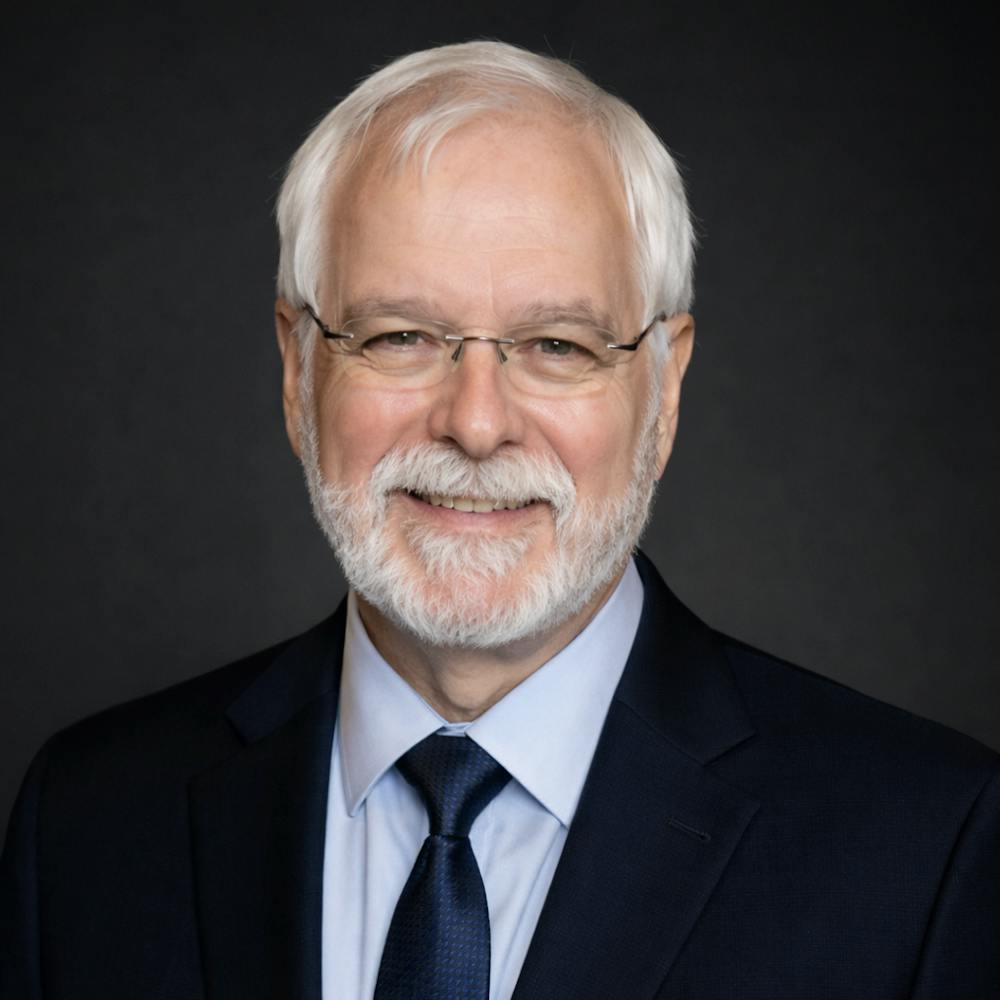
Professor of Neuroscience and Engineering John Donoghue PhD’79 was awarded the 2026 Queen Elizabeth Prize for Engineering for his work in brain-computer interfaces which help restore function in people with paralysis.
The £500,000 prize, which was first awarded in 2013, is given to individuals responsible for “groundbreaking” innovation that benefits humanity, the award’s website reads.
Donoghue was “in shock” when he learned about the award, he told The Herald. “The other people that they had selected along with me are just really tremendous scientists, engineers. So I was really taken aback to be included with that group, but it was wonderful,” he said.
He explained that his work centers around recognizing brain signals from individuals who have “lost their communication between their brain and their body” due to neurodegenerative diseases or injuries.
“What we’ve done is replace the biological (system) with a physical system — an engineered system,” Donoghue added.
In the 1990s, Donoghue and his team began to think about how brain signals can be interpreted and decoded to be used to run devices. It was then that BrainGate — a neuroengineering research team — was born.
When the team began their work, they didn’t know if a paralyzed person had signals in their brain when they thought about moving their limbs, he said. But in the early 2000s, they discovered these individuals had brain signals “related to movement,” Donoghue said.
The BrainGate team determined how to link these signals to a computer.
With this technology, BrainGate’s first patient, Matt Nagle, was able to communicate, play video games and do “everything, just through a computer,” Donoghue said.
Through BrainGate’s technology, the team also demonstrated that a paralyzed individual could “control a robotic arm” in place of their own.
“There’s this iconic picture of Cathy Hutchinson taking a drink using a robotic arm that she was controlling rather than having to have somebody else do it for her,” Donoghue said. “Those were demonstrations. We still have a ways to go before they’re products.”
BrainGate’s initial vision was “a very ambitious image,” he added. The group hoped that “one day you could be playing basketball with somebody, and they would say, ‘Oh, I had a spinal cord injury, but thanks to BrainGate, I’m completely fine. I can do whatever I want.’”
While the team is still “far off” from that goal, the prize serves as a “real tipping point” for the project and has generated global recognition — particularly from startups — that this device “will really work,” he said.
Donoghue credited his colleagues and students at Brown for his research advancements.
Arto Nurmikko, a professor of engineering and physics, fondly described his “close scientific (and) collaborative partnership” with Donoghue.
“He was my teacher and mentor who opened the doors to a new world to me,” Nurmikko wrote in an email to the Herald. “He is simply one of the very best scientific minds I have seen during my career.”
“I don’t think this would have happened any place else because we have these wonderful colleagues,” Donoghue said, adding that he would not have made the progress he did without the “full interaction” across faculty and students.
For Donoghue, the award is meaningful because it “brings attention to the accomplishments that have been made” as well as “the need for interaction across fields” and “the importance of engineering to human health.”
Nishita Malhan is a senior staff writer covering science and research.

Samah Hamid is a university news editor covering faculty and career & alumni. She is from Sharon, Massachusetts and plans to concentrate in Biology. In her free time, you can find her taking a nap, reading, or baking a sweet treat.