When the temperature feels like 22 degrees or below, around 40 volunteers transport people experiencing homelessness to warming centers established through Operation No One Dies, an initiative that works in coordination with the Rhode Island State Council of Churches.
The program received a $200,000 grant from the Executive Office of Housing, according to Kevin Simon, the director of outreach and communications of Mathewson Street Church. The state also recently approved the R.I. State Council of Churches’ request for a $150,000 grant.
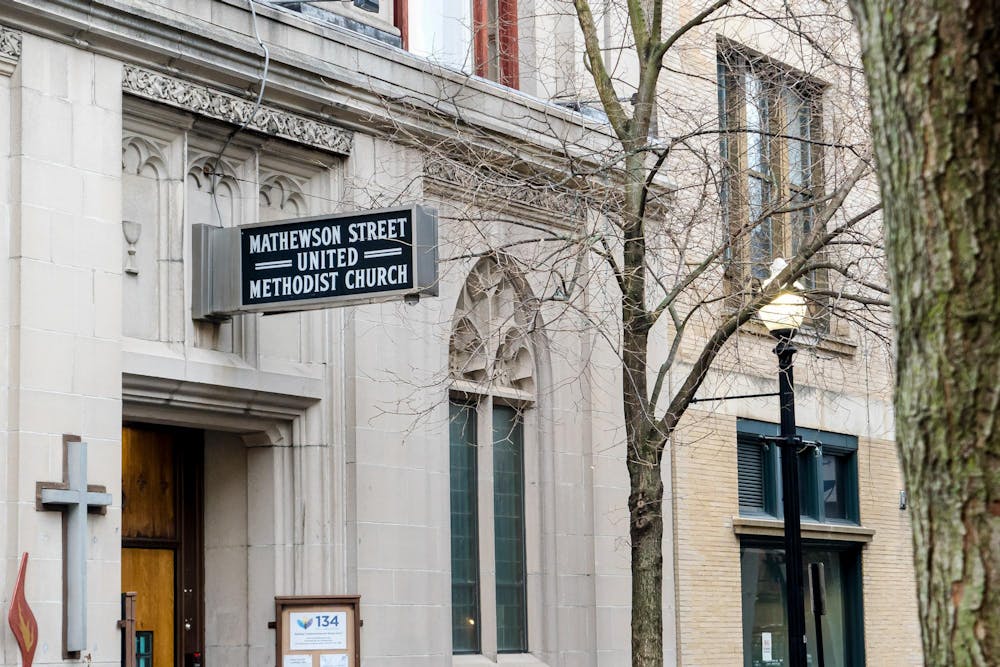
On cold nights, unhoused Providence community members gather at Mathewson Street Church. From there, volunteers drive them to the warming centers, which include the Open Table of Christ or Community Church of Providence, or they are given a place to stay within Mathewson Street Church, said Operation NOD Coordinator Harrison Tuttle.
The program can host around 50 people each night, with each church containing about 15 beds, according to Tuttle. Once at the shelters, individuals are provided with a bed, food and are given the opportunity to shower, Tuttle added.
“It is first-come, first-served,” she said, but noted that many individuals return nightly.
This winter, three people froze to death in Providence, including a mother and son found dead in their car in a hospital parking lot last week, Hirsch said.
When Operation NOD launched on Dec. 5, its organizers “were hoping to make sure that no one died,” said Eric Hirsch, a professor of sociology and anthropology at Providence College and the interim director of the R.I. Homeless Advocacy Project.
When all the beds are filled — which has happened often since the centers have been opened — Operation NOD coordinates with other locations in the state “in an effort to not turn anybody away,” Tuttle said.
The state has established seven regional access points to give unhoused individuals “centralized, easy-to-access entry points to housing-related services,” Emily Marshall, spokesperson for R.I.’s Executive Office of Housing, wrote in an email to The Herald.
“During periods of extreme cold, the state, city, service providers and neighboring communities activate a network of warming centers,” wrote Director of Housing and Human Services for the City of Providence Emily Freedman in an email to The Herald.
“Providence's faith communities have long played an important role in ministering to our most vulnerable residents, and using existing community spaces during extreme weather is both cost-effective and responsive,” Freedman wrote.
But staying in the shelters can be “very exhausting” for guests, since they have to leave by 6:30 a.m. so the churches can be used for their regular services, according to Patrick Miller, a volunteer driver who also oversees the transportation committee.
Throughout the night, volunteers may make many trips back and forth to transport the unhoused individuals. Several nonprofits and volunteers have also provided first-aid kits and other essential supplies, said Ruth Gallucci, a transportation coordinator for Operation NOD.
With warmer temperatures this week, Operation NOD has closed its centers for the time being.
Volunteers will discuss what the program can do moving forward to continue to meet the community’s needs, Hirsch said.
Miller noted that the program is thinking of enlisting a larger van for transportation. In future winters, Tuttle hopes more churches can join the operation to expand shelter access.
For many individuals, the space acts as a “second home,” Miller said.
Over his time as a volunteer, Miller has formed friendships with the community members he drives.
Even on days when he is not on shift, Miller drives to the shelters and drops off a McDonald’s meal or a pair of socks. One time, he brought a couple cakes to celebrate a shelter guest’s birthday.
“Every time you’re driving some of our friends, you just have all of these wonderful, personal conversations with them,” he said. “I think we approach every day with full hearts and make sure that we can lift our friends up every day.”
Ava Rahman is a senior staff writer covering housing, infrastructure and transportation.