
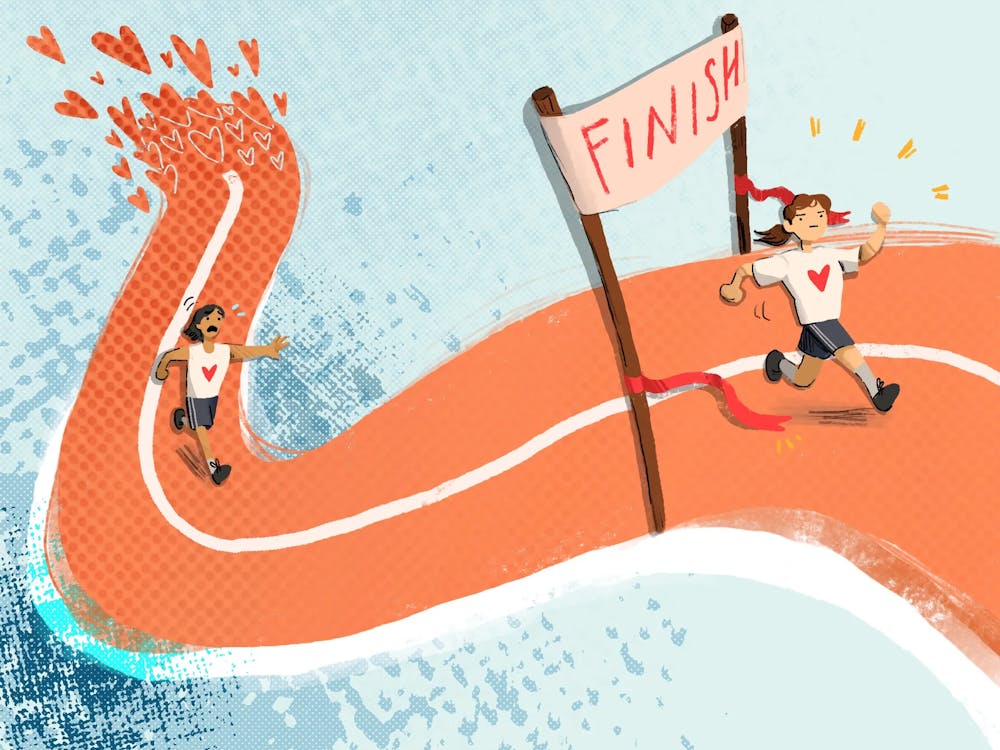
The 2026 Winter Olympics just ended, which means for two straight weeks we watched people hurl themselves into increasingly impossible spins, flips and midair twists in pursuit of international glory. We dissected judges’ scoring, held our collective breath through overtime and adopted a new roster of athletes to cheer on. For those 17 days, we were reminded that human beings will do almost anything to win.
But the win-at-all-costs mindset is not something we humans reserve for when a gold medal is on the line. It’s something many of us bring home — to school, work and, most destructively, dating. At the end of the day, love is just a game, and we’re all trying to win.
In modern dating, winning means not double-texting. Winning means pretending you have three other options waiting in the wings. Winning means taking exactly 43 minutes to respond because responding immediately would signal chalance — and chalance, in the eyes of Gen Z, is unacceptable. Above all, you win by caring less. Playing games is strategic concealment — dimming your enthusiasm because you believe attraction only flows toward the less invested party.
But in a competitive dynamic, the more honest you are, the more distant the other person becomes. This isn’t an untraceable issue: A lot of us learned early on that caring is risky. We’ve all watched friends get burned after catching feelings. Maybe it’s more personal — someone ghosted you or loved you inconsistently. So, we’ve adapted to control the outcome by controlling how much emotion we show. And if you act like you don’t care, you can’t lose.
The problem with trying to win dating is that it inadvertently reshapes your goals. Instead of asking, “Do I like this person?” you start asking, “Does this person like me more than I like them?” We all know the script: don’t say you’re looking for something serious, admit you’re excited about the third date or confess you deleted the apps. Over time, that constant self-surveillance can distance you from your own desires. You start monitoring optics instead of your actual feelings until you’re no longer sure whether you actually like the person in front of you or just like being slightly ahead of them.
If people are busy performing nonchalance, no one actually feels chosen, even if there is mutual interest. Two people can spend months in a stalemate of low effort while secretly wishing the other would just say something real.
But knowing what you want is not embarrassing. It should not be humiliating to say, “I like you” or “I’m looking for something real” or “I don’t do situationships.” Of course, it’s more complicated than just “be honest and everything will work out.” Instead of pretending you are “just seeing what happens,” you can admit you were hoping it could go somewhere. You can treat the person across from you not as an opponent to outplay, but as a collaborator in something you’re building together.
Mind you, there is such a thing as too much too fast. There’s a difference between scaring someone off because you started planning your wedding on the first date and scaring someone off because you said, calmly and clearly, that you’re looking for something meaningful. If you’ve ever dated someone with an avoidant streak, or been the avoidant one yourself, you know that intensity can trigger retreat. Part of your dating journey will be figuring out how to find your own personal balance.
The Olympics are about margins — shaving milliseconds off a run or sticking a landing with surgical precision. Dating, on the other hand, is about alignment. You don’t need to outmaneuver someone into loving you. You need to find someone whose desire meets yours. This requires allowing your interest to be visible. Say “I had a really good time tonight,” without diluting it into irony. Let them know you’re looking for something real, and trust that the right person won’t flinch.
This doesn’t mean that you abandon discernment. You should still observe how someone shows up and notice if they reciprocate. You should still protect yourself and not chase someone who keeps stepping back. But you also shouldn’t preemptively sabotage something good just to maintain the illusion of control. You might not get a gold medal. You might get rejected. But rejection isn’t losing. Winning dating — if we insist on using that word — might actually look like walking away from something misaligned with your dignity intact.
The real loss would be contorting yourself into someone who feels nothing just to avoid failing. What’s the point of winning the game and ending up alone on the podium? So let the Olympians chase gold. In dating, retire the scorecard. Care, not competitively, but honestly.
In her column, “Organic Chemistry,” Anusha Gupta ’25 MD’29 deals with the toughest sex and relationship questions on College Hill. Please submit your love related inquiries for her to address here. She can be reached at anusha_gupta@brown.edu. Please send responses to this opinion to letters@browndailyherald.com and other op-eds to opinions@browndailyherald.com.


