
On Dec. 13, the Brown community lost two students in an act of mass violence on campus.
Just five minutes before the shooting took place, President Christina Paxson P’19 P’MD’20 took off on a plane to Washington D.C. Typically, on a flight of that length, Paxson said she does not buy WiFi — she appreciates the brief break from work. “I get an hour, hour and a half to not have that bother,” Paxson said.
That day, though, Paxson’s flight was diverted to Pittsburgh due to inclement weather. Because of the added time she would spend in the air, Paxson purchased the internet around 5 p.m.
“So I get it, turn it on. My phone is blowing up,” she said. “Then I had to sit through that flight, get to Washington, turn around, come back to Providence right away.”
Now — just over two months later — Brown’s campus is attempting to strike a balance between grief and healing.
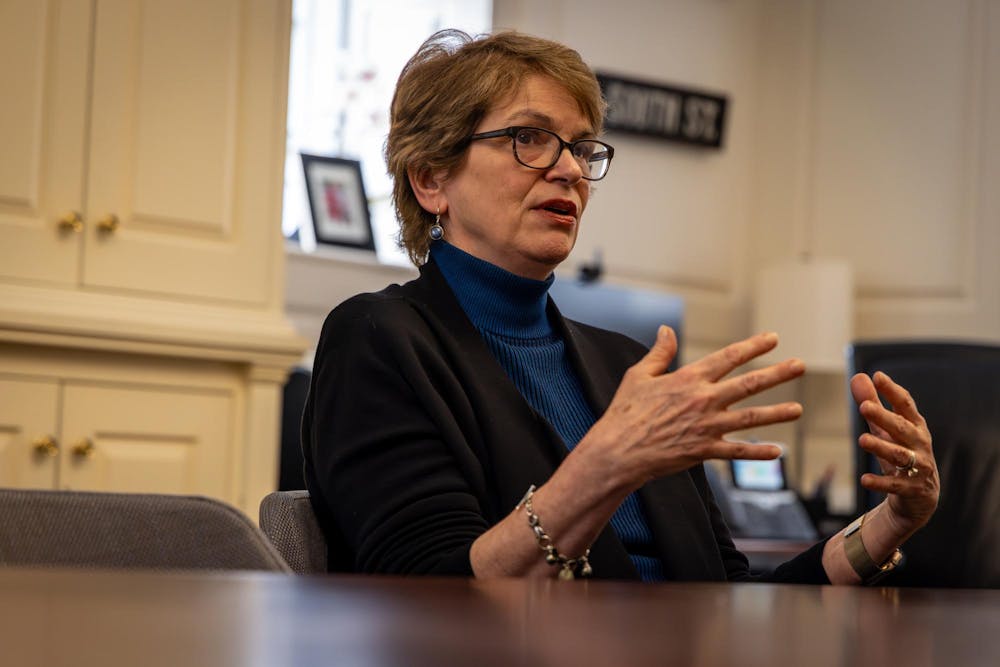
The Herald spoke with Paxson for her first sit-down interview after the shooting to discuss the night of Dec. 13, the University’s response to the shooting and plans moving forward.
The night of Dec. 13
The Providence Fire Department received the first call reporting the shooting at 4:05 p.m., and Brown’s Department of Public Safety and Emergency Management released its first alert at 4:22 p.m. The alert warned of an active shooter and directed community members to “Lock doors, silence phones and stay hidden until further notice.”
Members of the University community later learned that Ella Cook ’28 and Mukhammad Aziz Umurzokov ’29 were killed in the shooting. Nine other students were injured.
Paxson declined to comment on the 17-minute gap between the first call to emergency services and the campus alert. She pointed to the not-yet-released third-party after-action review carried out by global consulting firm Teneo as the best resource to find information related to the University’s response on Dec. 13.
The shooting occurred in Barus and Holley Room 166, where a teaching assistant for ECON0110: “Principles of Economics” was holding an optional review session before the class’s final exam.
In a press conference around five hours after the shooting took place, Paxson said she didn’t know what had been taking place in the room where the shooting happened. Paxson’s response was critiqued as seeming aloof or ill-informed.
The University’s priority “was to make sure that our students and others in the community were safe, and to start the investigation,” Paxson explained. Finding out what exactly was happening in the room was “not something that was of critical importance or concern,” she said.
According to Paxson, Brown has “a really well-developed protocol for management of emergencies writ large.” In case of an emergency, the University has protocols in place where pre-selected individuals are brought into a “virtual room” to manage the event, she said, adding that this process was “put into place right away.”
Prior to the shooting, the University did not have “mandatory active shooter drills on the campus,” Paxson said. “We’ve had them, but they’re not mandatory,” she added, noting that groups such as academic units and clubs could request individualized training for their communities.
The University has “not done active shooter training with students at Brown” unless they were part of a department that requested students specifically be part of the training, Paxson said.
“We will be doing more with more members of the community going forward,” she added.
The DPSEM held its most recent hostile intruder training last summer — around six months prior to the shooting — in conjunction with the Providence Police Department, Providence Fire Department, Brown Emergency Medical Services and the Rhode Island Nursing Education Center.
The immediate aftermath
Since the shooting, Paxson and other administrators have interacted with leaders at other schools that have gone through similar tragedies. Last week, Paxson said she spoke with the principal of Marjory Stoneman Douglas High School in Parkland, Florida, which was the site of the deadliest high school shooting in U.S. history.
Though the experience at a high school is very different from a university, Paxson said. “Every time you talk to somebody, you get more valuable insights on how you manage a recovery process from something like this.”
In the days and weeks immediately following Dec. 13, misinformation and disinformation disseminated online, leading to the doxing of members of the Brown community, including a student who some believed matched the description of the shooter.
“That was a very disturbing situation to see that misinformation out there in the media and spread very widely,” Paxson said. “We were in close contact with that student to support them and make sure that they were getting what they needed during what was a really awful situation for them.”
The weeks-long investigation following the shooting was handled by the PPD and the FBI. “We wanted to be as fully collaborative as we could be,” Paxson said. “That meant providing information on anything that they wanted to know about our police response, anything they wanted to know about campus buildings. We provided video access.”
On Dec. 18, Providence Chief of Police Oscar Perez identified the shooter as Claudio Neves Valente, a former graduate student who was enrolled at Brown in fall 2000 before formally withdrawing in 2003.
“He’s a mystery,” Paxson said. “All I know is that he was here … almost 25 years ago, left without a degree and has had literally no contact with the University since then.”
“Look, it's a tragedy, regardless of who does something like this,” she said. “And it’s just tremendously sad to think that a former member of our community would have done such harm.”
A future of change on campus
On Dec. 22 — nine days after the shooting — the University announced that the Brown University Police Chief Rodney Chatman was on leave, effective immediately.
Over the past year, there have been various concerns over DPSEM leadership and mismanagement. In August 2025, the Brown Police Sergeants Union issued a unanimous vote of no confidence in Chatman’s leadership. In October, the Brown University Security Patrolperson’s Association did as well.
Paxson declined to comment on why Chatman was on leave and whether the votes of no confidence were involved, saying that she could not comment on a “personnel issue.”
The University has also launched two external reviews: an after-action review of the events of Dec. 13 and a forward-looking comprehensive safety and security review of campus. Both will be carried out by Teneo and co-led by Courtney Adante and Bill Bratton.
Bratton is the executive chairman of risk advisory at Teneo, former commissioner of the New York and Boston Police Departments and former chief of the Los Angeles Police Department.
He worked in the NYPD during the crack epidemic of the ’80s and ’90s, and helped shape the department’s “broken windows” policing strategy, which describes police's zero-tolerance approach to misdemeanors. The strategy, a predecessor to “stop and frisk” — a policy that allowed officers to stop and interrogate on the basis of reasonable suspicion — has been critiqued for targeting communities of color and contributing to mass incarceration.
When asked about the University’s decision to work with Bratton, Paxson said they “looked at the totality of the experience of Teneo Risk, and the work that they’ve done for a variety of institutions.”
“The work that they’ve done for other universities is more relevant to Brown than work that any single person in that team has done for different municipalities,” she added, noting that Bratton’s work in the NYPD was “a long time ago.”
The U.S. Department of Education is also conducting a formal review of Brown’s compliance with the Clery Campus Safety Act, which stipulates that institutions of higher education must report campus crime data and their policies on campus safety.
According to Paxson, the review is “not directly about safety and security itself,” but “about (the University’s) system for reporting and tracking crimes,” she said.
The University is “providing all the information that they’re asking for,” Paxson said.
“Safety and security has got to be at the heart of everything we do,” Paxson continued. “We don't want to be over-policed at Brown. I don’t think anybody wants that. That’s not the goal. But we know that we can’t fulfill our mission unless the people who are here — students, faculty and staff — feel safe.”
Since the shooting, the University has also launched “Brown Ever True,” a campus-wide healing and recovery initiative.
“There’s a lot to be grateful for,” Paxson said. “I actually think that part of the recovery process, part of the healing process, is expressing that gratitude and coming together as a community to say what has worked well for us.”
She also shared that going forward, the Brown Ever True team is working on a permanent memorial for Cook and Umurzokov. “That’s something that we’ll need community input on, and we'll need input from the families, so that’ll probably take some time.”
“This is such a resilient community, and it’s been just amazing to see how students, faculty, staff, have really stood up to support each other,” she said. “Brown is still Brown.”

Roma Shah is a section editor covering University Hall & Higher Education and Admissions & Financial Aid. She's a sophomore from Morgan Hill, CA studying neuroscience. In her free time, she can be found doing puzzles, hiking or curled up with a book.
Jeremiah Farr is a senior staff writer covering university hall and higher education.


