
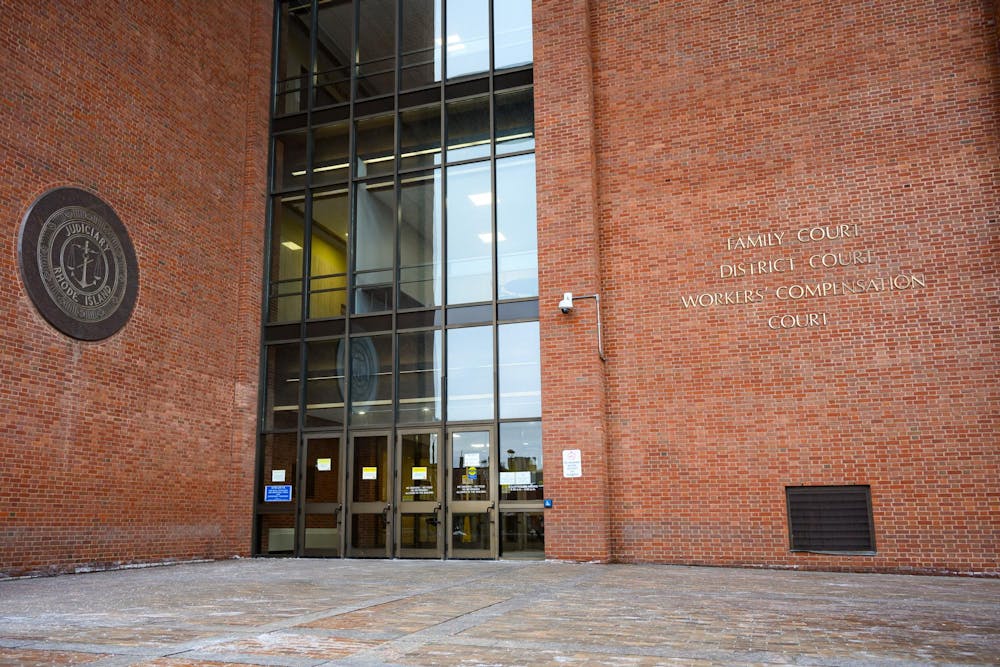
A recent bill introduced in the Rhode Island State House would protect Rhode Islanders involved in court proceedings from being arrested by U.S. Immigration and Customs Enforcement agents without a judicial warrant.
Both the R.I. House of Representatives and Senate bills state that they would require any law enforcement agency representative who “enters a courthouse” to identify themselves “to court security personnel and state the specific law enforcement purpose and proposed enforcement action” for taking an individual into custody. The bill will protect individuals on their way to hearings, and those at or leaving court.
The introduction of the act follows multiple detainments around Providence courthouses in recent months. On Jan. 15, several ICE agents breached security and ran through the first floor of the Garrahy Judicial Complex while in pursuit of two young men.
State Rep. José Batista (D-South Providence, Washington Park), the sponsor of the House bill, wrote in an email to The Herald that he has introduced this bill for the “past three legislative sessions.”
“Our courthouses are foundational to our democracy,” he wrote, adding that “our justice system is weakened when individuals are afraid to appear in court because they fear being targeted by federal immigration authorities.”
ICE did not respond to The Herald’s request for comment.
In an interview with The Herald, state Sen. Meghan Kallman PhD’16 (D-Pawtucket, Providence), the sponsor of the Senate bill, said that recent research in New York found “rates of reporting domestic violence have gone down because people don’t want to get involved in court proceedings at all if there’s a risk that they’re going to be picked up as a consequence.”
ICE activity in and around R.I. courthouses was brought to Kallman’s attention “by an immigration attorney long before the really, really aggressive raids on courthouses began as part of Trump’s ICE push,” she said.
The White House did not respond to The Herald’s request for comment.
She added that the bill is designed to protect those attending court from ICE’s “blatant intimidation arrest tactics” and that the need for the bill has become “more apparent” since the detainment of the 16-year-old intern in November.
Diego Castillo ’27, a neighborhood lead for the Deportation Defense Network’s College Hill organizing group, told The Herald that the Garrahy Judicial Complex, where he participates in outreach shifts, became “a sort of hotbed of ICE activity” relatively early into the Trump administration.
Castillo estimated that ICE would show up to the area “at least once or twice a week” on average last semester. Multiple social media posts from local activists groups documented individuals believed to be ICE agents stationed outside of the courthouse.
According to Castillo, the DDN views ICE as “an existential risk to undocumented people and to our community safety generally.”
Castillo shared that the group has been advocating for the possibility of virtual court hearings. Currently, individuals interested in having a remote hearing have to fill out a request form, which “creates a huge administrative load for undocumented immigrants,” Castillo said.
The Rhode Island Judiciary’s Office of Community Outreach and Public Relations did not respond to The Herald’s request for comment.
The R.I. bill is “modeled after legislation enacted in New York State, which was challenged by the Trump administration and ultimately upheld in federal court,” Batista wrote.
Batista also shared that in previous legislative sessions, opponents to versions of this bill have argued that it “would be preempted by federal immigration law, violate the Supremacy Clause or infringe upon the doctrine of intergovernmental immunity.”
But Batista wrote that U.S. District Judge Mae D’Agostino for the Northern District of New York rejected that argument in her November 2025 United States v. State of New York ruling.
The ruling “affirmed that while immigration enforcement is a federal responsibility, states retain the authority to govern their own institutions,” Batista wrote.
“I believe Rhode Island should follow this well-established constitutional principle to ensure that our courts remain accessible, safe and worthy of public trust,” he added.
Batista shared that the bill will be heard by the state House and Senate later this spring.
“This is not a partisan issue,” Kallman said. “We need to put some things in place to keep our community safe from a rogue agency.”
Annika Melwani is a metro senior staff writer covering state politics and justice. She is from New York City and plans on concentrating in English and International and Public Affairs. In her free time, she can be found reading or drinking an iced vanilla latte.


