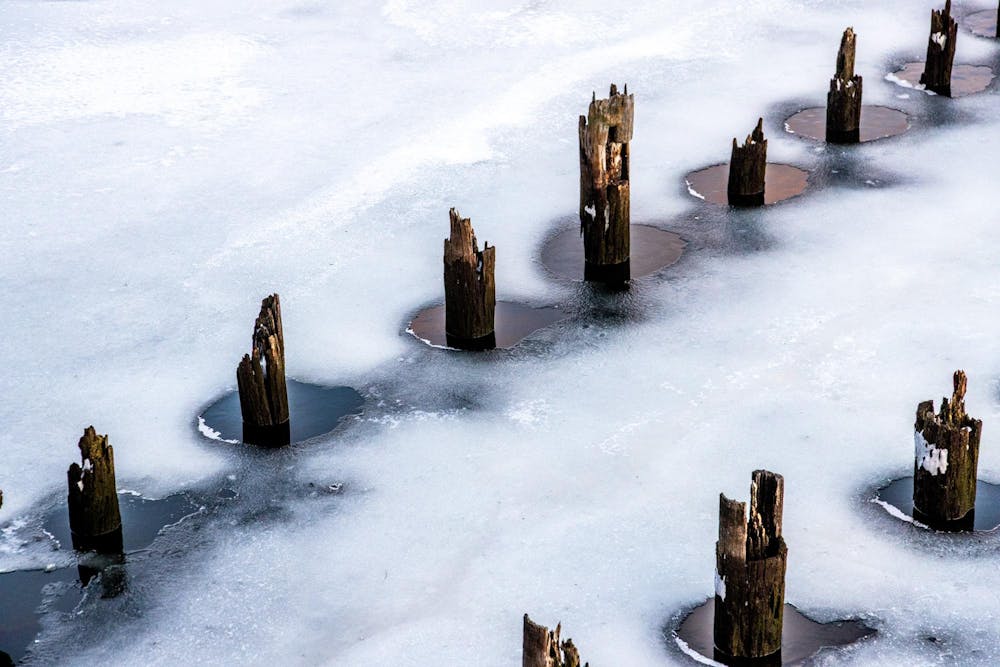
A new $2.34 million grant from the National Oceanic and Atmospheric Administration will allow the Rhode Island Coastal Resources Management Council, in collaboration with The Nature Conservancy, to remove 250 tons of old wood pilings — which are considered hazardous waste — from the Providence River.
The pilings were foundational supports used to turn and raise the old Point Street Bridge in the 1920s to allow for boat traffic. After the construction of the Fox Point Hurricane Barrier in 1966, large vessels were blocked from the river. The pilings became obsolete and have been slowly rotting since.
The wood is now polluting the river, Tim Mooney, director of marketing and communications for The Nature Conservancy of Rhode Island, told The Herald.
The hazardous waste was first brought to the attention of The Nature Conservancy and the council in 2023 during a project to dredge the bottom of the upper bay, Mooney said. Contractors identified debris from the pilings when it hindered the productivity of the dredging project.
“That started a conversation about, ‘Why are the pilings still there in the first place?’ And ‘Is removing them an option?’” Mooney said.
Mooney explained the pilings were treated with creosote, a chemical that “slows degradation (of wood) underwater.” Because of this treatment, the pilings are categorized as hazardous waste, which makes their disposal state and federally regulated.
According to Mooney, the closest facility the contaminants could be brought to was out-of-state in Ohio, which upped removal costs. “Transportation and handling costs right add quite a bit to the price tag,” he explained.
The pilings also pose navigational hazards to boats in the upper bay, Mooney said. This risk has only grown with the city’s efforts to revitalize the downtown Providence waterfront, which have brought “more boats and kayaks and canoes” to the water. Wood debris could also potentially be a threat to the hurricane barrier downriver, he added.
Pollution from the pilings threatens the health of the entire Narragenset Bay, Professor of Earth, Environmental and Planetary Sciences Steven Clemens told The Herald.
The Providence River “is one of the major rivers that feed into this estuary, and estuaries in general are wildly important worldwide,” Clemens said. According to Clemens, roughly “70% of the fish harvested in the open ocean have some type of direct connection to estuaries like Narragansett Bay.”
“The health of these estuaries and the rivers that feed them are just absolutely critical,” he emphasized.
Representative Seth Magaziner ’06 (D-R.I. 2) called the project “long overdue” in an email to The Herald.
“For too long, the deteriorating wooden pilings from the former Point Street Bridge have released harmful materials into the water, threatening local marine life and creat(ing) dangerous conditions for boaters,” he wrote.
The project will “strengthen natural habitats, improve navigation and tourism and enhance quality of life for people across Greater Providence,” Magaziner added.
Mooney mentioned that there have been “some concerns” about removing the pilings, as they are currently serving as fish habitats — which are already “scarce to begin with,” he said. But he believes “we can do better in terms of fish habitat than hazardous waste.”
According to Mooney, once contractors are chosen and begin the project, the removal process should take around four to six weeks.
As of now, the removal project is the second phase of The Nature Conservancy’s efforts to improve the water quality and safety of the river, building on work to remove sand and sediment that had accumulated, according to Mooney. The third phase includes plans to remove road salt and sand from the riverbed, similar to the city’s initial dredging project.