
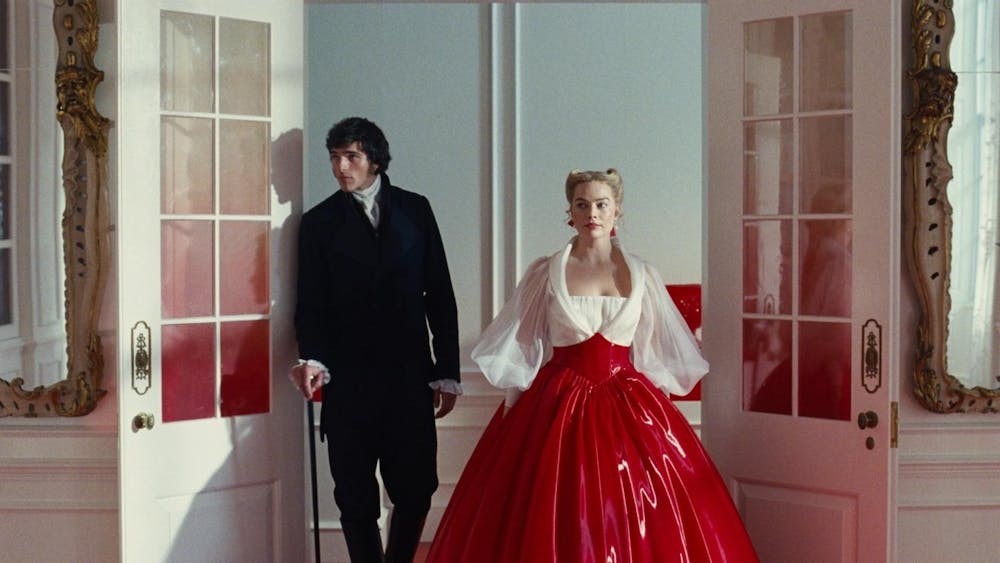
When thinking of director Emerald Fennell’s films, breathtaking visuals — born through her strong directorial vision and Linus Sandgren’s cinematographic skills — are the first thing that come to mind. Fennell’s recently released adaptation of “Wuthering Heights” is no outlier.
Sweeping shots of the English moors, powerful silhouettes and intense close-ups elicit feelings of awe and, at times, a deep discomfort in viewers. Paired with these visuals is Fennell’s knack for symbolism, which is especially notable in close-up shots of characters’ backs suffocated by corsets and a bedroom designed to resemble the face of protagonist Catherine Earnshaw (Margot Robbie).
But the striking visuals are not nearly enough to distract the audience from the film’s many offenses. While some have tried to argue that the film and Emily Brontë’s 1847 classic novel should be considered as entirely separate works, the book should be in conversation with its film adaptation. After all, they bear the same name.
The choice to place the title of the film in quotation marks acknowledges the difference between the film and its source material. Fennell explained this choice in an interview with Fandango earlier this year. “I can’t say I’m making ‘Wuthering Heights.’ It’s not possible,” she said. “What I can say is I’m making a version of it.”
The most prominent and dangerous shift from the novel is the whitewashing of Heathcliff (Jacob Elordi), Catherine’s love interest and one of the story’s main characters. In the book, he is described as “dark-skinned” and compared to a “lascar,” a derogatory term used for Indian and other non-European sailors.
In a further unwelcome deviation from the novel, Fennell turns Nelly into the villain of the movie. This harmful mischaracterization of Nelly’s original character distracts the viewer from Catherine and Heathcliff’s abusive and villainous natures.
These casting decisions also undermine the entire plot of the film — a considerable aspect of the tragedy behind Catherine and Heathcliff’s forced separation is the discrimination Heathcliff faces due to his race and his perceived otherness. In the novel, this social stigmatization fuels the character’s obsession with revenge. But without the racial dynamic, there is less context behind the world’s poor treatment of him.
“You can’t adapt a book as dense and complicated and difficult as this book,” Fennell said in the interview with Fandango. This serves as a lazy excuse for her major simplification of the plot and refusal to tackle the important societal issues of racism, classism and abuse that the book raises.
Fennell also removed the entire second half of the novel, erasing the portion that addresses the cycle of abuse and dispels any ideas that Heathcliff and Catherine’s romance was a healthy one.
By advertising the movie as being inspired by “the greatest love story of all time” in its trailer, Fennell’s film openly dismissed the theme of destructive obsession and abuse before it was even released.
Brontë’s novel was exceedingly groundbreaking in its time for its subversion of many familiar tropes around prejudice and femininity. This simplification changes the narrative into a predictable, seen-it-all-before romance. With different character names and a different title, there would be almost no similarities between the film and the book.
There is also something to be said about the film’s inconsistencies compared to the book, including the significant aging of the characters and the removal of Hindley, Catherine’s older brother. These changes further veer the story away from childish, dark obsession in favor of the “true love” Hollywood trope.
To further fan the flames, Fennell also butchered Edgar’s sister, Isabella (Alison Oliver) by turning her from an upstanding, self-assured character into an unhinged sort of sex slave.
But even if one puts aside the book for a moment, as many positive critics urge the audience to do, and considers the film as a stand-alone, the new storyline is a cliche and the characters have little dimension despite the cast’s strong acting.
While the score, composed by Anthony Willis, is startlingly dark and majestic, the occasional interjection of a Charli xcx song is disappointing and jarring. It turns these scenes into what feels like a music video, adding to the never-ending list of things that make it impossible to take the film seriously.
It’s evident in both her interviews and the film itself that Fennell has slapped a beloved, canonical title over a cookie-cutter tragic romance in the hopes of drawing audiences excited by the idea of watching something “cultural.”
But her exclusion of any complexity in favor of numerous sex scenes makes it clear that Fennell was aiming for a box-office hit instead of a literary tribute, much to the devastation of Brontë fans everywhere — and to the detriment of the story itself.
Correction: A previous version of this article misstated the nature of Catherine's relationship with Heathcliff. The Herald regrets the error.
Millie Barter is a senior staff writer covering RISD.


