
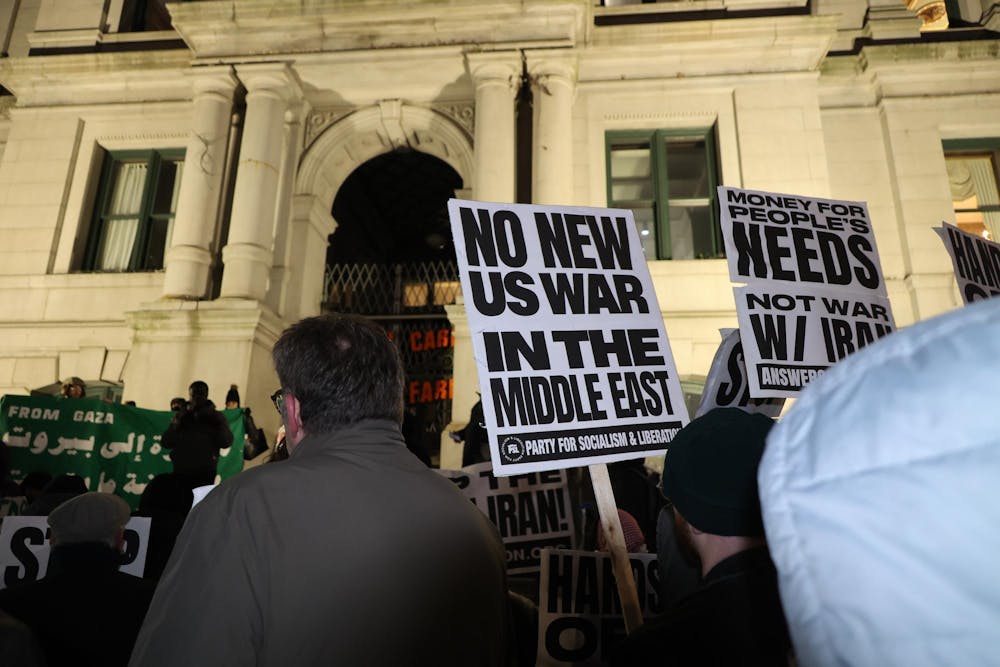
On Feb. 28, it was not the sunrise that woke up the city of Tehran’s residents, but bombs that shook the ground — the United States and Israel had launched a coordinated military attack on Iran. Airstrikes targeted Iranian military leadership, killing three top officials and Iran’s Supreme Leader, Ayatollah Ali Khamenei. Since then, additional casualties have included six American service members, Iranian schoolchildren and civilians across the Middle East.
On March 20, 2003, The Herald reported on the U.S. strikes on Iraq. The attacks followed claims that the Iraqi government was hiding weapons of mass destruction, and occurred under the purview of U.S. President George W. Bush’s Global War on Terror, which pushed for military intervention. In the wake of these attacks, former Brown President Ruth Simmons called on the community to “probe rigorously the causes and consequence of war.” As the bloody conflict in Iran drags into its fourth day, Simmons’s message remains as true as it was nearly 23 years ago: Brown has a civic responsibility to the American public to document and vocalize the costs of war in Iran.
Brown’s national reputation as a top academic institution is enough for the media to pay attention to developments on campus. From the local news covering the recent anti-ICE protest to major outlets like the New York Times reporting on our community’s grievances with the Trump administration, Brown has access to a national stage that amplifies students’ positions on a range of issues. This amplification is, like Simmons pointed out, one of the critical ways we can place pressure on the government. The University’s commitment to fostering a diverse pool of perspectives provides Brown with the unique stance to inject novel ideas into debates about war, contributing to national discourse in a way that enriches public opinion.
In the past, the U.S. government overwhelmingly voted for war in Iraq and Afghanistan. But the Brown community repeatedly questioned the implications of this support.
In 2001, students staged a walkout against the airstrikes in Afghanistan, with a few professors dismissing classes early so students could partake in the demonstration. In a Herald opinion piece the next day, Carl Takei ’02 argued that “real justice cannot be achieved with cruise missiles.” With the backdrop of 9/11 and America’s determination to root out the actors behind it, this stance demonstrates a nuanced understanding of the consequences of impulsive military action.
Two years later, following the invasion of Iraq, students protested a visit to campus by Richard Perle, a pro-war member of the Bush administration. They were successful in causing a disturbance that highlighted their disagreement with Perle and the Bush administration’s pro-war stance. At a time when war was at the forefront of the political agenda, this criticism was especially critical because these students gave voice to the dissent Americans were feeling across the country.
This history of anti-war movements at Brown highlights the strong political will and culture that the University has exhibited in the face of national conflict. From Afghanistan to Iraq, our students have, in one way or another, protested the actions of the U.S. government, and this practice should extend to the war in Iran.
Beyond student activism, Brown has engaged in the anti-war movement through its research endeavors. For example, the Costs of War project brings together scholars and experts from a wide range of disciplines — from economics to anthropology — in an effort to document the toll of violent conflict on our global community. The project has already released findings on the large displacement of Iranians due to previous U.S. attacks on the country. These findings are a critical and reputable way we can keep U.S. leaders accountable. We may never know what the impact of initiatives like the Costs of War project could have had in influencing congressional decisions, but the documentation allows us to understand the real impacts of violent conflict.
Brown’s collective action against war in Iran is especially important as the Trump administration attempts to distance the military from higher education, even cutting ties specifically with Brown. The U.S. military has always thrived on the talent of the academic community and the diversity of perspectives it offers. If Brown and similar institutions are cut out of the conversation on military decision-making, these diverse perspectives would be lost, debilitating the ability to provide dissent within armed forces.
With Brown’s tradition of anti-war protests and research, we should strive to set these same standards and stay engaged in the national discourse on Iran. We must stage impactful protests, produce thorough research and continue to represent Brown as the important cultural, political and intellectual institution that it is.
Shayyan Ahmed ’27 can be reached at shayyan_ahmed@brown.edu. Please send responses to this column toletters@browndailyherald.com and other opinions to opinions@browndailyherald.com.


