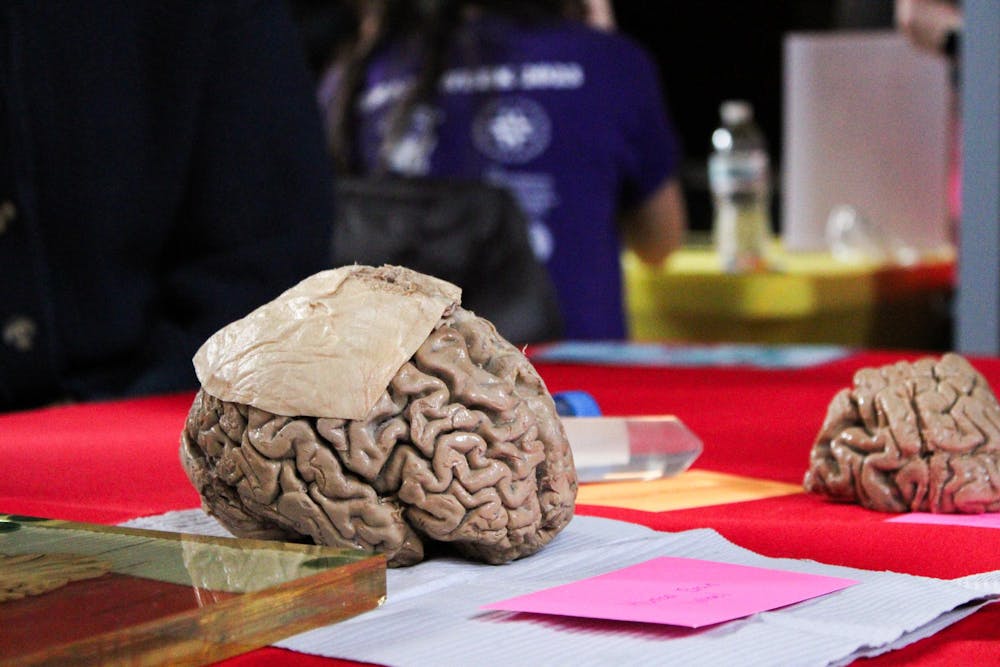
On Sunday, the student group Brown Brain Bee welcomed the Rhode Island community to Sayles Hall to learn about the brain and how scientists study it at the annual Brown Brain Fair.
Brown Brain Bee aims to inspire “the next generation of neuroscientists” by increasing exposure to the field for high school students, according to the club’s mission statement.
“Our goal is to demystify the brain and showcase the novel research happening right here at Brown,” Veda Dayananda ’28, Brown Brain Bee community outreach and high school coordinator, wrote in an email to The Herald.
The annual Brown Brain Fair was co-planned with graduate students from the Department of Neuroscience and the Carney Institute for Brain Science, as well as the nonprofit Brain Waves Rhode Island, Eric Jiang ’27, Brown Brain Bee head coordinator, wrote to The Herald.
“Our target audience is all ages, especially oriented as a family-friendly event, with lots of engaging, interactive stations,” Jiang wrote. Some of these activities included a robotic arm, EEG scanners and do-it-yourself activities to educate people of all august about the brain’s function, Jiang added.
Booths at the event featured research labs and advocacy organizations that taught guests about different aspects of neuroscience and the brain. The fair hosted various activities, such as an interactive robotic arm and neuron model-making activity with pipe cleaners.
One six-year-old guest, Amara Brown, especially loved the booth where he “controlled a robotic hand to get a piece of candy,” he told The Herald, proudly displaying his Almond Joy.
The event included expert-led lightning talks on aging, memory and tools used by scientists to study the brain — such as a MRI — among other topics.
One of the main goals of the event was to provide education about the brain in everyday life, Jiang wrote. “It is important for (visitors) to learn about neuroscience and the brain because of how central our brain and mental health is to our wellbeing,” he added.
Brown Brain Bee Publicity and Volunteer Coordinator Neil Stringer ’27 wrote in an email to The Herald that the event is important to expose high school students to the field of neuroscience because “high schools don’t generally teach neuroscience as a core course.”
“We seek to lower the barrier-of-entry for neuroscience, a field that gives many an impression of being academically elite and out-of-reach,” Jiang wrote.
Stringer also noted that Brown has a “unique opportunity” to open up access to scientific expertise for the broader R.I. community, noting that he believes these fairs help “instill a thirst for growth and investigation in the community.”
For Stringer, “the most rewarding part of organizing this event will likely be the wonder on the students’ faces as they learn about the most interesting parts” of neuroscience, he wrote.