
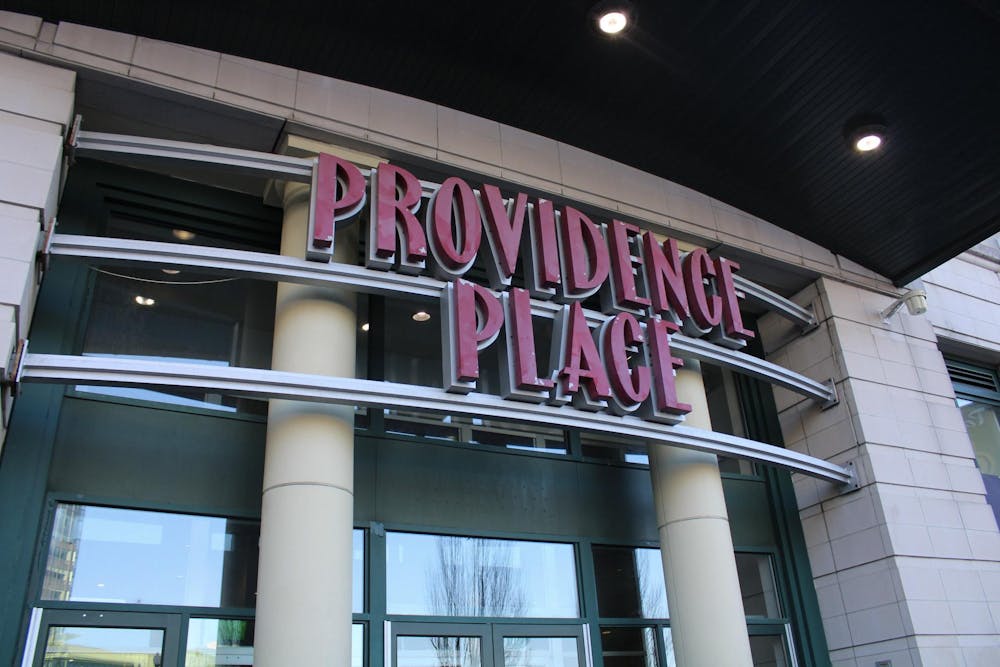
Parking garages. Escalators. Fast food. Screaming children. These are just some of the staples of the American mall that are in danger of disappearing in Providence. In late 2024, it was reported that the Providence Place Mall, the state’s largest shopping center, was ordered into receivership, a state of limbo indicative of poor financial management that can act as an alternative to bankruptcy. And on Feb. 4, the Providence Preservation Society named the mall on its list of endangered properties in 2026. But the loss of our city’s iconic brick-laden building is not inevitable, and Providence must act to redevelop the space before it shuts its doors forever.
The precarity of Providence Place is not an unfamiliar story: Malls across the country have experienced closures throughout the last 20 years due to the rise of online shopping, with many more struggling following the COVID-19 pandemic. Yet as mall attendance declines, we must ask ourselves what has been lost as the era of shopping malls disappears.
Malls — much like parks, libraries and coffee shops — act as “third places,” locations beyond the home and workplace where people connect and build community. Third places foster strong senses of belonging, create new social networks and help alleviate feelings of isolation, ideally at little or no cost. For college students, the mall can act as a space to connect with local residents while strengthening interpersonal skills and improving mental health through social interaction. There has been a decline in third places as a result of factors from the expansion of digital communities to reductions in organized religious gatherings. For this reason, we must preserve our mall to act as a space for congregation and social revitalization.
Admittedly, the framing of an argument for community building centered on malls may appear consumerist. Described by some as soulless gray retail behemoths surrounded by fields of concrete atop which a sea of metallic cars sit, malls are the perfect place for consumption-based expeditions across the country, including in Rhode Island. While I would argue that there are better third places than under the fluorescent lights of an air-conditioned retail site, preserving malls as third places is still vital. Indeed, such spaces are uniquely positioned given the wider audiences they attract, the range of services they provide and the place they have in the American ethos.
Perhaps, too, we could redefine what it means for a mall to be a mall. Malls across the United States are undergoing massive transformations to keep the sprawling spaces alive. Lakewood, Colorado replaced its anchor indoor shopping mall with an array of urban parks, offices and apartments; Newark, New Jersey redeveloped a 400,000-square-foot retail space to include restaurants, grocery stores and an arts center. The possibilities for mixed-use in malls are endless, and Providence Place must undergo similar developments if it wishes to survive.
In the process, these projects have also improved local communities by creating both temporary and permanent jobs, as well as generating tax revenues that can improve local services, education and infrastructure. Some of these projects have also featured affordable housing units, offering Providence a possible solution to the housing crisis that has long gripped the city. There are significant hurdles that exist in embarking on such ambitious conversion projects, including rezoning and considerable investments. But it’s an incredibly attractive alternative when compared to losing a vital piece of our built environment.
However, maintaining these types of spaces does not just require intervention by external actors. People must exit their homes, occupy these places and socialize with members of their communities. Americans are already nostalgic for times when these spaces thrived and wish to see malls survive. Perhaps we ought to make this a modern reality.
To the careful observer, the mall is more than its walls and windows. It is the beginning of friendships, of families, of communities, of love. The various interactions happening around us as we stroll about scanning primped mannequins extend beyond the mall — through these spaces, we learn to build identities, foster connections and empathize with one another. We see individuals in a natural state of existence, battered by the stress of finding a birthday present or eased by the refreshing taste of a fountain drink.
Americans have, by and large, tapped out of their responsibility for civic engagement and community building, withdrawing from the social capital that built the world we know. If we are to repair the harm that everything — from technology to the pandemic — has done to the bonds of our society, let us begin by rebuilding our communities and reconnecting with one another in third places. And perhaps we should start by preserving our mall.
Nicholas Clampitt ’26 can be reached at nicholas_clampitt@brown.edu. Please send responses to this op-ed to letters@browndailyherald.com and other opinions to opinions@browndailyherald.com.


