
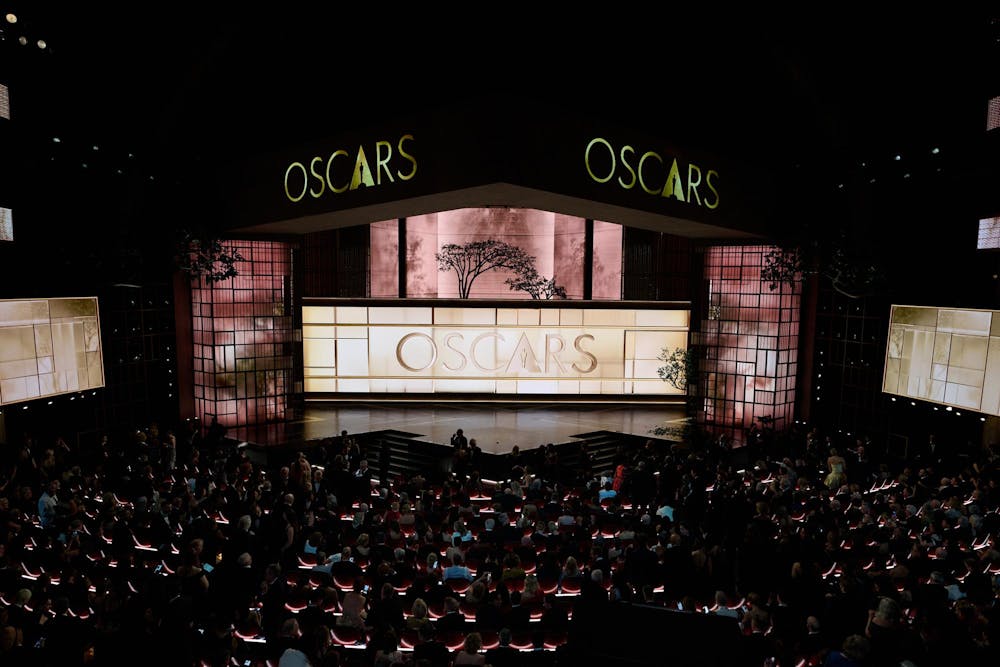
While the Academy Awards are a celebration of film, they are also one of the few moments when Hollywood has the opportunity to present itself as a socially serious American institution. Unfortunately, the ill-advised decision to have Conan O’Brien host the 98th Academy Awards, aired live from Hollywood’s Dolby Theater, undercut much of that ambition.
The night’s highlight was certainly Autumn Durald Arkapaw’s history-making win of the award for best cinematography for her work on “Sinners.” As the first woman to win the award, Durald Arkapaw, stood before the room in a suit dress and invited the women in the audience to rise in a moment of female solidarity. The gesture marked her acceptance as a rare instance in which the awards were used as a means of collective uplift, rather than individual achievement.
Durald Arkapaw’s Oscar was one of many won by “Sinners.” The film ended the night with four Oscars, including best actor in a leading role for Michael B. Jordan. But alas, “Sinners” was not able to secure the cherry on top for best picture. “One Battle After Another,” took home the prestigious award, as well as best director. In the end, it was the Paul Thomas Anderson-Leonardo DiCaprio collaboration which swept the evening, walking away with a total of six Academy Awards.
It was unfortunate that many of the evening’s talented filmmakers had to share their monumental moments with the persistent distractions of O’Brien’s lackluster hosting. He opened the show with a confusing, if intermittently entertaining, sequence in which children chased him into the theater as he entered wearing Aunt Gladys’ wig from “Weapons,” a surreal opening that set the stage for a night defined by tonal oblivion. The audience’s discomfort was palpable as O’Brien’s jokes consistently fell flat.
In his remarks, O’Brien alluded to the current issues surrounding AI and Hollywood — the use of AI has taken center stage recently as Hollywood writers negotiate for contractual protections and job security. The show proved to be a missed opportunity for necessary commentary. The best O’Brien could muster was a joke about being the “last human host,” saying that, “next year, it’s going to be a WayMo in a tux.”
Fortunately, other presenters added the necessary political undertones to compensate for O’Brien’s mediocrity.
Jimmy Kimmel — who has hosted the event in the past — compared CBS to North Korea in a joke about free speech. He also quipped, in reference to President Trump, “oh man, is he going to be mad his wife wasn’t nominated for this” — alluding to Melania Trump’s nomination-less documentary. This joke, unlike O’Brien’s, actually acknowledged the elephant in the room, drawing attention to Trump’s past attempts to censor Kimmel. In September 2025, Trump temporarily suspended Kimmel’s late-night show.
Kimmel also presented the award for best documentary short to Netflix’s “All the Empty Rooms,” which tells the story of gun violence through the preserved childhood bedrooms of kids and teens whose lives were taken by school shootings. This was one of the night’s most poignant moments, as the parent of one of the students, Gloria Cazares, addressed the crowd.
“Since that day, her bedroom has been frozen in time. Jackie is more than just a headline,” Cazares said. “We believe that if the world could see their empty bedrooms, we’d be a different America.” Stories like Cazares’ are the ones that should take center stage. In a country where tens of thousands of people die from gun violence each year — many in school shootings — such moments of public testament carry weight beyond the boundaries of the film industry.
Kimmel then delivered the award for best documentary film to “Mr. Nobody Against Putin.” Following the win, David Borenstein delivered an apt speech that did not shy away from speaking honestly about the United States government.
“When we act complicit, when a government murders people on the streets of our major cities,” he said. “We all face a moral choice.”
Borenstein’s co-director Pavel Talankin, who spoke in Russian and had a live interpreter, followed his colleague in political call-to-actions. “In the name of our future, in the name of all of our children, stop all of these wars now,” Talankin said.
The messages, though deeply profound, felt alarmingly isolated when juxtaposed with the trite host.
These few moments of political clarity just barely redeemed O’Brien’s unfunny and crude jokes. Film is often understood as a medium of social critique. So when the voice chosen to guide such a ceremony appears to mock that responsibility, it calls into question the seriousness with which the institution itself understands its cultural role.

Talia LeVine is a section editor covering arts and culture. They study Political Science and Visual Art with a focus on photography. In their free time, they can be found drinking copious amounts of coffee.
Millie Barter is a senior staff writer covering RISD.


