
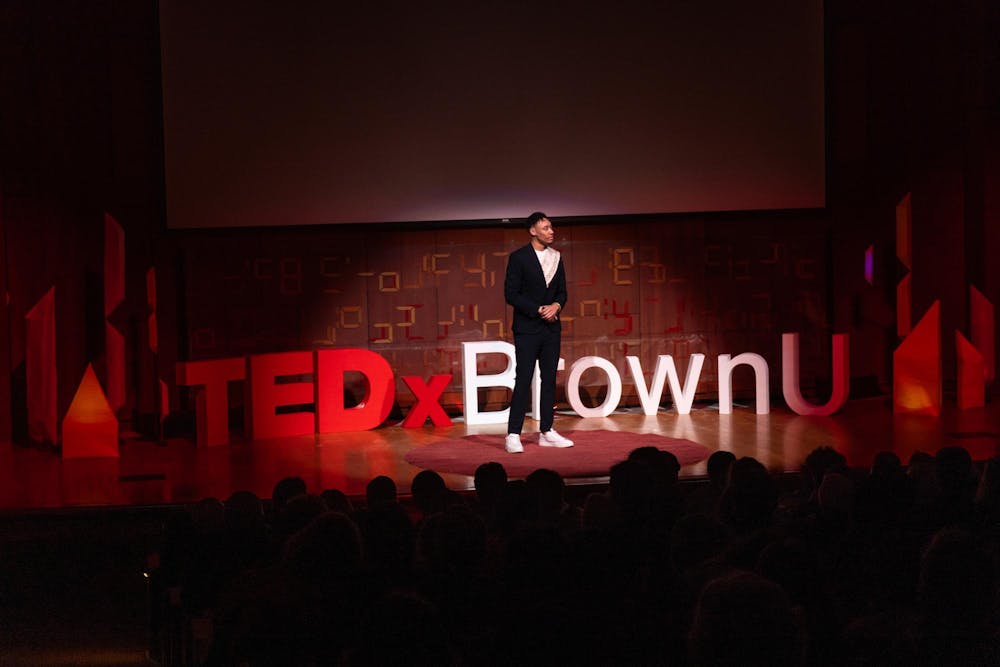
TEDxBrownU’s 2026 conference, “Don’t Blink,” hosted a range of speakers from basketball-playing neurosurgeons to student songwriters. Held on Sunday in Salomon Center, the conference focused on the power of presence in a fast-paced world.
The student-run event series has occurred annually for over a decade. This year's iteration includes a raffle, local brand partnerships and an intermission featuring performances from performances by the Chattertocks, an a capella group and Daebak, a K-pop dance group.
Alex Greven, a neurosurgery resident at the Barrow Neurological Institute and a former professional basketball player, gave the first talk of the conference. He focused on passion, commitment and the importance of taking risks to meet one’s dreams, citing his decision to pursue playing professional basketball, which later informed his dedication to becoming a neurosurgeon.
“You’ve got to triage your dreams,” he said during the talk.
Taking the “Don’t Blink” theme to heart, Malia Chavinson ’27 gave the second talk of the afternoon, where she argued for the importance of facing trauma head-on by discussing her personal experience with sexual assault and explaining how she has transformed her anger into advocacy.
“I think I just really wanted my trauma to be a vehicle for positive inspiration and to help other people,” Chavinson told The Herald after the conference.
Ismar Volić, professor of mathematics at Wellesley College and director of the Institute for Mathematics and Democracy, argued that math is the basis of democratic systems in his talk. He discussed how math can be used to revitalize and reimagine our government in a changing world.
Growing up in Bosnia during the dissolution of Yugoslavia, Volić said he witnessed the downfalls of democracy from an early age. Inspired by his upbringing, he has channeled his passion for math into pushing for quantitative political literacy.
Daiela Simon-Seay ’26, a songwriter and contemplative studies concentrator, concluded the first half of the conference by arguing for the importance of listening to one’s body. In her talk, she discussed weaving the power of sound with the rhythms of her menstrual cycle as well as her experiences with premenstrual dysphoric disorder.
“I was really eager to share my story and my journey with understanding my hormones,” Simon-Seay said in an interview with The Herald after her talk.
Simon-Seay said she appreciated the opportunity to have a platform to talk about these topics, noting how “special” it was to “know that people understand and feel the struggle and the beauty of it all.”
“Whoever you are, listening to your own rhythms is what allows you to show up fully — for yourself and for the world,” Simon-Seay said in her talk.
After the performance-filled intermission came to a close, Cayden Brown, an American juvenile rights activist seeking to improve underprivileged youth access to legal systems, discussed his experience in the custody courtroom as a child and his passion for Teen Court, a restorative justice program for young people.
Cayden Brown described the opportunity to speak at TedxBrownU as “serendipity” and an “unlikely blessing.” He learned of the chance to apply to speak at the event when he came to visit Brown with his brother.
A seasoned public speaker, Cayden Brown said he found the experience very valuable and praised his fellow speakers.
“They all used whatever happened to them in life to find purpose,” he said. “I think we all identified in that space, and we share that together.”
Hongyu Jasmine Zhu ’27 explored the importance of community in her talk, speaking about how grief can be transformed into something creative, beautiful and imaginative.
After the death of her mother during her first year at Brown, Zhu brought her community together to create a book with photos and stories to honor her mom’s life. She channels the power of connection as she works with children in Providence dealing with grief.
Zhu told The Herald that the intention behind her talk was to take “the audience members on this journey of (her) own grief with the storytelling memorial.”
Rani Elwy, a professor of psychiatry and human behavior and of behavioral and social sciences, took the stage next, emphasizing the importance of expanding evidence-based practices in clinical and community healthcare.
Touching on her son’s medical experiences and her work in healthcare accessibility, Elwy delivered a talk that ended with a call to action, arguing that policy reform is the first step in ensuring accessible healthcare.
Concluding the conference was a talk from Joyce Ng GS, a 9/11 survivor and a Brown master’s student. Recounting her experience at the World Trade Center Complex on Sept. 11, 2001, she discussed her life’s goal to support others and ensure the history of the tragedy is preserved.
She connected her 9/11 experience to the ever-growing regularity of school shootings across the country, noting that the experience is now shared by members of the Brown community.
After Ng's talk, TedxBrownU co-president Michael Wang '26 gave some of the event's final remarks, emphasizing that the speakers "have all put so much heart, soul, passion and time into meticulously crafting these speeches with our team."
Lucia Santiago is a senior staff writer covering undergraduate student life.


