
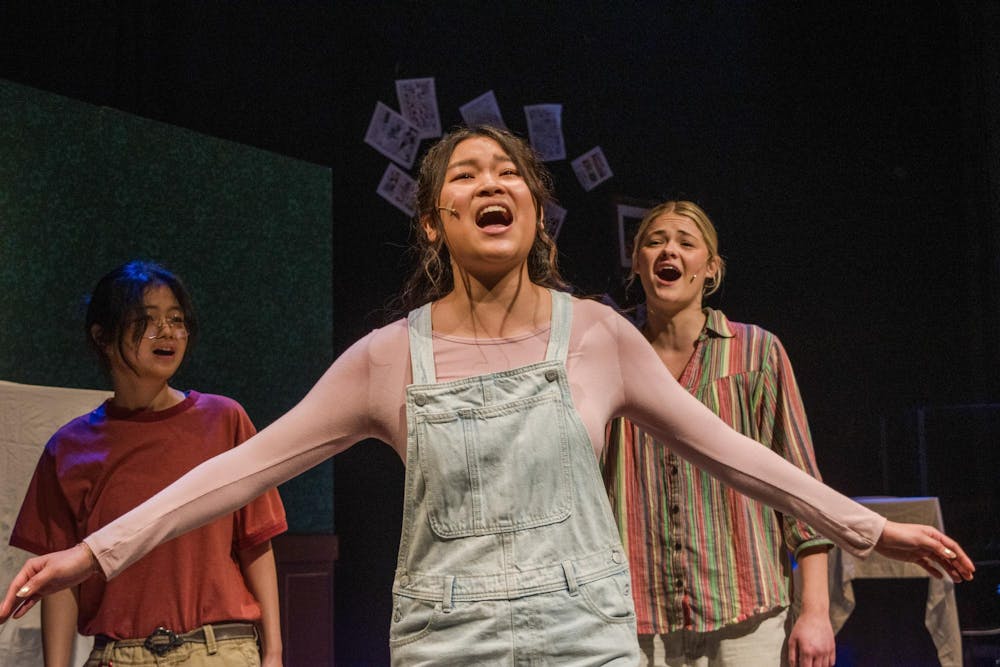
This past weekend, Ensemble Theatre at Brown transformed the Fishman Studio in the Granoff Center for the Creative Arts into a funeral home, a historic Pennsylvania house, an art studio and an Oberlin College dorm for their heartwrenching production of the Tony Award-winning musical “Fun Home.” The show was exactly what college theater should be.
The 2015 musical was adapted from Alison Bechdel’s 2006 graphic memoir, “Fun Home: A Family Tragicomic.” The show was performed off Broadway for multiple years before opening on Broadway in 2015 and becoming the first Broadway production to feature a lesbian protagonist.
“Fun Home” breaks the paradigm of queer women being depicted as side characters or stereotypes — such as in “Rent” and “Falsettos” — by “offering a sincere yet fanciful, profound yet entertaining” lesbian coming-of-age story, Director Maria Diniz ’26 wrote in her director’s note.
Ensemble’s production perfectly captured the essence of college theater. While every actor had the perfect voice for their role, the casting success was particularly evident in the three actors who played each iteration — a young child, a college student and a woman in her 40s — of the protagonist. Actors were not chosen to appear as though they were related by blood, nor were they chosen with the confines of appearing age-accurate. Instead, it was evident that each actor was chosen for their sheer talent, vocal range and fit for the character.
Small Alison was played by Nina Sethanandha ’29, whose performance was so genuine that it often didn’t even feel like she was acting.
Dylan George ’29, who played Medium Alison, delivered a spectacular performance, beautifully depicting the nuances of Bechdel’s young-adult journey of self discovery through interactions with her love interest, Joan, played by Zoe Napurano, a Rhode Island School of Design senior. Their scenes were imbued with an air of cautious flirtiness that will likely resonate with any young queer person who has ever questioned their identity
But Jocelyne Lioe ’29 truly brought the show over the top with her portrayal of present-day Alison. The story follows Alison as she works on her memoir, and the cast acted out her thoughts as if they were characters in her mind. At times, she would leave her desk and move through the scene, floating across the stage almost like a ghost, watching past versions of herself with a bittersweet nostalgia.
The rest of the Bechdel family was also spectacularly cast. Seth Peiris ’26, who played Alison’s father, Bruce Bechdel, presented a very nuanced version of the character, showcasing the character’s flaws and the pain behind them. An important component of the story is that alongside Alison’s journey of self actualization, she must also reckon with the complex past of her dead father, whom she discovers was closeted and had sexual relations with minors. Peiris’s scenes with the teenage Roy, who was played by Peter Brueggemann ’29, were intense and convincing.
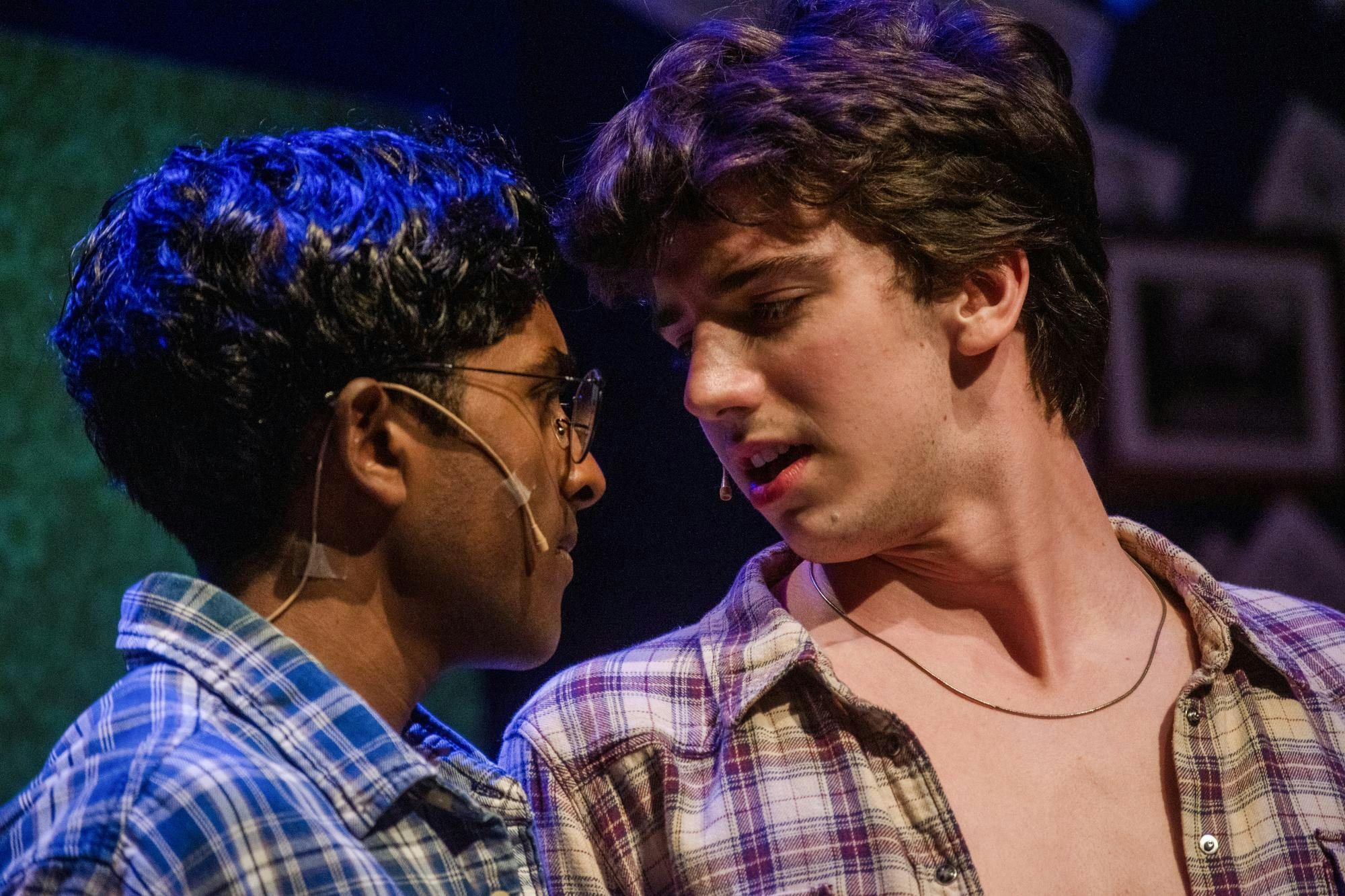
Seth Peiris ’26 (left) and Peter Brueggemann ’29 (right).
Brueggemann also played the other young men — and sometimes underage boys — with whom Bruce had mostly problematic relations. While it was often impossible to tell which of them he was playing, Brueggemann managed to depict all of the characters with ease. If the goal was to depict these young men as disposable sexual accessories, he hit the mark.
One of the most poignant moments was when Alison’s mother, Helen Bechdel, played by Jada Boadu ’29, sings “Days and Days” while recounting the hardships of her marriage to a closeted, abusive man, just days before he dies by stepping into oncoming traffic.
Throughout the song, Boadu descends further and further into despair, still somehow managing to never miss a note. The emotion in the song resonated throughout the studio, leaving the audience with goosebumps.
The show also handled sensuality in a way that did the coming-of-age story justice. In one scene, Medium Alison declares that she is “changing her major to sex with Joan with a minor in kissing Joan.”
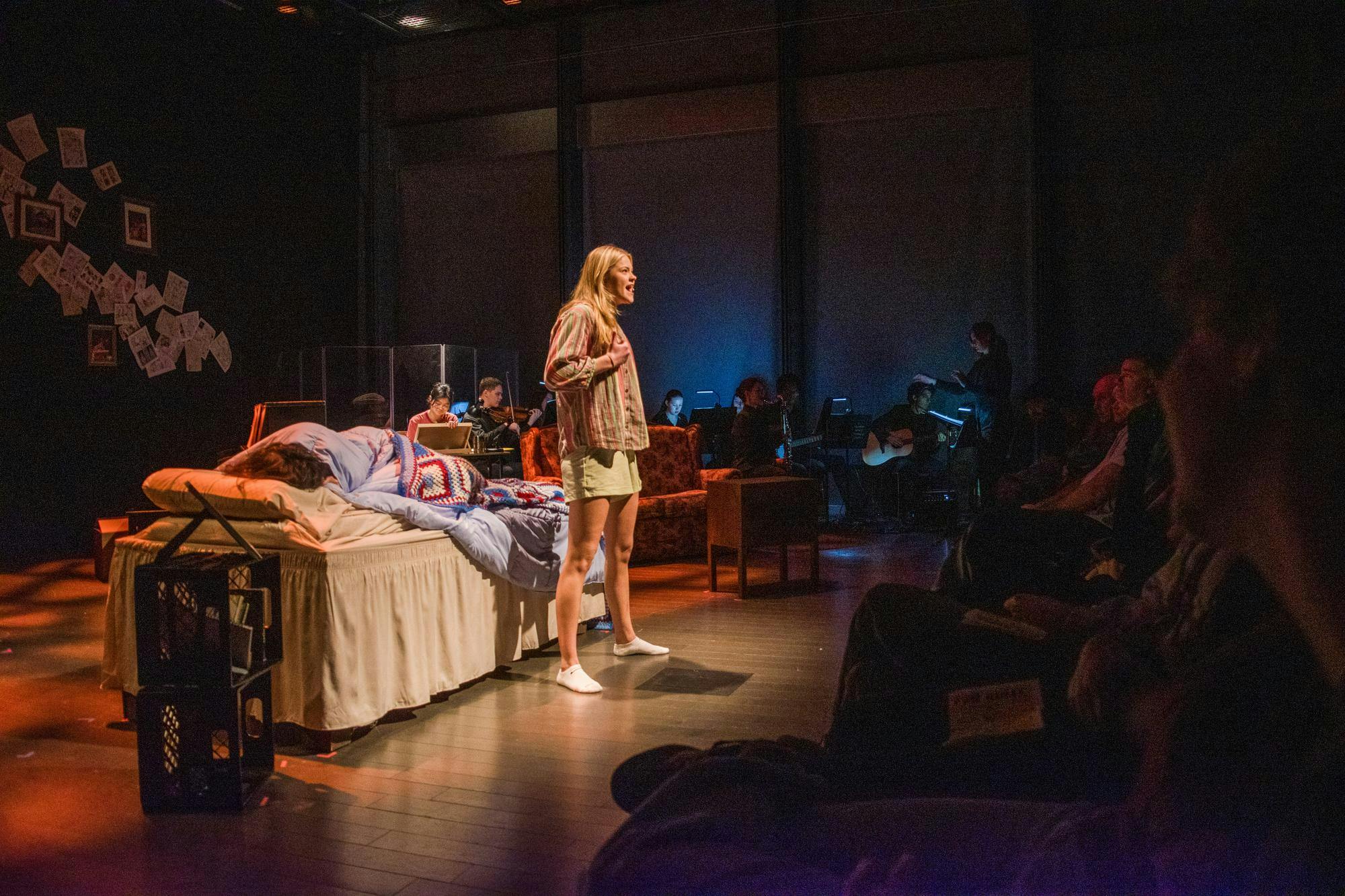
Dylan George ’29.
This moment, which follows Alison’s lesbian awakening, truly captured the heart of the show. “Fun Home” manages to be both vulnerable and funny, conveying complex stories of queerness with elegance and humor.

Talia LeVine is a section editor covering arts and culture. They study Political Science and Visual Art with a focus on photography. In their free time, they can be found drinking copious amounts of coffee.


