
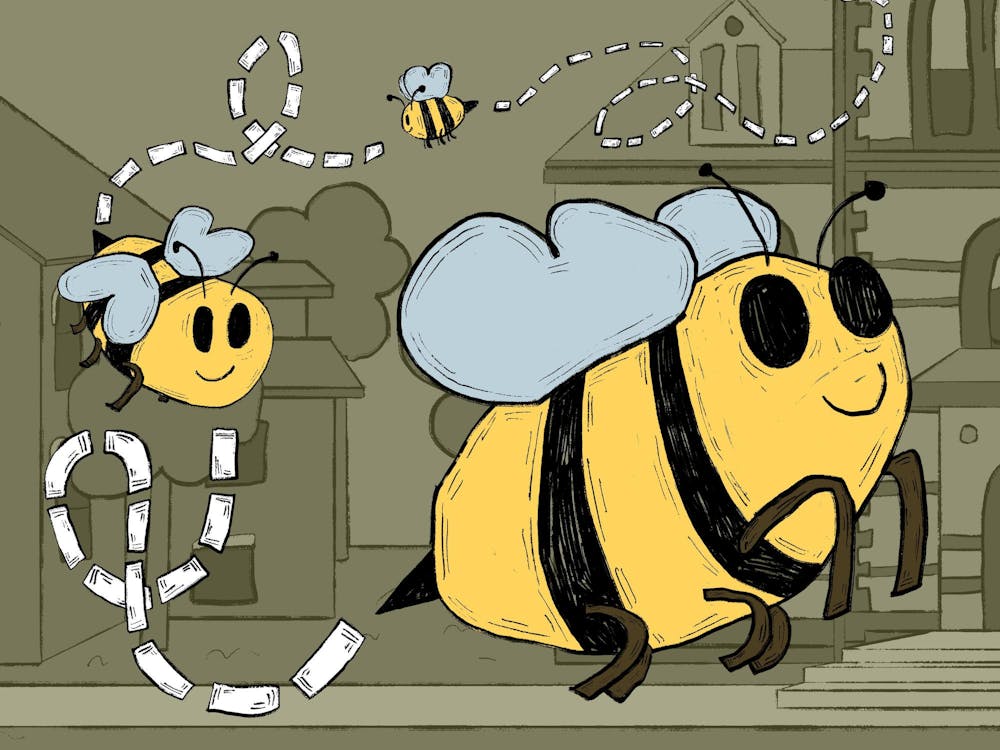
As spring returns to College Hill, there is plenty to look forward to: flowers blooming, joyous tour groups and a much needed melting of the snow. One spring staple, however, may not return in full force — the bees. Pesticides, invasive parasites and habitat loss have overwhelmed colonies and keepers across the country. Over the last decade, pollinator populations have faced increasingly devastating winter die-offs each year. With so many of these essential species facing dire threats, it’s time for Brown and Rhode Island to do their part to protect our pollinators.
I grew up on a bee farm, so the health of pollinators has been a pressing concern for much of my life. Though I may be biased towards the creatures I’ve come to call pets, it is a fact that they are integral to ecosystem health and food production. Almost 80% of all plants and 35% of the world’s food crops depend on pollination in order to reproduce. The disappearance of bees and other pollinators threatens not only the diversity and health of ecosystems, but also the agricultural industry and food supply for countless species across the globe.
Since the 1960s, North American bees have struggled in the face of increased pesticide use, habitat loss and climate change. The arrival of the invasive Varroa Mite to the United States in 1987 fanned the flames of population decline. Now, Varroa infestation has grown to become a primary cause of managed-bee die-offs. Another significant threat to domesticated bees arrived in the late 2000s: Colony Collapse Disorder. CCD, which occurs when the majority of the hives workers suddenly and mysteriously disappear, first devastated beekeepers in the winter of 2006-2007. Despite a decline in cases around the 2010s, beekeepers across the United States have begun to report a possible “second wave” of CCD following the extreme die-offs of the last couple years. In the winter of 2024-2025, bee colony losses exceeded 60% — the largest die-offs in American history.
Managed bees aren’t the only populations under threat. As climate change worsens, other populations of pollinators — such as butterflies, beetles, hummingbirds and bumblebees — are reeling as well, with over one-fifth of native pollinators and 34% of native bee species at elevated risk of extinction across North America. Rhode Island is no exception, and a recent University of Rhode Island pollinator survey found that only six of eleven native bumblebee species are still present within the state.
For Rhode Island, pollinator decline poses an especially serious threat to agriculture. Unlike commodity crops such as corn, wheat and soy that are capable of wind pollination, high-value crops, such as squash and berries, grown on Rhode Island farms are particularly reliant on specific pollinators to reproduce. The presence of local pollinators is especially essential for Rhode Island’s predominantly small-scale farms, which can’t afford to truck-in pollinators like some large farming operations. With more than 250 species of bees in our small state, preserving population diversity — and not just overall numbers — could make all the difference for the health of our ecosystems and agriculture.
In the face of such dire numbers, loss of pollinators can begin to seem like just another hopeless environmental crisis. However, this is thankfully not the case. Across the country, many universities have joined the cause of aiding pollinators. In the Ivy League, the Pollinator Network at Cornell conducts cutting edge research and conservation efforts. And here in Rhode Island, URI’s Bee Lab has done invaluable work in documenting the state of local pollinator populations. Brown University, however, currently does little to aid pollinator research. The Brown Beekeeping Society has seemingly suffered a collapse themselves, disappearing from campus and social media last year. It’s time for Brown to join the buzz, and put in the work to create pollinator-focused programs on campus.
Combatting declining bee populations doesn’t necessarily require suiting up and braving the risk of stings. Simply making the small choice to avoid pesticides and actively support organic agriculture proves an easy and effective way to help out pollinators here in Rhode Island and beyond. Sadly, despite Brown’s supposed commitment to sustainability in its dining halls, the University does not commit to sourcing produce from organic farms. While I commend Brown’s effort to reduce pesticide use and increase pollinator-friendly habitats, a commitment to organic agriculture would offer a stronger step towards supporting pollinators, bringing Brown closer to achieving their lofty promises of sustainability.
Another effective way to help out pollinators is to make an effort to plant native wildflowers. To the University’s credit, Brown plants over 1,000 flowering plants around campus, which provide a source of nectar to local pollinators in an urban environment. Brunonians can take a page out of the University’s book and make an effort to plant local flowers. Living out of an apartment or dorm can make gardening seem impossible, but even just keeping a couple of potted flowers or a window box can make a difference for local pollinators.
Saving our pollinators will require both individual and institutional effort. But if Brown, Brunonians and Rhode Island prioritize pollinator health, we could make a real difference. So, the next time a bee follows you through a field or dares to land on your picnic blanket, no need to scream or run away; simply thank her for the beautiful flowers and wonderful food we enjoy here on College Hill.
Reid Gold ’29 can be reached at reid_gold@brown.edu. Please send responses to this column to letters@browndailyherald.com and other opinions to opinions@browndailyherald.com.


