
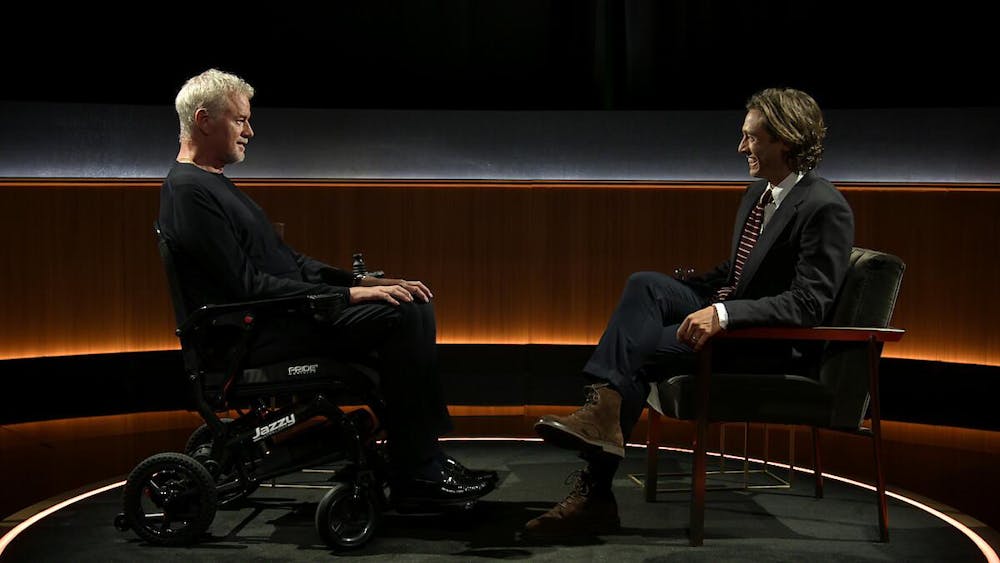
On Feb. 20, the day after actor Eric Dane’s passing, Netflix released the second episode of its show “Famous Last Words” — a series of interviews with celebrities only released following their passing. In a display of impactful vulnerability, Dane lays himself bare in front of a global audience, choosing to impart a final message of perseverance.
Dane, who passed away after a battle with amyotrophic lateral sclerosis — otherwise known as ALS or Lou Gehrig’s disease — was famously known for his role as Mark “McSteamy” Sloan on the television show “Grey’s Anatomy.” But his conversation with the show’s host, Brad Falchuk, focused less on his career and more on Dane’s personal life.
Throughout the 50-minute episode, filmed in November, Falchuk was not shy with his questions. Early on, he delves into Dane’s difficult childhood and the loss of his father, who died from a self-inflicted gunshot wound when Dane was seven. Dane explained how this experience shaped the way he views himself and his relationships with others — and his calm, thoughtful response sets the tone for the rest of the interview.
“Out of pure survival, I am forced to stay in the present. But I don’t want to be anywhere else. The past contains regrets. The future remains unknown. So you have to live now,” Dane said.
Having battled with ALS — which he first revealed publicly in April 2025 — Dane himself serves as an example of this tenacity. Throughout the interview, he expressed complete disbelief as to how he has managed to live out his sickness with acceptance and a sense of humor.
“I’m a complainer,” he said. “But my spirit has been surprisingly pretty buoyant.” The conversation makes clear that ALS changed his outlook on life, and that knowing how little time he had left forced him into a state of positive reflection.
Over the course of the interview, Dane became increasingly open with Falchuk and spoke about how he never truly believed that he was “enough.”
In admiring his wife, Rebecca Gayheart, Dane comments on her perseverance, calling it proactive. But he contrasts this to his “resilience,” which he describes was a necessary “act of defense.”
Falchuk, far from a passive interviewer, takes the moment as an opportunity to challenge Dane’s beliefs about himself.
“When you describe really living every moment up until the end … that feels like perseverance, not resilience. Resilience feels like survival,” Falchuk retorted. “Yeah, you’re right,” Dane replied. The viewer is moved watching Dane’s change in self-perception on camera, and the moment encapsulates the authenticity of the interview.
The beginning of the episode established that the specific goal of the interview was to leave a message for Dane’s children, who will not have the opportunity to fully get to know their father as adults. He said he hoped they would be able to gain insight into his life and maintain a tangible record of his advice through the interview.
At the end of the interview, Dane was allowed a moment alone with the camera, where he spoke directly to his children, listing things that he has learned from his disease that they should carry with them in their lives. While this seems like a startlingly public way to express a very personal message, it is incredibly moving and almost impossible not to internalise his lessons from behind the screen.
“I hope I’ve demonstrated that you can face anything. You can face the end of your days. You can face hell with dignity. Fight, girls, and hold your heads high,” he said. “Billie and Georgia, you are my heart. You are my everything. Good night. I love you. Those are my last words.”
This is not a Netflix show that can be used as background noise for passive scrolling — the unfiltered and undramatized intimacy makes it feel almost disrespectful to look away and not live in the present, just as Dane implores.
Millie Barter is a senior staff writer covering RISD.


