
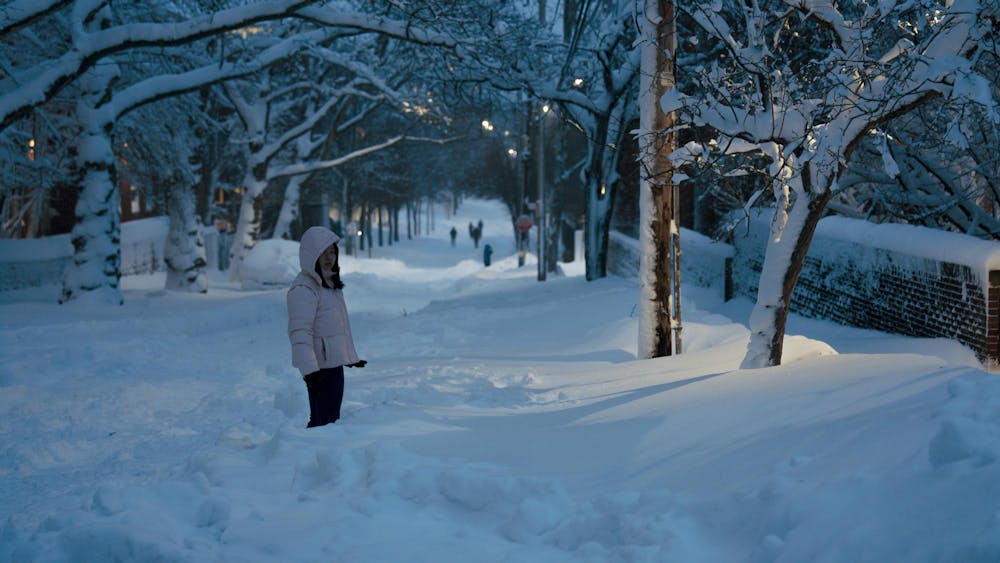
Last week, Providence received a record-breaking 37.9 inches of snowfall. Around 48 years earlier, the first snowflakes of the Blizzard of ’78 fell.
The snow began on Monday, Feb. 6 and over the next 36 hours, nearly 30 inches of snow blanketed the ground, sometimes at a rate of three inches per hour. In the wake of the snowstorm, cars were abandoned on the street, and classes were canceled for the rest of the week.
On Feb. 8, then-President Jimmy Carter declared Rhode Island a disaster area. Hundreds of guardsmen were deployed to the state, where they helped dig out thousands of motorists and usher dialysis patients to treatment.
Former University President Howard Swearer attempted to resume instruction on Thursday but reversed the decision at the request of Gov. Joseph Garrahy. According to The Herald’s coverage at the time, Herald reporters called the governor for comment about classes resuming. The governor then called Swearer and asked him to refrain from beginning instruction.
At that time, dining hall workers slept in University housing and worked double shifts during the emergency. The Verney-Woolley Dining Hall resorted to stocking supplies using a toboggan, The Herald previously reported.
The storm may have come as a surprise to Brown students and Rhode Island residents. Meteorological forecasting was far less accurate at the time, wrote Frank Nocera, a meteorologist at the Boston/Norton office of the National Weather Service, in an email to The Herald.
He explained that less powerful computers meant forecasting in the 1970s had lower resolution. Now, satellites capture more detailed imagery that updates every 30-60 seconds.
“Seven-day forecasts today are about as accurate as three-day forecasts were in the 1980s,” Nocera wrote.
“The amount of snow in ’78 caught everyone by surprise, so there weren’t travel bans,” said Sam Fulcomer ’80, a High Performance Computing Information Technology architect at Brown. “Route 95 became a parking lot, impeding snow clearing/removal and shutting down the highway for much longer than our recent storm.”
Due to the surprise, several students were unable to return to campus. Robert Horton ’78, for example, was stuck in Cambridge, Massachusetts for the duration of the storm and its aftermath, he wrote in an email to The Herald.
“1978 was far worse,” Fulcomer wrote. “It’s not really close.”
In the aftermath of the storm, 65% of Brown students reported being infected with the flu, according to an informal campus survey conducted by University Health Services. Carrie Kuempel ’80 P’14 was a resident advisor in Keeney Quadrangle — then dubbed “West Quad.” In an interview with The Herald, she recalled bringing food from Sharpe Refectory back to some of the sick residents in her hall.
Kuempel said she also took trays from the dining halls to go sledding down College Hill. Some brave students even sledded down the Graduate Center’s spiral staircase.
“It was very chill,” said Barbara Raab ’81, a first-year student at the time and former Herald writer. “There was nothing anybody could do. There was nowhere anybody could go.” Raab added that this was a time before personal computers or cellphones — she wrote her papers on a typewriter at her desk.
“Before smartphones, social media and the internet, when many at my age didn’t even have a television, the experience of the blizzard was more immediate,” Horton explained. “We wandered outside, chatted with strangers, climbed to the top of snowdrifts and looked into second-floor windows.”
Charles Kimes ’80 remembered “really nice snow sculptures,” he wrote in an email to The Herald. Kimes was one of the many students assisting in shoveling the University’s pathways.
Around 300 students, most of whom were fraternity members, helped shovel the campus as part of “Operation Digout.”
He also noted that some professors made up for the canceled classes during reading period.
Then-Dean of Faculty Maurice Glicksman announced that making classes up was expected but not required, The Herald previously reported.
The city and University resumed “normal operations” around Feb. 17, 1978. But the blizzard has long remained a part of Rhode Island’s history.
Michael Salzillo, a lifelong Providence resident, lived through Providence’s 2015 snowstorm. His family often talks about the Blizzard of ’78.
“It was folklore,” Salzillo said.

Talia is a metro section editor covering the health and environment and community and culture beats. She is a sophomore from Bethesda, MD studying history and international and public affairs. In her free time, she enjoys exploring Providence one wrong turn at a time.


