
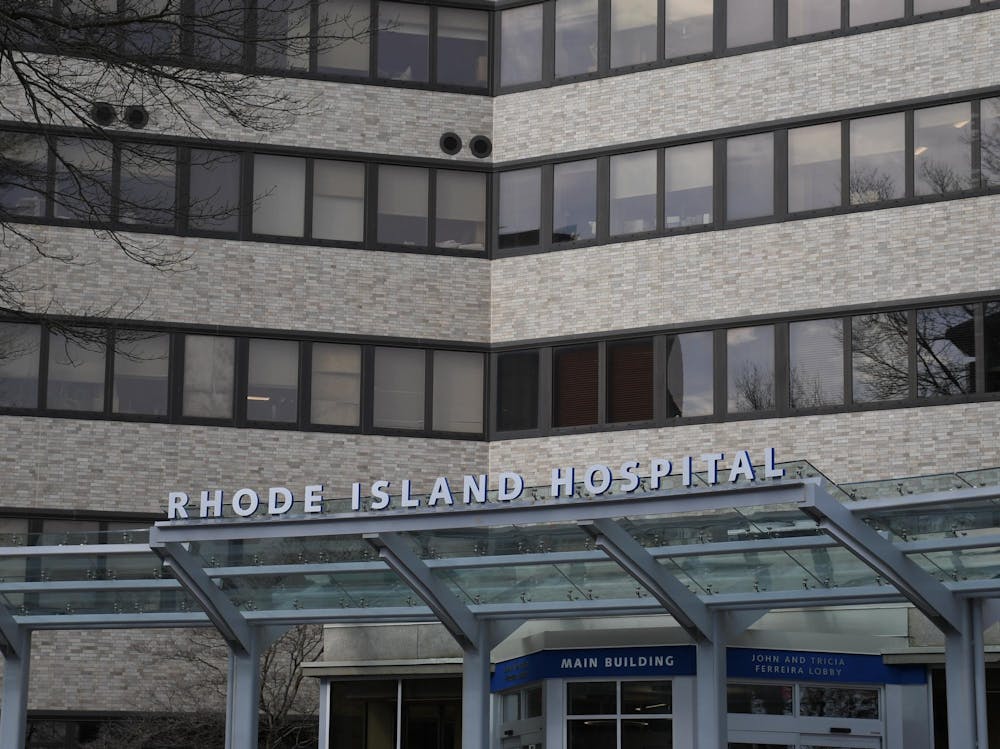
Brown University Health must turn over patient and administrative records related to gender-affirming care for minors to the U.S. Department of Justice, a federal judge in Texas ruled Thursday.
The ruling comes amid a federal investigation into healthcare providers across the nation — including Rhode Island Hospital, which is operated by BUH — about the distribution of puberty blocking and hormone therapy drugs to minors. Federal judges in other jurisdictions have shot down similar DOJ subpoenas for information on gender-affirming care at other healthcare providers.
The DOJ served Rhode Island Hospital with a subpoena last July demanding the hospital release wide-ranging records on the matter, including the records of patients who received gender-affirming care and the doctors who provided it.
In a petition filed by the DOJ on Thursday, federal lawyers alleged that the hospital had not adequately responded to the subpoena. “In fact, it has produced only one six-page document in response,” the petition reads.
Chief District Judge Reed O’Connor, a George W. Bush appointee to the U.S. District Court for the Northern District of Texas, agreed later that day that Rhode Island Hospital failed to fully comply with the subpoena. In a court order, he wrote that Rhode Island Hospital may be held in contempt if it refuses to turn over the records within 14 days.
“The Department of Justice expects and demands full compliance with validly issued subpoenas like the one at issue here,” said Brett Shumate, assistant attorney general for the DOJ’s Civil Division, in a Friday news release. “Non-compliance with lawful process is never an option.”
In a statement sent to The Herald, a spokesperson for BUH wrote, “We recently became aware of the motion filed by the Department of Justice and are currently reviewing it carefully with counsel.” They declined to comment further.
Jeffrey Robbins, a visiting assistant professor of the practice of political science at Brown and the former assistant U.S. attorney for the District of Massachusetts, said in an interview with The Herald that Rhode Island Hospital’s alleged minimal compliance with the July subpoena, in addition to their failure to make an argument against it, was “incomprehensible.”
“It's basically an exhortation to a court to issue an order,” Robbins said.
The BUH spokesperson did not respond to a request for comment.
In the DOJ’s petition, lawyers wrote that the federal investigation “is being carried out” in O’Connor’s district in Northern Texas, but it did not provide further details.
According to Robbins, the investigation likely includes healthcare providers that are within O’Connor’s district, giving him jurisdiction over multiple providers in the broader investigation — including Rhode Island Hospital. The Herald could not confirm whether any of the hospitals under investigation were located in O’Connor’s district.
Robbins noted that the district chosen for the ruling may have been selected for political reasons, as O’Connor has a history of ruling in favor of Republican positions.
“It wouldn’t surprise me in the slightest that they are conducting this investigation in a judicial district which is red and conservative,” Robbins said.
The DOJ did not immediately reply to a request for comment.
But still, Robbins added, there is nothing inherently problematic “about an investigation like this brought in (one district) to administer subpoenas to entities which operate in (other districts).”
Robbins said that BUH’s options to appeal the order may be limited. “Their failure to move to quash or to modify the subpoena, I think, gives them no discernible argument for appealing this order,” he said.
BUH is a separate entity from the University, but the two organizations are affiliated, and Brown President Christina Paxson P’19 P’MD’20 serves on the healthcare system’s board of directors.
The federal investigation into Rhode Island Hospital revolves around whether hospital officials provided gender-affirming care to minors to treat gender dysphoria — a use of the medication that has not been approved by the Food and Drug Administration.
The FDA has approved drugs including puberty blockers to treat other conditions, such as precocious puberty and prostate cancer, according to documents included in the petition.
But physicians may be prohibited from providing the drugs for gender-affirming care while coding them into medical systems as treatment for approved conditions, according to the petition, as that practice may constitute a form of fraud.
The federal investigation has found evidence that “raised questions concerning whether puberty blockers and cross-sex hormones have been fraudulently distributed for unapproved uses involving (Rhode Island Hospital) patients,” according to a document filed with the petition.
But the FDA website notes: “Once the FDA approves a drug, healthcare providers generally may prescribe the drug for an unapproved use when they judge that it is medically appropriate for their patient.”
This story was updated on Sunday to include an interview with lawyer Jeffrey Robbins, a visiting assistant professor of the practice of political science.
This is a developing story. Check back for more updates.

James Libresco is a senior staff writer covering staff & student labor. He is a first-year student from Alexandria, Va. studying political science and contemplative studies. In his free time, he can be found playing basketball, meditating, or losing in Among Us.


