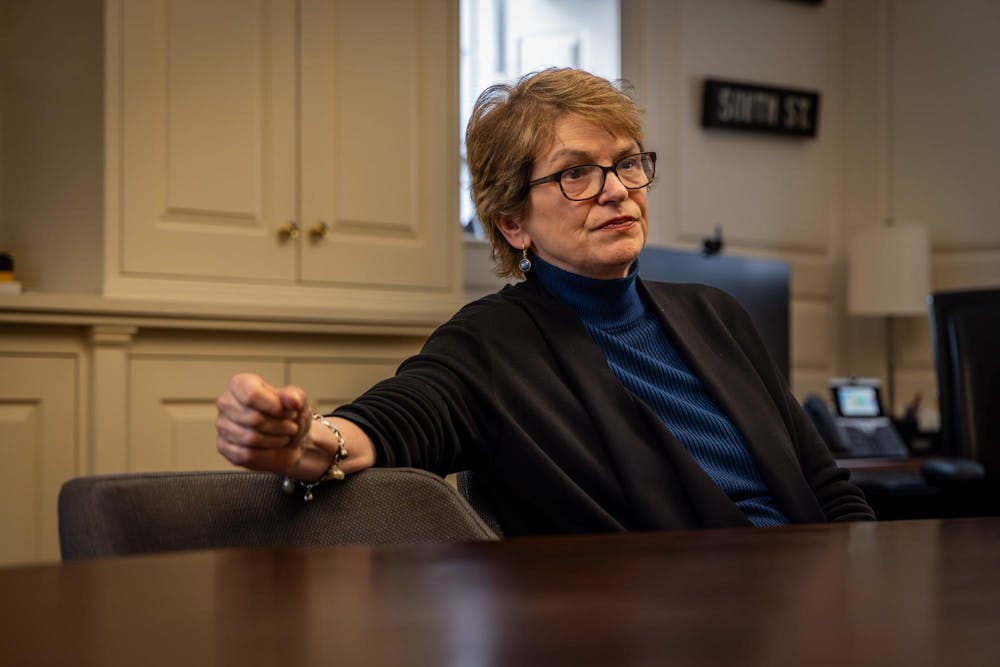
President Christina Paxson P’19 P’MD’20 discussed topics including grade inflation, rising public mistrust of higher education, increasing tuition and Brown’s relationship with the federal government at a Washington D.C. event hosted by the American Enterprise Institute, a center-right public policy think tank.
The event was moderated by Fredrick Hess, director of education and policy studies at the AEI. The talk centered on the future of higher education amid threats from the Trump administration, including executive orders on gender, antisemitism and diversity, equity and inclusion on college campuses, as well as challenges to financial aid.
Brown plays a unique role in the future of higher education, Hess explained in an email to The Herald. “Brown is a prominent institution with a long history,” Hess wrote. “It’s one of two or three dozen research universities that has an outsized impact on how the nation thinks about higher education.”
Hess opened the conversation with the recent erosion of public trust in higher education, and asked if this increased skepticism is due to university actions or results from external circumstances.
Paxson attributed mistrust to two main sources: the increasing price of college and concerns about “the so-called indoctrination of students,” a concern she believes is more prevalent among people with right-wing beliefs.
Paxson said the cost to attend Brown has not increased in the past decade when adjusted for inflation. “The sticker price is exactly what it was a decade ago,” she said at the event.
In a Wednesday morning email to The Herald, University spokesperson Brian Clark wrote that Paxson misspoke and intended to refer to Brown's net price rather than sticker price.
In the 2016-17 school year, the direct cost to attend Brown sat at $64,556. According to the U.S. Bureau of Labor Statistics consumer price index inflation calculator, that amount from September 2016 now has the buying power of $87,379.81 in February 2026. Direct fees exceeded $90,000 starting in the 2025-26 school year.
In February, the Brown Corporation approved an additional 4.25% increase in undergraduate tuition and fees, raising the direct costs of attendance for the upcoming academic year to $97,016. According to the Federal Bureau of Labor Statistics, the CPI grew 2.7% from December 2024 to December 2025.
Paxson added that for “the vast majority of American families,” Brown’s financial aid would lower the cost below the sticker price.
According to The Herald’s Fall 2025 poll, about half of Brown students receive financial aid. Paxson noted that it is a challenge to communicate to families that universities like Brown can become more affordable with these financial aid offerings.
She added that for many families, “it is less expensive to go (to an elite school like Brown) than it is to go to one of their often very fine state institutions.”
In response to claims of alleged indoctrination and free speech concerns on college campuses, Paxson referred to a Gallup-Lumina poll on higher education in which only 2% of students reported feeling unwelcome on their college campuses due to their political beliefs.
These are “important issues,” Paxson acknowledged. “But I think the headlines overstate the problem,” she said.
She also mentioned that in the University’s 2025-26 Campus Climate Survey about 90% of students reported that they didn’t feel they had to suppress their identities to fulfill the requirements of their coursework. Paxson added that she wishes that the number was higher, but emphasized the University is working on improving it.
“I’m pretty happy with 90% as a starting point, so we’re in a good place there,” she said.
The Campus Climate Survey also found that 67% of undergraduates and 60% of medical students reported feeling they could “freely express their political or social views on campus.” The Herald’s Fall 2025 Poll found that over 45% of undergraduate respondents felt uncomfortable expressing their political beliefs at Brown, with the trend being more pronounced among conservative students.
Hess then emphasized the importance of having faculty members with diverse viewpoints, asking Paxson if she is concerned that “in some disciplines, there’s just not the kind of breadth that you’d like to see.”
“People sometimes imagine classrooms as places where professors are coming in and saying, ‘This is my view, and you better share it,’” Paxson said. “Whether you’re conservative or liberal, that’s bad teaching.” She said that the “vast majority” of Brown faculty attempt to cultivate a classroom in which diverse perspectives are welcome and that students are comfortable sharing them.
The pair then discussed the University’s July agreement with the federal government, which came after Brown’s funding from the National Institutes of Health was frozen in April. The freeze meant that new research grants couldn’t be obtained and “bills weren’t being paid on active grants,” Paxson explained. “This put a lot of stress on our scientific enterprise, clearly, to the point that I was worried that faculty would leave.”
Paxson emphasized that the settlement with the Trump administration did not impact the University’s governance and was in-line with Brown’s values and “commitment to open discourse, to academic freedom,” she said.
Paxson contrasted July’s agreement with additional provisions in October’s “Compact for Academic Excellence in Higher Education,” which Brown declined to join. Paxson said that the Trump administration’s compact included provisions she “did not feel comfortable signing onto.”
Demands in the compact included freezing tuition for five years, limiting grade inflation and capping international undergraduate enrollment to 15%.
Hess specifically asked Paxson about grade inflation, referring to previous Herald coverage from 2014 in which Paxson was quoted saying that Brown’s “fraction of the As is getting pretty high — too high for comfort.”
“I would say something very different now,” Paxson said. “One of the great things about Brown is we bring in students, and we encourage them to be intellectually curious, to dive into their studies, to compete with themselves to do better, but not to have sharp elbow competition with each other.”
Paxson said that she isn’t concerned about grade inflation, adding that Brown’s current culture around grades centers a focus on learning and creates a positive and collective academic community.
She added that Brown students are still “getting into the best professional programs. They’re getting into great graduate programs. They’re getting great jobs. I am not hearing from anybody, ‘Oh, I thought this was a good student because they had all As, but it turns out they don’t know anything.’”
Hess also asked Paxson about indirect costs for research, which have been a topic of contention between Brown and the federal government.
Paxson explained that while grants provide funding for the salaries and equipment required to conduct research projects, they don’t include the cost of general necessities such as utilities, rent and shared equipment. Indirect costs cover the additional expenses required to complete the research, and are typically reimbursed to universities at an agreed-upon rate by the federal government.
“It’s fair that taxpayers help pay for (indirect costs) if they’re getting the work done, but we’re concerned these overhead costs are also covering bureaucratic bloat,” Hess said. But Paxson noted that indirect costs are often essential for research, noting “They’re not extras. They’re real costs.”
In June, Brown joined a lawsuit against the Department of Defense to block a 15% cap on indirect costs for all current and future projects. The University has filed lawsuits against the National Institutes of Health, the Department of Energy and National Science Federation over similar indirect funding cuts.
Paxson said she wishes that the process for securing federal funding was more transparent for taxpayers to know where their money is going, as it currently feels “like a black box and that there’s not as much accountability as there could be.”
Update: This article has been updated to include comment University spokesperson Brian Clark shared with The Herald about Paxson's statement regarding changes to Brown's net price.
Jeremiah Farr is a senior staff writer covering university hall and higher education.