
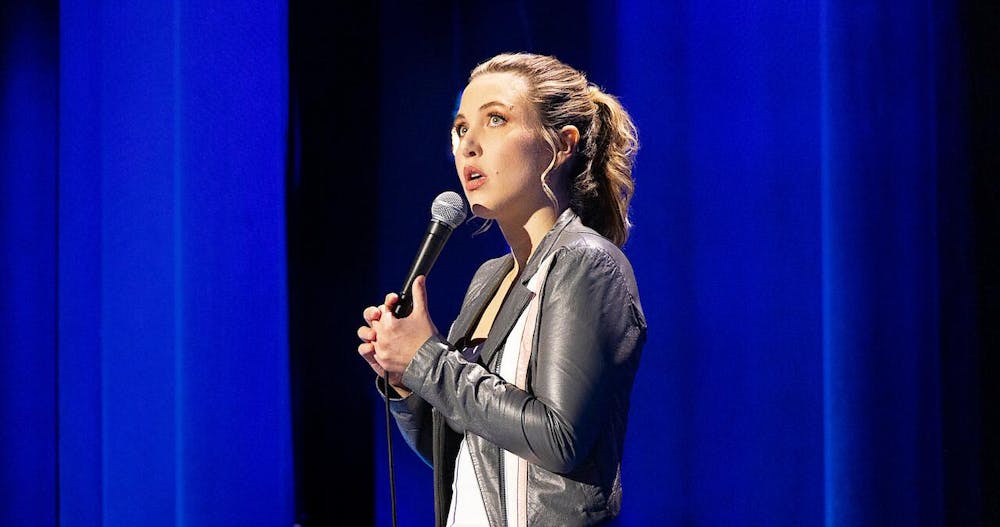
On Feb. 24, Taylor Tomlinson returned to the screen with her fourth Netflix comedy special, “Prodigal Daughter.” At first glance, the performance may just seem like another polished installment in Tomlinson’s catalog of Netflix hits — but “Prodigal Daughter” is far from predictable. Featuring a thematically cohesive narrative around the religious complexity, the special feels more intentional than its predecessors.
Tomlinson, now in her early 30s, is best known for humorously tackling deeply personal and often uncomfortable subjects. Across her career, she has explored mental health, the relatable struggles of the dating world and the liminal limbo of early adulthood, all with sharp wit.
As a queer woman raised in a conservative Christian household, Tomlinson has long incorporated religion in her material — but in “Prodigal Daughter,” it becomes the very spine of her performance.
The special opens by setting the tone with a slow-pan through a church, almost as if inviting the viewers to take a seat in the pews. The visual choices in the introduction feel calculated, and by the time Tomlinson appears on stage donning a black leather jacket, viewers have a clear idea of what’s to come.
The title — “Prodigal Daughter” — references the biblical parable of the prodigal son, though Tomlinson quickly reframes it. She argues that the renowned parable does an injustice to the prodigal son’s older brother, a detail that allows viewers to get a taste of her broader cultural critique: inherited narratives often leave someone out.
Throughout the rest of the special, Tomlinson weaves together reflections on her religious upbringing with comments on her identity. At one point, she jokes that the show contains “a lot of God stuff and a lot of gay stuff, and my agents are nervous.”
While some aspects of Tomlinson’s comedic delivery border on awkward and dry, her masterful timing, impeccable facial expressions and layered delivery redeem the dull moments in her performance. During one of her bits, she awkwardly jokes that Easter is “where all our merch is from,” while raising her hand and crossing her legs to mimic a cross.
Yet a purpose lies beneath these punchlines. “Prodigal Daughter” is not merely autobiographical — it is also confrontational. Tomlinson comments on how certain churches can weaponize guilt, transforming everyday adolescent uncertainty into existential panic.
“Because if God does exist, he does not exist to make you feel better than other people,” she argues. “He exists to make you better for people.”
Tomlinson seems intent on challenging Christian nationalism and the strict cultural rigidity that shaped her early worldview. But rather than approaching the topic with anger, she chooses to laugh at contradictions and poke fun at these painful experiences, almost as if reclaiming the narrative. Tomlinson jokes that she “started doing stand-up in churches. They called it testimony, but I was getting laughs.”
Overall, “Prodigal Daughter” is a compelling watch — though not a comfortable one. Tomlinson does not allow the audience, particularly those familiar with the faith and traditions she critiques, to remain passive.
Behind the witty, humorous lines that define the special lies a cultural tension that Tomlinson is adept at navigating — one rooted in the expectation that faith and queerness do not share the same stage.
Timothy Ro is a senior staff writer covering arts and culture.


