
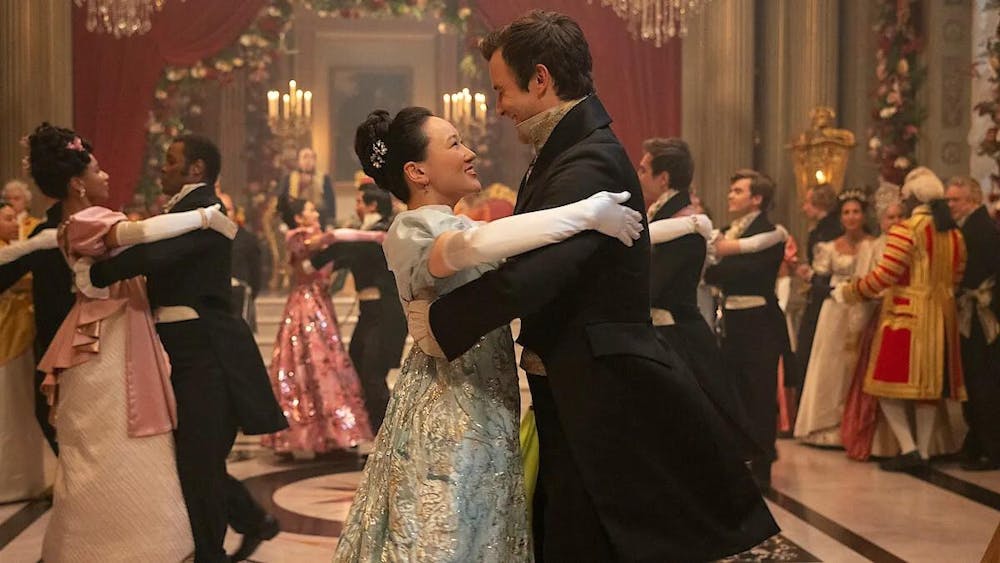
This past Thursday, Netflix released the latest installment of its hit show, “Bridgerton,” and despite a rougher start to the fourth season, the show’s creators had a relieving redemption.
The first half of the season ended with quite the cliffhanger: Benedict (Luke Thompson), swept away by a steamy stairwell hookup, asked Sophie (Yerin Ha) to be his mistress.
Reasonably, Sophie stops talking to Benedict. The plot shines in its ability to build out Sophie’s character beyond her role as Benedict’s love interest. Her endearing interactions with the Bridgerton siblings develop into what almost immediately resembles a sisterly bond with Francesca (Hannah Dodd), Eloise (Claudia Jessie) and Hyacinth (Florence Hunt).
While Benedict’s ask is frustrating and far from the show’s classic romance, it is balanced by the reason of Will Mondrich (Martins Imhangbe), who calls him out on his behavior. Will Mondrich’s wife, Alice Mondrich (Emma Naomi), also provides a refreshing respite from the Bridgerton family’s all-consuming drama. In one of the more interesting storylines, Alice attempts to find her footing in royal society as a new lady-in-waiting for Queen Charlotte (Golda Rosheuvel).
The unexciting tale of Benedict’s love is offset by his sisters’ poignant storylines. When tragedy strikes within the family, Francesca — whose marriage was one of the focal points of season three — is forced to reckon with her husband’s sudden death after he is “felled by a common headache.” Francesca and her husband, John Stirling (Victor Alli), became fan favorites within the neurodiverse community, with some viewers relating to the characters’ more introverted and reserved personalities.
But when John dies, Francesca — who prefers silence and orderliness — is left without the one person in the world who she felt truly understood her. Francesca’s actress, Hannah Dodd, brings that emotion to life. At John’s funeral, Dodd’s raw acting makes the grief feel tangible beyond the show’s use of fraught dialogue.
At times like these, the grief emanating through the screen feels genuine. Although a theme underpinning the season is that many of the characters feel unmoored, they all, slowly but surely, learn how to express their feelings. The show’s display of grief is elegant and a reminder that everyone grieves differently.
Dodd’s acting overall was almost certainly one of the highlights of the season, and of all the plotlines yet to come, Francesca’s future remains the most intriguing. Subtle moments of Francesca’s quiet affection almost seem to tease potential feelings for her late husband’s cousin, Michaela. The possibility would be a relief to fans who are still awaiting a queer happily ever after for any of the show’s principal characters.
The emotional weight of the show is made lighter with a new focus on Hyacinth as she begins preparations for her long-awaited societal debut. Her dance recital — a youthful choreography to an instrumental Charli xcx’s “360” — is one of the show’s more fun scenes. The choreography is not only perfect for the moment, but it is the perfect representation of preteenhood, a theme that is so often lost in steamy young adult romance shows.
Her interactions with her peers also provide an apt depiction of teenage awkwardness, with no one quite knowing how to behave around someone of another gender.
Hyacinth’s story is part of the show’s expansion beyond ideas of marriage. It is a step toward becoming a more well-rounded plot beyond the previous season’s heavy emphasis on sex.
Despite this attempt at complexity, the show’s weak point is its perfunctory engagement with class divides. Sophie is a lady’s maid who was born out of wedlock and thus is considered ineligible to marry into nobility.
The writers had an opportunity to break various barriers and defy social norms, but sadly, they ignore this opportunity in favor of simplicity: Sophie lies about her upbringing when she’s presented to Queen Charlotte.
It will certainly be entertaining to watch as future seasons continue to explore the hybrid regency-modern world the show is set in. The show is caught in a difficult balance between historical accuracy and meaningful representation. Time will only tell if the writers can continue to find the happy medium.

Talia LeVine is a section editor covering arts and culture. They study Political Science and Visual Art with a focus on photography. In their free time, they can be found drinking copious amounts of coffee.


