
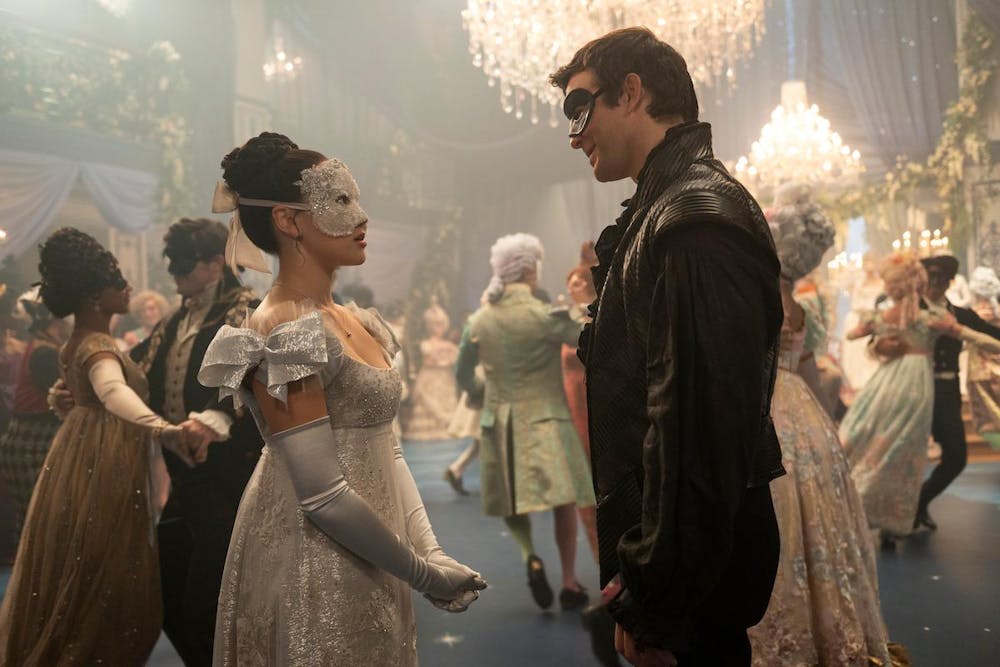
Watching the latest installment in Netflix’s hit show, “Bridgerton” viewers cannot help but be reminded — constantly — of an age-old fairytale: Cinderella. Although “Bridgerton” does not feature any carriages turning into pumpkins, the main storyline of the season is tritely reminiscent of the classic Disney film.
Season four, which has released four episodes thus far, follows the second Bridgerton brother, Benedict (Luke Thompson), as his mother urges him to find a wife and cease his “rakish” behavior — a term for sexually promiscuous men who engage in illicit behaviors like gambling and drinking to excess. Despite his older and younger brothers being happily married, Benedict shows little interest in settling down. That is, until he meets the “Lady in Silver.”
But even though their ensuing love story is the primary plot of the season, it is, at best, a lackluster attempt at romance.
The season starts with a brief reminder of Benedict’s bisexuality before shifting to his intense fascination with the anonymous woman in the silver gown with whom he dances at a masquerade ball. The lady leaves Benedict with her glove, but not her name — one of many callbacks to Cinderella's tale.
Meanwhile, viewers meet this season’s love interest: Sophie Baek (Yerin Ha), who has worked as a maid in her stepmother’s household since the death of her father. Sophie was born out of wedlock, an origin that labels her an “illegitimate” child — a fate seemingly worse than death in the eyes of the Ton, Britain’s regency-era elite.
Benedict rescues Sophie in a cliche damsel-in-distress moment, and the two begin a friendship. As Benedict continues searching for the Lady in Silver, he grows close with Sophie, not realizing she is the very woman he is seeking. While it’s evident that this is intended to be a commentary on class — how could the elegant woman he waltzed with be this humble maid? — it is instead evidence of Benedict’s unentertaining oblivion, diminishing the allure of the romance.
Even as Benedict’s character begins to show glimmers of growth, the show’s writers throw an out-of-place wrench into the romance, and Benedict once again lives up to his “rakish” reputation. Even if he seems more progressive than other men of that era, he is far from the feminist that viewers want him to be.
The show, in line with its previous seasons, features multiple well-timed instrumental covers of pop songs, such as a classical rendition of Oliva Rodrigo’s “bad idea right?” that bring a sense of 21st-century whimsy to the regency era.
But these aptly-placed covers fail to make up for the fact that the show is more repetitive than a repeat-after-me song. The writers’ room better have more original plans for the next two seasons — since it’s already been renewed for a total of six.
At the very least, hopefully the coming seasons will allow for an actual queer romance to blossom onscreen, beyond Benedict’s various sexual encounters.
Part two of the season is set to premiere Feb. 26, and with any luck it will give Sophie the happy ending she desperately deserves.

Talia LeVine is a section editor covering arts and culture. They study Political Science and Visual Art with a focus on photography. In their free time, they can be found drinking copious amounts of coffee.


