
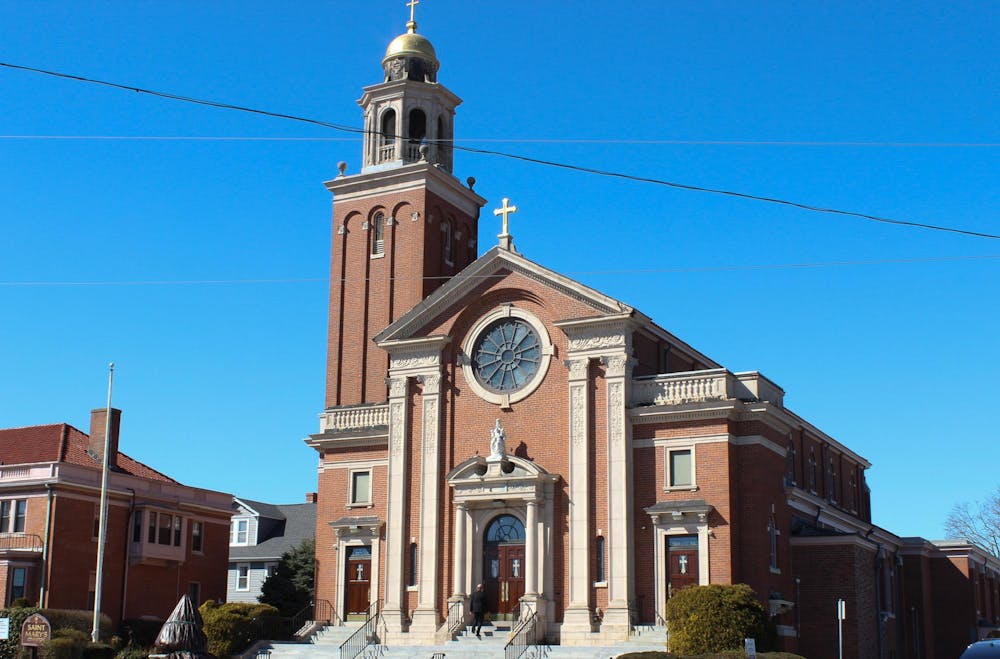
This month, R.I. Attorney General Peter Neronha P’19 P’22 released a report detailing the results of the state’s investigation into child abuse by the Diocese of Providence. Since 1950, over 300 children were abused by 75 priests. Criminal charges have been filed against four of the named clergy. The report found that the diocese systematically covered up abuse by failing to report complaints to authorities and transferring accused priests to different parishes instead of firing or reporting them. This resulted in more children being abused. It seems the prevailing mantra, at the time, was that “we must by all means avoid scandal,” as one bishop put it in 1971. In covering up child sex abuse, the entire church was complicit.
With all this public scrutiny, one might expect the diocese to emerge penitent. But their statement responding to the report was one long deflection of responsibility. They pat themselves on the back for voluntarily cooperating with the investigation, and emphasize that all the abuse occurred decades ago. “Today’s standards cannot adequately judge responses from forty years ago,” the church leaders argue, while pointing to the church’s accountability reforms from the ’90s, which it claims have been effective for its time. They criticize Neronha for presenting “this 75-year history in ways that might lead the reader to conclude these issues are an ongoing diocesan problem or that these are new revelations.” Never in its statement does the church apologize or ask for forgiveness. But in order to regain the trust of the public, the Diocese of Providence must repent.
The Bishop of Providence, Bruce Lewandowski, to his credit, does apologize. “I take this opportunity to apologize to the victim-survivors of sexual abuse by Catholic clergy for the failures of Church personnel and others in past decades to protect them and keep them safe,” he said. Yet this apology is insufficient because he made it in his personal capacity, not on behalf of the diocese. The remainder of his statement on the report toes the line between an apology and an excuse. He emphasizes that “there are no credibly accused clergy in active ministry,” that this was “in the past” and that he is “confident that (their) parishes, schools and ministries are among the safest places for children today.” Though all of this is important to share with the public, it implies that no further investigation, reform or accountability is needed and that victims should simply move on.
But the diocese has not been cooperative with the investigation and needs continued reform, according to Neronha. In a press release, Neronha said the church only partially cooperated with the investigation — they refused in-person interviews and “dragged their feet” when turning over documents. Neronha wrote that “their tendency to reflexively turn inward is part of what perpetuated this crisis, and I’m not sure if all of the lessons have been learned.” According to some reporting, this is the reason the R.I. investigation took years longer than other regions. The report also claims that many of the diocese’s modern practices are far from adequate because they lack written procedures for internal investigations, fail to prevent grooming and insist that victims submit to polygraph tests, an inaccurate and legally inadmissible intimidation tactic. The report recommends tightening oversight, both within the church and in Rhode Island law.
I am not an expert in child abuse prevention, so I cannot comment on what reforms are needed, but I know a fake apology when I see one. The church is trying to play the hero and bury responsibility in the past. Though today’s individual priests aren’t guilty of the crimes of their forefathers, institutions have a duty to account for their past sins. This is especially true for a storied institution like the Catholic Church that is proud of its nearly 2,000 years of faithful works, but acts as if abuses in the 1980s are ancient history.
The great irony is that the Catholic Church is failing to practice what it preaches. The need for repentance — owning up and changing one’s behavior — is core to the Christian faith. The Apostle John writes that “If we claim to be without sin, we deceive ourselves and the truth is not in us. If we confess our sins, he is faithful and just and will forgive us our sins and purify us from all unrighteousness. If we claim we have not sinned, we make him out to be a liar and his word is not in us.”
One of the greatest works of Catholic literature, Dante’s “Inferno,” written in the 14th century, is all about fake apologies. The epic poem is a grand tour of the Nine Circles of Hell, in which the narrator meets souls suffering poetic justice for their sins. When they tell him why they’re in Hell, their accounts deflect responsibility in subtle and creative ways, claiming that they’re the good guy and the victim, and what they did was mostly not their fault. I was reminded of the Inferno when I read the diocese’s response to the investigation.
As a Christian, when I first read this book in high school, it was — and still is — hard for me to understand how a just and loving God could send many of his children to hell. Doesn’t God have the power to save everyone? How could finite sin justify infinite suffering? The “Inferno” is fiction, not scripture, but it gave me a helpful answer. Accepting responsibility is necessary for forgiveness. To Dante, humans bring hell upon themselves by refusing to admit they’ve done anything wrong. Unfortunately, his work is a reflection of the denial and dishonesty of real leaders here on Earth.
In Christianity, God cannot forgive sins unless we confess. In the same way, the Rhode Island community’s scars cannot heal unless the church owns up to them. The diocese can do this by publicly apologizing for the sins of their predecessors. There are also opportunities for reparative action: The United States Conference of Catholic Bishops urges churches to raise awareness of sexual abuse from the pulpit instead of sweeping it under the rug. The Boston archdiocese pays for the medical care, therapy and medications of sexual abuse survivors. Providence’s diocese should do the same.
This is all the more important today because the Catholic Church is in a period of growth driven by Generation Z parishioners, who are too young to remember the first eruption of the church’s sex abuse scandal in the early 2000s. If the church doesn’t learn its lesson, it risks repeating these crimes in future generations.
As a member of the Rhode Island Christian community, I am ashamed of the diocese. I apologize for sexual abuse and coverups, perpetrated by churches of all denominations in both the past and present, and I promise to be part of the solution. On behalf of the church, I ask for forgiveness from survivors, the families of survivors, those who have lost faith as a result of church abuses and God.
I pray that the Diocese of Providence does the same.
Evan Tao ’27 can be reached at evan_tao@brown.edu. Please send responses to this column to letters@browndailyherald.com and other opinions to opinions@browndailyherald.com.


