
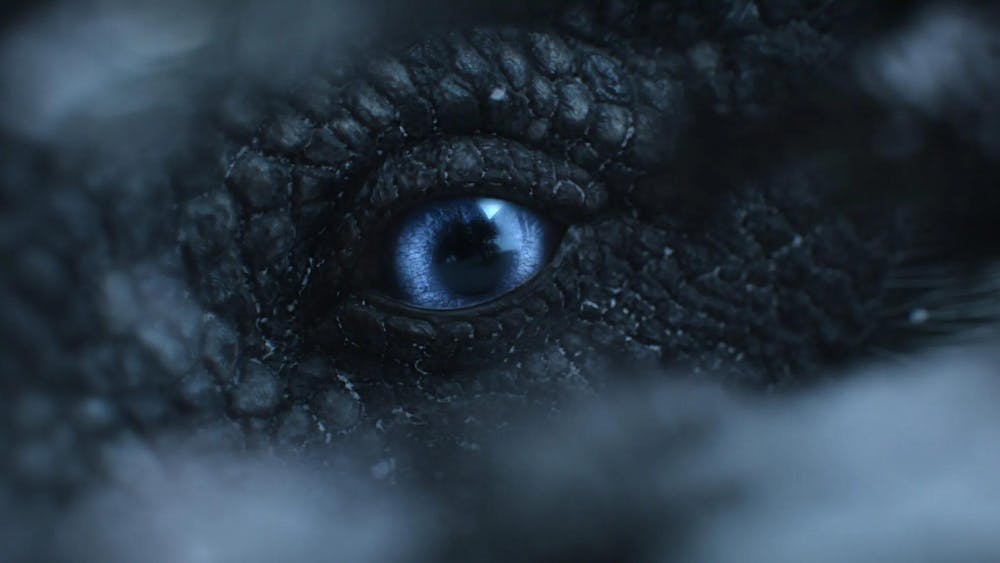
Over three decades after Steven Spielberg directed the classic adventure movie “Jurassic Park,” he’s still not done with dinosaurs. Netflix released Spielberg’s “The Dinosaurs” last Friday, a docuseries following the rise and fall of the dinosaurs during the Mesozoic era. With Spielberg’s impeccable production and Morgan Freeman’s fluid narration, it’s no surprise that the series has received critical acclaim.
The first episode opens on a thick-skulled Pachycephalosaurus looking for its family in a herd of herbivores. After finding its relatives, the dinosaur smashes heads with a rival in an intense battle for dominion. While it may seem like the creature is about to lose, it’s saved by the bell when a Tyrannosaurus rex suddenly pounces on its rival.
Throughout both this scene and the series in its entirety, the breathtaking landscapes are complemented by CGI so realistic that one might wonder how Spielberg resurrected the beasts.
With the combined sounds of Lorne Balfe’s thunderous orchestral music, loud dinosaur screeches and Freeman’s smooth and calming narration, the science docuseries feel more like a docudrama. From the birth of the first Marasuchus to the asteroid that ends it all, the series is rife with spectacle. In fact, the jump scares and dramatic sequences may be too flashy for someone looking for an objective, scientific documentation of dinosaur evolution.
Later in the series, viewers are left on the edge of their seats after a confrontation between the grotesque, long-necked pterosaur Hatzegopteryx and the endearing dwarf sauropod Magyarosaurus. Spielberg stages the sequence almost like an action-movie chase, and the lost Magyarosaurus ultimately finds safety in a nearby cave. But, when one of his comrades cautiously looks outside, the Hatzegopteryx returns with a sudden and shocking strike.
Alongside these action scenes, the series portrays the long history of dinosaur life on Earth, starting with fledgling and helpless dinosaur species roaming the supercontinent of Pangea. While the larger reptiles of this period are able to overpower these early dinosaurs, viewers know that in 10 or 20 million years, these small critters will evolve into fearsome giants. Freeman’s narration adds an especially grand and cinematic element to the retelling of this history.
While thoroughly interesting, the docuseries’s favoring of flair over detail may alienate more “expert” audiences who already know the basic facts of the dinosaur age. Nonetheless, there is still enough vivid imagery of the Mesozoic ecosystems to entertain even the most dedicated dinosaur enthusiasts.
Throughout the series, Freeman highlighted a common factor seen throughout the rise and fall of every species: climate patterns. At the end of a Triassic period, global warming and volcanic eruptions ultimately led to the extinction of about 75-80% of all marine and terrestrial species. On the other hand, the cooling period that occurred over a hundred million years later was responsible for the rise of the T. rex’s ancestors and the fall of countless others.
The continually changing landscapes are masterfully rendered, and the stunning visuals and weather effects are a beautiful addition to the series. Most of the time, the Mesozoic world appears similar to today — with forests, beaches, oceans and tundras covering the Earth. After intense periods of environmental change, though, the Mesozoic world was rendered desolate with only endless snow or endless desert.
Although the dinosaurs and their Mesozoic compatriots were helpless against the environmental forces that doomed them, their story poses an important reminder for viewers today: While the dinosaurs were helpless, humanity is not — and there is still a chance to combat climate change before it is too late.
Any nature docuseries would have a hard time standing out in Netflix’s myriad of award-winning documentaries. But with Spielberg’s direction and Morgan Freeman’s narration, “The Dinosaurs” makes it hard not to become emotionally invested in these ancient creatures.


