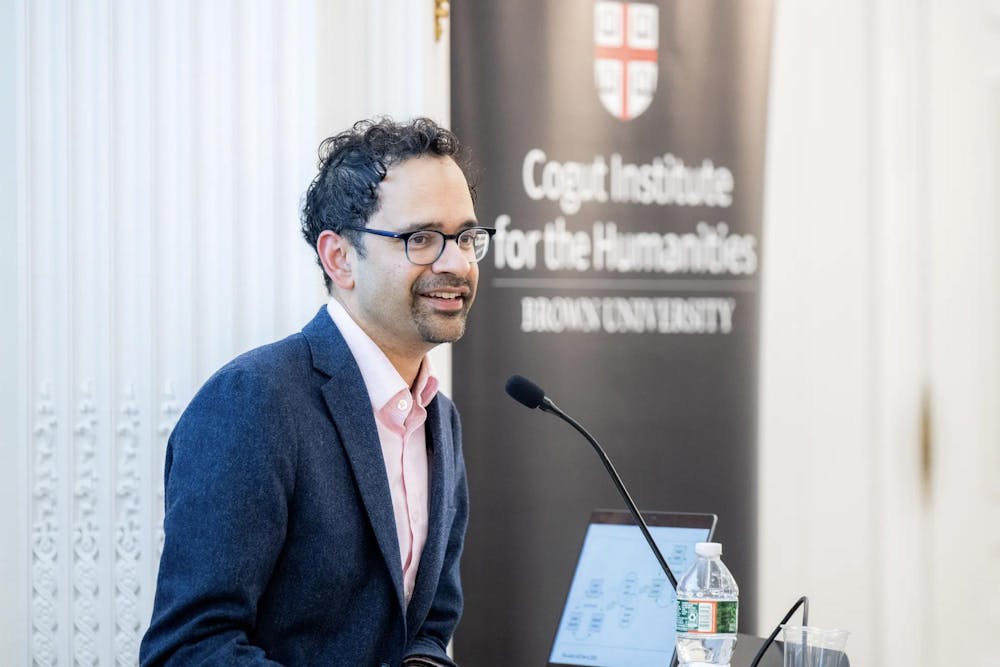
In his Wednesday talk titled “How Violence Drives the Planetary Crisis,” Yale History Professor Sunil Amrith identified armed violence as a unifying thread across the three aspects of the triple planetary crisis: climate change, biodiversity loss and the pollution crisis.
The event was hosted by the Cogut Institute for the Humanities as part of the Flynn Speaker Series, the Cogut Institute’s “flagship series,” according to Gregory Kimbrell, the institute’s communications manager. The organization brings speakers to Brown based on student and faculty suggestions.
With the “appalling acts of violence” on Dec. 13 at Brown and the ongoing war in Iran, Amrith was initially hesitant about discussing such a heavy topic, which he decided on prior to December, he said.
“But I share these thoughts today with the conviction that this is an important moment to think about the relationship between armed violence and environmental crisis, and in the hope that taking a long historical view will provide at least a little distance from the immediacy of the horror all around us and perhaps even some parts forward” he said.
The “triple planetary crisis,” a term used by the United Nations Environment Programme, describes diminishing biodiversity, the rapid acceleration of climate change and extreme pollution, Amrith said. But these three factors are “kept separate in public discussion,” he noted. Often, policy only factors in climate change.
But Amrith asserted in his lecture that the three factors work together, and the connecting thread is armed violence.
Amrith cited this decade’s wars in Gaza, Ukraine, Sudan, Myanmar and Iran as contributors to global warming, noting how warfare destroys animal habitats and produces large amounts of toxic waste and emissions.
Between 5% and 6% of total emissions in the world can be attributed to military emissions, but initiatives like the UN Convention on Biological Diversity do not include armed conflict as an environmental threat, he said.
One “obvious” reason for this omission, Amrith hypothesized, is that powerful arms exporters have “actively excluded” militarism from global discussions about the environmental crisis. But even further, Amrith aimed to unpack how warfare has been rendered “more invisible” through historical narratives as a contributor to the planetary crisis.
Citing multiple historians, Amrith explained how the Industrial Revolution in the 19th century was a turning point in environmental destruction, and “arms were at the heart of it.”
“Many of the processes and technologies that underpin the deepening human impact on earth systems had military origins, and … armed violence was essential to their unfolding across the globe,” he said.
The role firearms have played in the demolition of the environment is also particularly marked, Amrith pointed out.
“The total extermination of bison from the American West in a matter of a few decades is only the most visible manifestation of a process that unfolded around the world, from the forests of India to the slaughterhouses of Chicago,” he said. New technologies create a sense of “human exceptionalism,” Amrith said, creating a “sense that earthly constraints no longer applied to human beings.”
Amrith explained that mechanized warfare in the first half of the 20th century — especially in World Wars I and II — exacerbated environmental and human destruction to an even more extreme degree.
Amrith also discussed the naturalization of war, which has been portrayed to seem “so sudden and so far beyond anyone’s control that only the metaphor of a natural disaster could capture its force.” The atomic bombings of Hiroshima and Nagasaki are examples of how destruction “was quickly naturalized as a form of weapon,” he said.
Amrith also put forth potential paths toward repairing violence and the planetary crisis. Establishing more comprehensive data on war-related emissions and treating environmental harm as a public health issue are two possible steps forward.
“It’s useful to begin by asking the question of ‘What is broken, and when, and by whom?’ before we can then start to imagine what repair might look like,” Amrith said. “In most of the work in political theory, repair is also about repairing moral relationships.”
For Amanda Macedo Macedo GS, a Ph.D. candidate in theatre arts and performance studies, the talk gave her new insights on “thinking about the fragmentation and the damage” of the planet as “a victim of human conflict.”
Diana Buendia GS, a third-year Ph.D. candidate studying environmental history, attended the event because of Amrith’s reputation as a “renowned scholar of climate and environmental history.”
Third-year Ph.D. student in history Ria Modak GS said she first met Amrith when she took his class on global South Asian history as an undergraduate at Harvard.
“It’s been really wonderful to follow his work … and the way that he’s brought that method and discipline in the field to much broader questions about environmentalism and anti colonization,” Modak said.
Amrith’s work “is radically interdisciplinary, collapsing distinctions between and bringing together history, environmental science, political economy, migration studies, geography and public health,” Prerna Singh — Associate Professor of Political Science and International and Public Affairs and of Behavioral and Social Sciences — said in the lecture’s introduction.
Elizabeth Rosenbaum is a senior staff writer covering science and research.