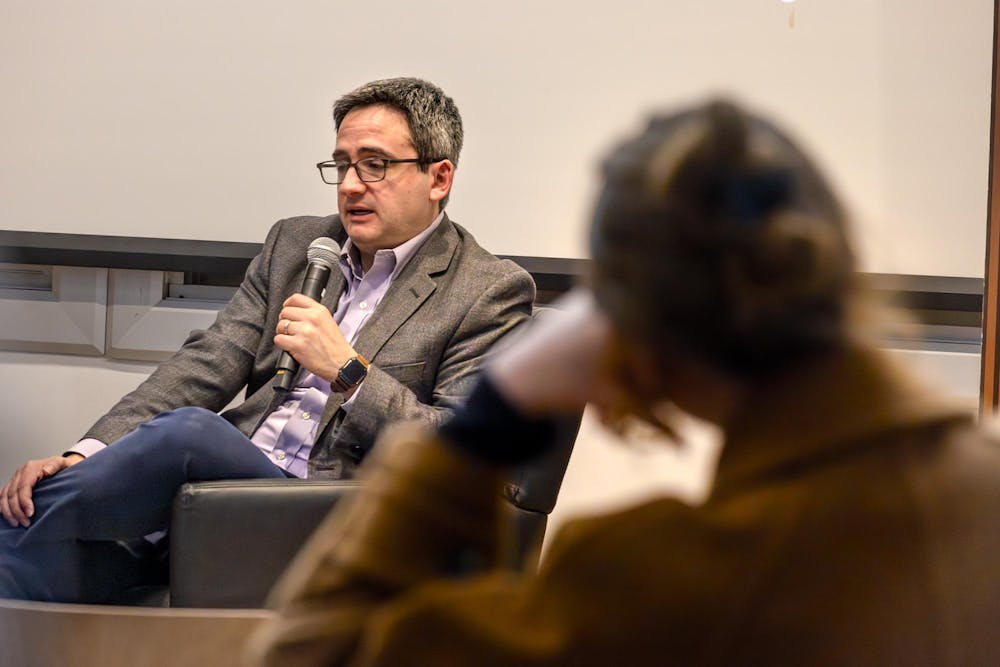
On Monday, the Brown Political Union hosted Oren Cass, founder and chief economist of conservative think tank American Compass, for a conversation about the Trump administration’s tariffs on foreign goods.
While attending Harvard Law School, Cass served as the Domestic Policy Director of former Massachusetts Governor Mitt Romney’s 2012 presidential campaign. Cass is also the author of “The Once and Future Worker: A Vision for the Renewal of Work in America” and served as a senior fellow at the Manhattan Institute before starting American Compass in 2020.
Prior to the event, The Herald sat down with Cass to learn more about his perspective on the future of U.S. foreign economic policy and higher education.
Cass expressed support for the tariffs levied by the Trump administration last year. “The U.S. has a commanding position because we are the market everybody wants to sell to,” Cass told The Herald.
In his conversation with The Herald, Cass dismissed widespread worries that increased U.S. tariffs will incite other countries to retaliate. He also claimed that many countries, including South Korea, Japan and Taiwan “are prepared to agree to new (trade) terms that are much more favorable to the United States.”
When asked by The Herald about the future of U.S. trade, Cass predicted that tariffs will continue to be a part of the long-term national policy since they create revenue for the government.
Since tariffs create revenue for the government, Cass said, “anyone who shows up and says, ‘I want to get rid of the tariffs,’ is going to either have to explain what taxes they’re going to raise instead, or what programs they’re going to cut.”
During the BPU conversation, Atman Shah ’28, the event’s moderator and BPU vice president, claimed that studies show that “96% of the burden of these tariffs has been placed upon the American workers.” He asked Cass if he saw these costs as necessary in the short-term.
Cass said he believes that next year, the tariffs will cause inflation to fall. “It’s not inflation in the sense of a spiraling rise,” Cass said. He also disagreed with Shah’s statistics. “The studies don’t say 96% (of tariffs) land on American workers. They, at best, say they’re landing on consumers or a similar population. But most of the estimates are somewhat lower than that,” he said.
Cass’ economic stances evolved over the course of his career as he developed a keen interest in, what he described to The Herald as, “areas where there was an orthodoxy that wasn’t being questioned, not because it was such a great orthodoxy, but because no one thought they should question it.”
Cass pointed to national trade policies with China as one of these areas. In 2011, it was generally accepted that “the more you can trade, the more prosperous everybody will be,” Cass said, even though “over a decade, massive offshoring to China had decimated American manufacturing communities.”
“There was virtually nobody looking at that issue or taking it seriously or analyzing it,” Cass said, not because economists had “thought it through,” but “because they were relying on some very basic and outdated assumptions.”
Manufacturing, Cass said at the BPU event, “represents one of the most important things that a community can actually produce for the rest of the world.” He highlighted its importance in national security, maintaining “engineering talent” and producing U.S. jobs.
When asked by The Herald about his thoughts on the current state of higher education, Cass said the United States needs to “dramatically cut down on what we do give in support of colleges because the reality is that a huge share of the spending in higher education has nothing to do with actually providing a good start in life to people.”
“We operate colleges the way we do, especially at the high end, with what I would call, an amusement park entitlement,” Cass added.
In Europe, “whether you’re going to college or not, you sort of are similarly situated in a lot of ways,” Cass said. He suggested that the United States could foster a similar system by providing financial incentives for people pursuing trade pathways.
Cass touched on the intersection between higher education and his vision for the future of the U.S. economy.
“I worry when I see a large share of college students … look at the problems in the political systems and blame that on somebody else,” he told The Herald. “It is going to be their responsibility to help figure out how to solve the problem and actually create a system that frankly works a little bit less well for themselves, but better for everybody else.”
Noa Saviano is a senior staff writer covering Graduate Schools and Students. She is a freshman from New York City and plans on concentrating in Comparative Literature and Cognitive Science.