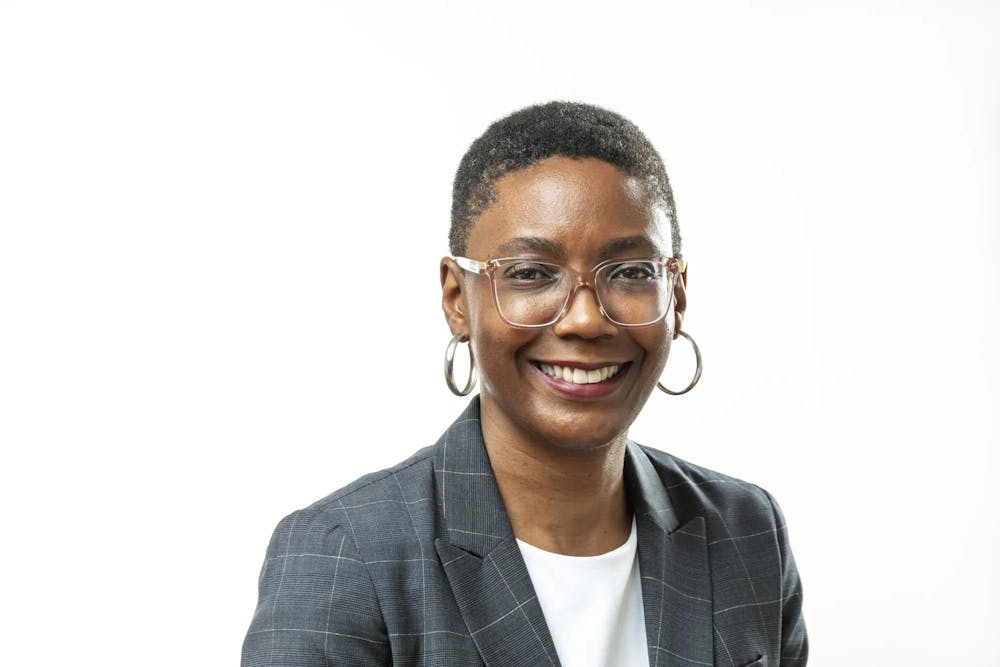
Later this month, Itohan Osayimwese, chair of the Department of History of Art and Architecture and a professor of urban studies, will begin her role as vice president of the Society of Architectural Historians. She will hold this position for two years before assuming the presidency in 2028.
The Society of Architectural Historians is a “major organization for the discipline,” Osayimwese said, noting that the society serves as a hub for collaboration between scholars and is important for training graduate students.
Osayimwese will be the society’s first president elected in a “member-driven election,” she said. Previously, the president was nominated by the organization’s board of directors.
One of Osayimwese’s goals during her tenure as president is to form a committee that will explore ways to strengthen the discipline and expand career opportunities for graduate students in the field. She also wants to reflect on architectural history curriculum and “make it more relevant to society,” she said in an interview with The Herald.
Osayimwese’s current research at Brown is focused on the restitution of African art from European and U.S. museums. Her 2025 book, “Africa’s Buildings: Architecture and the Displacement of Cultural Heritage,” specifically explores the violent methods colonial officials and collectors employed when collecting architectural objects, and how these objects’ practical functions were erased when they were categorized as decorative.
“My contribution is to help people understand that some of what we talk about as African art are actually parts of buildings, like structural columns,” Osayimwese explained. The structural columns are “beautiful works of art,” but they also “actually hold up buildings,” she added.
These pieces of architecture were removed from Africa during the colonial period, according to Osayimwese. As the “illicit trafficking of works of art and architecture has continued right up to the present,” these valuable works are being traded outside of their countries of origin, she said. Some of these architectural elements can be found in major museums across the United States, Osayimwese added.
Osayimwese’s research also investigates “what happened to the building when these important parts were removed,” she said.
Osayimwese has taught courses at Brown related to her research, such as HIAA 0770: “Architecture and Urbanism of Africa.” For the course’s final project, students examined museums to determine how these institutions acquired African architectural objects, she said. Some of that student work made its way into her 2025 book.
History of Art and Architecture Ph.D. candidate Yannick Etoundi GS has worked closely with Osayimwese as an advisor since he began his Ph.D. in 2021.
Etoundi, a member of the Society of Architectural Historians, said that Osayimwese has always been very “active” in attending events and helping graduate students navigate the field.
He emphasized that Osayimwese prioritizes “professionalization,” encouraging graduate students to publish papers and think about how they can show the work they’ve done. This shapes a student to be an “expert” in the discipline, Etoundi said.
“Art history can sometimes be a bit Western-centric,” but Osayimwese looks beyond the Western perspective in her work, Etoundi said. She “definitely brings that to the work she does, and I think (she) will be good in a leadership role like this,” he added.
When Assistant Professor of History of Art and Architecture Gretel Rodríguez arrived at Brown in 2018, she and Osayimwese became close friends. “From day one, she became a mentor and someone to whom I came regularly for advice and just to share a fun conversation,” Rodríguez wrote in an email to The Herald.
“I am certain that, in (Osayimwese’s) new role as vice president, she will use that platform not only to further the mission of the Society of Architectural Historians but also to increase equality and access in what can be perceived as a rather exclusive corner of the academic world,” Rodríguez added.
Elizabeth Rosenbaum is a senior staff writer covering science and research.