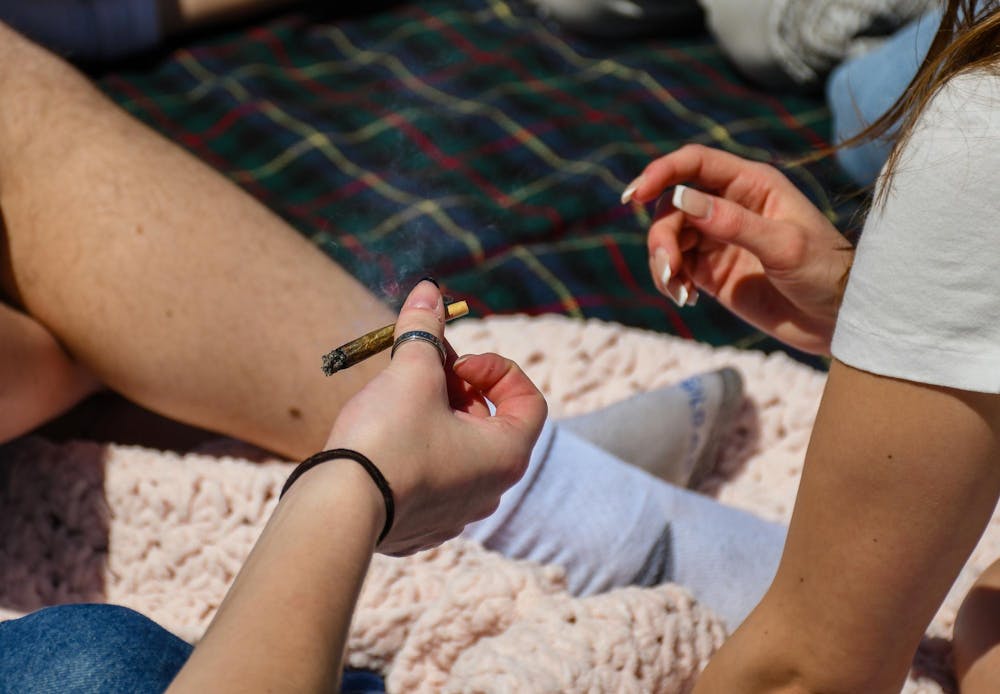
As winter turns to spring on College Hill and trees begin to bud, Brown’s campus is getting greener in more ways than one. This coming Monday, passersby may see a bit of a haze as they cross the Main Green as they witness the annual April 20 student tradition.
Especially among college students, it is widely believed that while cannabis users can become dependent on the drug, marijuana is not addictive in the same way that other intoxicating substances are.
To find out the truth about the impacts of regular cannabis use, The Herald spoke with Jane Metrik, a professor of behavioral and social sciences and of psychiatry and human behavior, who studies cannabis use. Her response: “The short answer is that it is quite addictive.”
According to Metrik, cannabis use disorder is a diagnosis in the most recent edition of the Diagnostic and Statistical Manual of Mental Disorders, also known as the DSM-5. People who develop a dependence on cannabis can show the same 11 symptoms that are used to identify addiction across all addictive substances, she added.
“What I think is so different about cannabis is that those consequences are maybe more subtle,” she said.
Multiple Brown students have also been exposed to the idea that cannabis is not addictive.
Anika Mahns ’26 believes cannabis “can be addictive, but not in the typical way,” categorizing it as more of a “social dependency.”
Anie Udobong ’26 said she also doesn’t believe that cannabis is addictive in the same way as other drugs. In Udobong’s view, those who choose to use cannabis “won’t completely be safe” from developing withdrawal symptoms or other physical repercussions. But it "manifests a bit differently from other drugs."
Misconceptions about cannabis’s addictiveness arise not only from the drug’s externally subtle effects but also from its relatively low risk of fatality, Metrik said. “There’s, for example, not a high incidence of cannabis-related deaths the way that we see from alcohol or the way we see from opiates,” she said. “There’s not a lethal dose of cannabis.”
Cannabis use is on the rise, and as it increases, so too does cannabis use disorder. Metrik said that national data from the Substance Abuse and Mental Health Services Administration found that “about 23% of U.S. adults used cannabis” in the past year, with about a third of users meeting criteria for cannabis use disorder. In order “to meet the lowest threshold for a mild substance use disorder, you only need to meet criteria of two out of 11 symptoms,” she added.
According to Metrik, cannabis has become a more potent drug in recent years, so the belief that it may not be very addictive could be “because historically, it’s been a less potent drug compared to what we have now.”
Brown students’ intuitions echoed Metrik’s sentiment that safe recreational cannabis use requires users to be mindful about frequency, environment and method of ingestion.
Mahns said she thinks different mediums of cannabis use can “for sure” influence the chances of addiction. “If you have a pen (or even) a bong, the more you own, the more you use it.”
Bogomil Kissiov ’28 argued that safe and responsible cannabis use is possible if such use is “infrequent and very deliberate.”
Udobong also said that students should be intentional with their use, emphasizing that those smoking for the first time should do so with people they trust and be mindful of the form and strain of the cannabis they are consuming.
Metrik — who considers “harm reduction” in her background as a licensed clinical psychologist — said that students should avoid daily use of cannabis and stay away from cannabis products with high concentrations of tetrahydrocannabinol, more commonly known as THC. She also said that those using cannabis for the first time should avoid edibles because it is harder to gradually control the amount ingested.
“Once you got it, it’s in the system, and you’re stuck with it,” she said.
With April 20 on the horizon, Metrik hopes that students think about their safety and “listen to some of this messaging to reduce some of the risks associated with cannabis use.”