
Before Dec. 13, Coffee Exchange was just another busy cafe near Brown’s campus. But when an active shooter sent the University into a 13-hour lockdown, what used to be the place where students grabbed their lattes turned into a site of refuge. Thirty students sheltered there for hours, welcomed by employees who kept the shop’s doors open long after closing. That image of students huddled together, protected by a community beyond Brown’s gates, remains with many of us. Like so many other Providence businesses, Coffee Exchange kept us safe.
When the Undergraduate Council of Students opened a mutual aid form, thousands of offers to help with rides, places to stay and funding poured in from alums and Providence community members. As UCS leaders and volunteers, we watched those offers come in, since we were part of a group of students responsible for matching those who needed help with those who were offering it. It gave us so much hope to see how many people in our community were there to support us. In our hour of need, Providence kept us safe.
Despite the University’s extractive history within the city, Providence backed Brown students when they were hurting. And yet, in the rush to secure campus, Brown sidelined the community bonds that kept students safe by implementing security measures that make campus inaccessible for our Providence neighbors. As Brown tightens its security policy, we cannot forget the importance of supportive community ties, both within and outside the Van Wickle Gates.
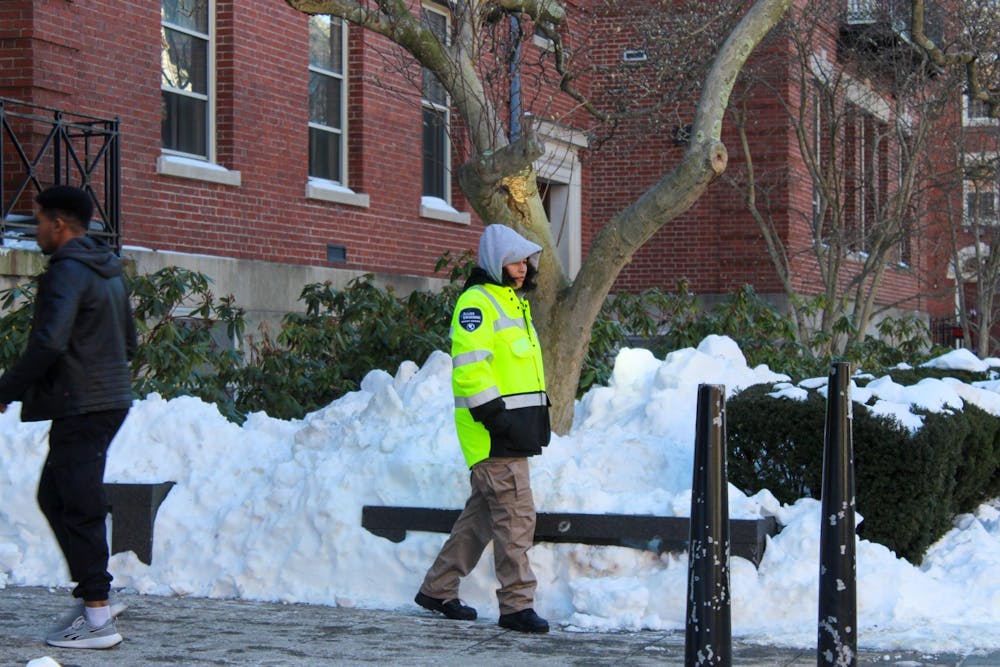
Before the start of the spring semester, Brown increased both security personnel and video surveillance on campus. When we walk across campus, it feels like a fortress that has sealed itself shut — every building now requires a Brown ID for entry. There are security personnel on every corner. Every cop car and locked building is a reminder of how our campus was torn apart.
Before these changes, Brown’s campus functioned as a semi-public space: Providence residents could use Brown University Library spaces for in-person research access and access spaces like the Brown Design Workshop. Many of these opportunities were explicitly open to the public, reflecting Brown’s long-standing framing of itself as a hub for public scholarship and community engagement. But the increased security measures have created an additional barrier for the public to access University resources. Our University’s mission statement begins with “to serve the community, the nation and the world.” Yet, we betray this mission when we create barriers for the public to be physically integrated with the campus community.
In a 2024 Herald article, former BDW monitor Angela Baek ’24 emphasized how the BDW “welcome(s) everyone and really want(s) to build a community of makers.” The article emphasizes that the community was central to the BDW’s very ethos, as one of their primary aims was “to increase engagement with the greater Providence community.”
This commitment is reflective of a broader institutional posture, where Brown is positioned as a porous campus embedded within Providence. Brown wants knowledge-making and community engagement to be mutually constitutive rather than bounded by gates or credentials. Yet, in the current moment, this vision of expanding access has eviscerated, and those same community members have since been walled out. When spaces like the BDW become inaccessible, they signal a contraction of that larger civic relationship and foreclose trust between the University and the communities it claims to serve.
Matthew Kraft, professor of education and economics, told the New York Times that the University’s increased security measures “come with real costs” to community “relationships and openness.” Research conducted by Cheryl Lero Jonson, the chair of and a professor in the department of criminal justice at Xavier University, on these measures further validates these concerns. Her work concluded that access control policies — such as limiting building entry by requiring ID swipes — do not reliably prevent shooters from entering. Intruders may possess valid access or force their way in. The former was the case in shootings at Virginia Tech and Columbine; the latter at Sandy Hook. The research also notes that an increased law enforcement presence can heighten fear rather than alleviate it. If these measures neither guarantee safety nor foster a sense of security, then their tradeoffs become even more costly — especially when they come at the expense of the community networks that have already proven to be necessary to our safety.
We are not arguing that the University should not provide measures to protect its students. We do not dispute that visible security measures make some people feel safe. But we believe that the measures Brown is implementing cannot guarantee us protection from gun violence. Instead, they color the semester with a rouge of fear and suspicion. As the University works towards strengthening campus safety through its ongoing review, it must ensure that the voices it gathers are representative of local community members, capturing the sense of care that has long defined what Brown hopes to be.
For us, the shooting redefined our understanding of safety. More than just the absence of harm, safety means community care, mutual aid, accessibility and trust. It means warm lattes, open cafes and neighbors who open their doors to those in need. It means the presence of people who refuse to leave one another behind.
Brown must continue to welcome all members of its broader community. This includes the Providence residents who consistently remain Ever True to the beautiful Brown we know and love. These people keep us safe, and we can’t imagine our Brown without them.
Raya Gupta ’29 and Kenneth Kalu ’27 were volunteers for the Undergraduate Council of Students mutual aid form and serve as leaders of Brown Rise Up. Alexa Theodoropoulos ’27 is the UCS Treasurer and worked on the UCS mutual aid form and ran other UCS initiatives following Dec. 13. They can be reached at raya_gupta@brown.edu, kenneth_kalu@brown.edu and alexa_theodoropoulos@brown.edu.


