
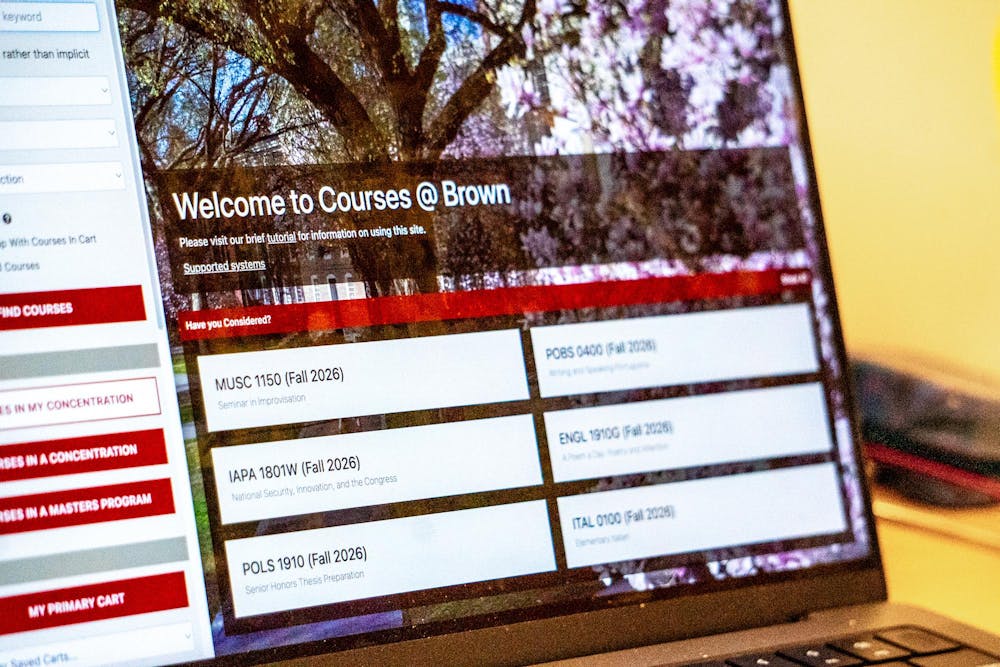
With pre-registration around the corner, I’ve turned to Courses@Brown to plan my schedule for the fall. While many courses have clear, precise and direct names, there are plenty of others with odd titles. While these unclearly titled courses are a minority, they matter. Brown challenges students to be the architects of their education but course titles with specific references that only make sense to concentrators can make it easy to stick with what is comfortable. Further, students might not take unclearly named courses out of a fear of how they may appear on transcripts or resumes. To help alleviate these issues, Brown should implement stricter guidelines for course titles.
These guidelines should not be overbearing. After all, good course titles are interesting. Instead, the guidelines should require that course titles accurately reflect the contents of the class and are readable even to someone without extensive background knowledge of the topic. Ideally, this is a list of major themes, a period of study or even a few of the writers being studied. For a good example of this style of title, I turn to ASYR 1020: “Alien Writing: Invented Scripts from Demons to Dune.” In this example, the course starts with a vague phrase — Alien Writing — and then immediately explains what it means in the context of the course. Before this clarification, the phrase could be interpreted in many differing ways — perhaps the class focused on texts which feel alien to the reader, or on science fiction as a genre. After the clarification, potential students understand that it is an analysis of alien languages within their respective fictional works, and they even have an idea of some of the assigned readings too!
On the other hand, ENGL 0202X: “‘I’m not hysterical, I’m homicidal!’: The Monstrous Feminine” fails to communicate much to a potential student. After reading this, I am left with more questions than answers. What exactly is the dichotomy in the exclamation? And in what sense is femininity being positioned as monstrous? The class title fails to answer these questions. Ultimately, the only way to resolve this was to consult the course description, which informed me that the course is focused on literal monsters.
When a course title necessitates that a student check the course description to understand what it is about, the Open Curriculum becomes much less accessible. With over 1,400 courses to explore, it is infeasible to expect students to read the course description for every class they might think about taking. In increasing the amount of effort required to find classes, professors are indirectly discouraging students from exploring their courses, which may lie outside of prospective students’ comfort zones. Someone who has already taken many classes in the Department of English — and as such might already be familiar with Barbara Creed’s “The Monstrous-Feminine” — might intuitively have a better understanding of what ENGL 0202X is about from the title but a student studying engineering might be confused. Imprecision in course titles makes it harder to uphold the spirit of free inquiry that Brown seeks to encourage.
Furthermore, courses with unclear titles make it difficult for students to reference them when searching for jobs. When evaluating relevant coursework on a resume, employers are attempting to gauge how courses might prepare a candidate for success. When courses are so vague that potential students — who are already immersed in Brown’s academic environment — cannot decipher their relevance, future employers will surely struggle too.
Course titles should also be serious. This would not, however, necessitate that all courses sound bland. Many current courses on C@B strike the right balance between being interesting, serious and descriptive. For example, GRMN 1321E: “Classicism and its Discontents: Goethe and Kleist” contains a fun allusion to Freud’s famous “Civilization and its Discontents” but still manages to remain firmly grounded within its themes.
Further, courses should avoid including explicit jokes, actively provocative statements or unserious-sounding hypotheticals in their titles. For an example of this latter offense, I present EEPS 0100: “Surviving the Apocalypse: Earth’s Journey Through Natural Disasters Past and Present.” While the information after the colon does a somewhat decent job of outlining what will be studied in the course, the phrase “Surviving the Apocalypse” adds an air of levity to an otherwise rigorous course. It brings to mind images of zombie outbreaks and action movies, not a rigorous course on natural disasters throughout earthly history.
A rigorous course title is especially necessary for courses that are important for the graduate school application process. Unserious titles do not convey the rigor or content of the courses students take, and do not provide an accurate representation of what students have actually learned. When reading the title of a course such as EEPS 0100, it doesn’t seem to be particularly challenging. This could be particularly disadvantageous if a student were applying to an environmental science Ph.D. program or any other science-heavy field. Those reading their application may feel as though the student was not fully challenging themselves through their studies. In a situation like this, students might feel that taking these courses is a waste of credit.
For the sake of both the spirit of the Open Curriculum and the students taking advantage of it, Brown should institute a stronger set of requirements and guidelines for course title creation. Professors and students at Brown take their pursuits seriously, so the names of our courses should be held to a similar standard of excellence.
Avery Kaak ’29 can be reached at avery_kaak@brown.edu. Please send responses to this column to letters@browndailyherald.com and other opinions to opinions@browndailyherald.com.
Avery Kaak is a columnist for the Brown Daily Herald. He is from Orlando, Florida and is planning on concentrating in philosophy. In his free time he enjoys reading and running.


