
On top of my four classes, recently I feel as though I am enrolled in an invisible fifth class, BRWN 0010: “Scrolling Through Courses@Brown.” The only assignment in this class is to pick the most exciting, perhaps concentration-fulfilling fall courses available. To complete this assignment, I consider the required readings, the number of problem sets assigned and whether I want to drag myself to an 8:30 a.m. lecture three days a week. But, during this pre-registration period, I have adopted another metric to evaluate courses: whether or not they offer field trips.
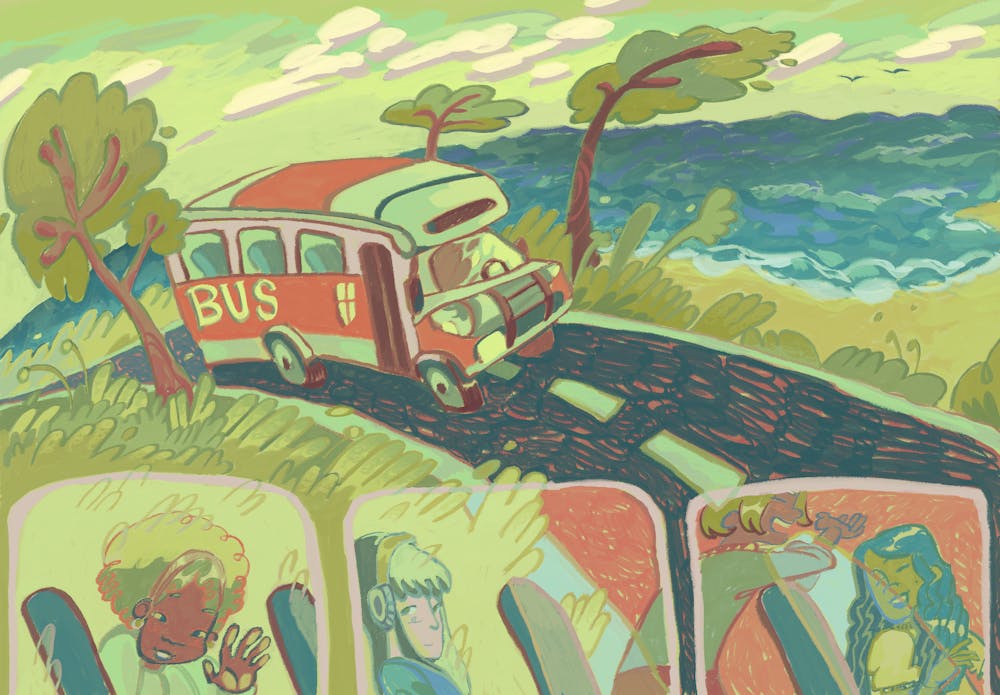
In my two semesters on College Hill, some of my most enriching learning experiences have occurred outside of the classroom. Though field trips are often associated with the natural sciences, K-12 curricula and the cartoon “The Magic School Bus,” they offer unique opportunities for academic engagement that can benefit students across departments and courses. To supplement in-class learning, more courses at Brown should integrate field trips into their curricula.
Courses in the Department of Earth, Environmental and Planetary Sciences provide a great model for this kind of education. “Hands-on learning” is central to the department’s ethos, and field trips are common within its courses. I took the department’s introductory course, EEPS 0220: “Earth and Environmental Processes,” last fall, and found myself scrambling over rock formations with my classmates on a pleasantly warm fall day in Newport, Rhode Island. With my clipboard in hand, I began to make connections to concepts that I learned in class. Before the trip, I struggled to understand sediment deposition and quartz formation within a textbook or lecture, but these concepts made much more sense when I could see quartz layered within the rocky outcroppings across from the Cliff Walk’s famous mansions.
This expedition is a perfect illustration of how field trips can help students practice class content in the real world. On this trip, every student was expected to take notes and draw on weeks of lecture learning to explain how the various rock groups may have formed. Beyond just learning class subject matter, taking students beyond campus builds collaborative skills that cannot be practiced when students have to quietly sit in rows listening to lectures.
Many other academic departments also integrate exciting fieldwork into their curricula, but these experiences are often few and far between. Still, classes like URBN 0230: “Urban Life in Providence: An Introduction”— which uses Providence as a “first-hand case study” — and BIOL 0940D: “Rhode Island Flora: Understanding and Documenting Local Plant Diversity” — where students learn how to identify local flora — offer examples of how field trips can be successfully interwoven across class curricula. Expanding their implementation in more classes would offer students a richer education.
When it comes to these traditional field trips, the University ought to ensure that professors have adequate funding to provide such opportunities for students. While DEEPS sponsors an annual fall camping trip and a weeklong spring break field trip, departments that may not have access to the same funds shouldn’t be limited from planning similar excursions. Currently, the University offers Salomon Curricular Mini-Grants and Community-Based Learning and Research Course Mini-Grants of up to $500 to support class expenses for an engaged course, but this may also include honoraria for guest speakers, class supplies and even printing, leaving less room to budget in field trips. If the University is able to supply funding for global trips through Global Experiential Learning and Teaching grants, they should also fund grants for courses that want to incorporate local field trips.
Certainly, not every field trip needs funding. Courses can offer solo experiential learning options that not only provide a cost effective alternative, but also allow large classes to participate in this development. A student might, for instance, be required to visit the Rhode Island School of Design museum and write about an artifact on display or collect survey data at the Providence Place Mall. These kinds of learning experiences are currently underutilized by professors at Brown.
There is fieldwork for every area of study. If Brown truly wishes to prepare students to “discharge the offices of life with usefulness and reputation,” then more classes should offer experiences that allow students to apply their learning to the real world. In this way, field trips offer students a more well-rounded, robust education — sending students on a yellow bus and packing a sandwich is encouraged, but not required.
Clara Murray ’29 can be reached at clara_murray@brown.edu. Please send responses to this op-ed to letters@browndailyherald.com and other opinions to opinions@browndailyherald.com.


