
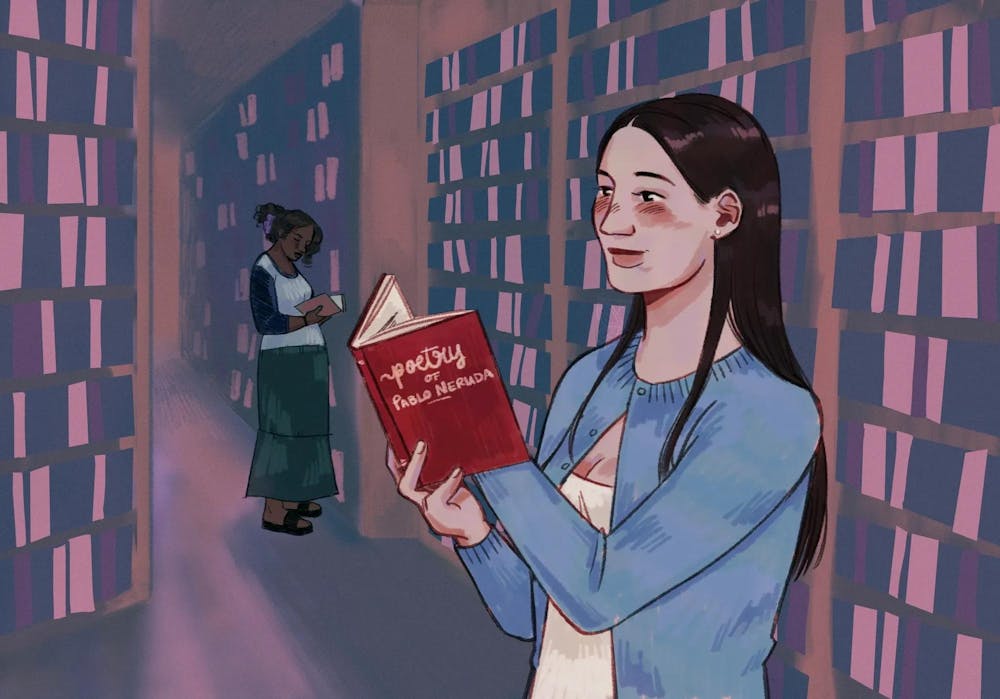
In a time when artificial intelligence has grown more and more prevalent, there is absolutely no use for it in my first-year seminar. In LITR 0710: “Writers on Writing Seminar,” my class reads a collection of poems, essays or a novel every week, discusses the works and then has the privilege of hearing the authors themselves speak about their process and answer our questions. One evening that was particularly impactful was when Pulitzer Prize winner Anne Boyer came to speak after we read her collection of poems and essays “Garments Against Women.” Boyer, who teaches at Scotland’s St. Andrews University, told us poetry is essential for young people because of our desire to find meaning in life outside of work and school. In our overwhelming age of AI, grounding ourselves in experiences or rituals that bring us back to our humanity is necessary. I suggest writing poetry.
In April 2025, ChatGPT had 541 million monthly users. This past March, ChatGPT had 891 million monthly users — nearly a 65% increase. Brown is no exception to the tightening of AI’s global grip. The Herald’s 2025 First-Year Poll revealed that almost half of the Class of 2029 used AI at least weekly — a conservative estimate in my opinion. In addition, Assistant Professor of the Practice of Computer Science Eric Ewing PhD’24 told The Herald last year that in one of his courses, when he noticed that 25 of his students submitted suspiciously similar code on an assignment, 22 of them ended up admitting to using AI.
From mental health to romantic advice, we have also turned to AI for guidance on our most human problems and experiences. We are treating the chatbot like it is a person — but it’s not. Our reliance on AI is distancing us from our own human abilities, such as critical thinking and emotional processing. The boom has left us not only questioning the future of the economy, but also the future of what it means to be human.
During this time of uncertainty, my first-year seminar has reminded me of the value of poetry. Amid the bombardment of our artificial world, each class has reconnected me with my humanity. Poetry, especially written in free verse, is a way to process without restriction in a world that demands clarity and structure from us. While our writing is often judged by the clarity and potency of our thesis, poetry offers something beyond what AI can help with. Our ideas do not need to make perfect sense on the page, as they rarely do in our heads. In poetry, we are allowed to be multifaceted beings who often feel more than we can make sense of. As Walt Whitman writes in “Leaves of Grass,” “Do I contradict myself? Very well then I contradict myself, (I am large, I contain multitudes).”
In college, students typically must make some single coherent argument when they are being graded on their writing. It is so rare that we get the chance to write just for ourselves these days — without a prompt or a rubric. The practice of writing poetry for ourselves offers another way of writing: one that cannot be mimicked by a chatbot’s opinion or objectively graded by our professors. While students at Brown could all benefit from taking a poetry class at some point in their four years, poetry can be a solitary grounding practice we do for only ourselves.
Research also supports the idea that poetry activities can be linked to improved self-awareness and healthier functioning. By contrast, a Massachusetts Institute of Technology study found that ChatGPT users have lowered brain engagement and consistently underperform at “neural, linguistic and behavioral levels.”
Poetry does not have to exist in the intimidating rigid meters and rhyme schemes of Shakespeare and Keats. Contemporary poets might not be writing “Sonnet 18” or “Ode to a Nightingale,” but the art form has taken on a whole new life — there are countless poets creating art about the contemporary world that could help us feel grounded in the overwhelming noise. As I began writing poetry myself, I began to realize why the genre, in new and old forms, has persisted throughout human history. Each time I wrote a poem for my class, I became more comfortable with my voice. Soon, I realized how the form served me. I wrote poems inspired by everything in my life, from feminist essays we read in class to random lingering thoughts from my personal life. When my grandfather passed away a few weeks into the class, poetry became part of my grieving as an outlet to process memories. With each line, I wanted to build on his memory. I used repetition as a tool and highlighted specific motifs that resonated with me most. My assignments were not only making me a better poet — they were helping me work through difficult topics. If we outsource all of our writing to AI and never experiment with the writing we do, we rob ourselves of this opportunity.
I discovered “Wild Geese” by Mary Oliver early into my adolescence and regard it as the first poem that completely altered my understanding of the power of poetry. Through her poetic form, Oliver communicates the most human of sensations and emotions, especially for a young person: self-acceptance and finding one’s natural place in the world. We are meant to look to ourselves and nature to find comfort, rather than succumb to external expectations and pressures. We do not need to turn to AI when we lack answers. As Oliver reminds us, “you only have to let the soft animal of your body love what it loves.” Instead of searching externally, simply start by writing about what you feel.
Beatriz Lindemann ’29 can be reached at beatriz_lindemann@brown.edu. Please send responses to this column to letters@browndailyherald.com and other opinions to opinions@browndailyherald.com.

Bea Lindemann is a staff columnist and a member of the Editorial Page Board. She is from Miami Beach, FL and plans on concentrating in Political Science.


