Richard Feynman famously said that “if you want to make a simulation of nature, you’d better make it quantum mechanical.” But Garnet Chan, professor of chemistry at the California Institute of Technology, disagrees.
“The whole field of chemistry developed without even needing to think about quantum mechanics, and certainly without having to think about a quantum computer,” Chan said in an interview with The Herald prior to the lecture.
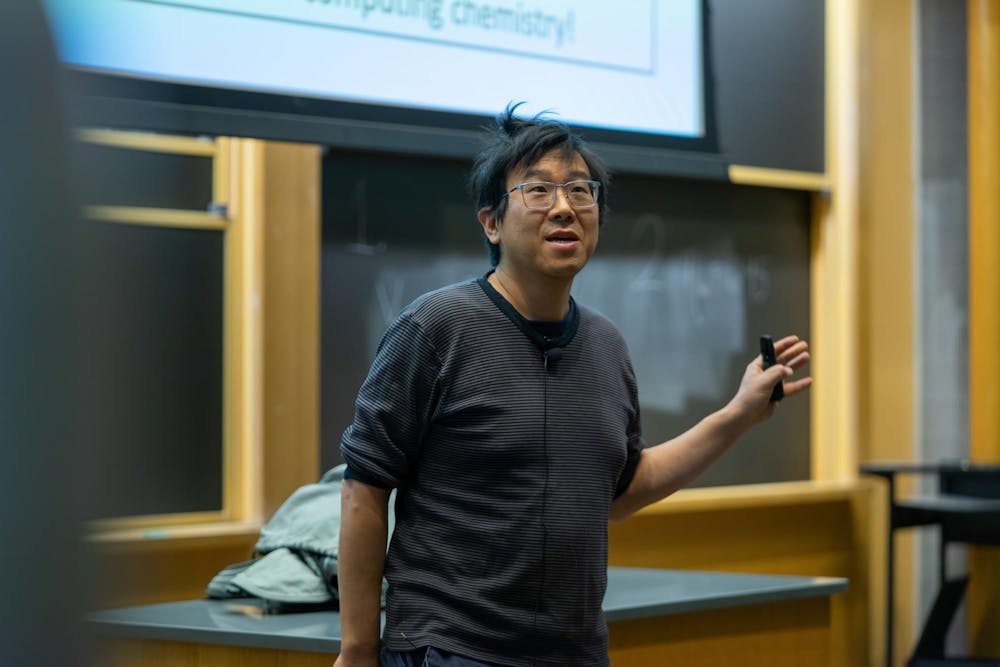
On Thursday, Chan delivered the 2026 John Howard Appleton Lecture hosted by the Department of Chemistry. In the lecture, Chan argued for a “more measured perspective” on the hype around quantum computing, which he called a “hot topic” today.
Classical computers process data by storing information in bits — basic units of binary information recorded as either a zero or a one — but the growth of classical computing power has slowed due to physical constraints. Quantum computers store information in qubits, which allow information to exist in a quantum state — meaning it can exist as some mixture of the “classical possibilities” enabled by binary bits.
As a result, quantum computers are thought to be more powerful because the amount of information stored with quantum computers grows exponentially as the number of bits increases, but it only grows linearly for classical computers.
At his talk, Chan argued that despite popular hype around quantum computing, classical computing can still be a valuable tool in solving some of chemistry’s most difficult problems.
But “at the same time, quantum computers do offer a new computational device,” he added. “In history, whenever there's a new type of computation, we always find a way to use it.” Quantum simulation, Chan explained at the lecture, is using quantum computers to solve physical problems.
Chan spoke of an example from his work using classical computing to better understand nitrogen fixation — the process by which nitrogen in the air is converted to usable compounds, such as ammonia. Nitrogen fixation — a topic that scientists have analyzed using quantum computers and that is necessary for life on earth because it allows plants to grow — is carried out either industrially or by bacteria using the nitrogenase enzyme.
“Understanding nitrogen fixation is of basic interest because we want to understand the world,” Chan told The Herald. “It’s a fundamental dance that one would like to understand.”
Much high-profile research has been conducted on using quantum computing to understand nitrogenase, which has a complex structure, Chan said. “Over the last decade, you know, there’s been a lot of activity devoted to this task of asking, ‘How efficiently can a quantum computer simulate this particular molecule?’”
But Chan and his team were able to use classical computing to simulate the enzyme’s structure and more simply and accurately.
Chan told The Herald about how he developed his interest in quantum and theoretical chemistry, which he grew to greatly prefer to the experimental realm of the field.
“Experiments, you know, they work one day, they don’t work the next day,” Chan said. “But your computer does the same thing today, every day. So life is much better when you're a theorist.”
Matthew Coley-O’Rourke, assistant professor of chemistry, worked under Chan as an undergraduate researcher at Princeton and later as a Ph.D. candidate at Caltech. He described Chan as a mentor who combined “rigorous scientific demands with understanding interpersonal challenges.”
Coley-O’Rourke said he hoped students would take away from the lecture “inspiration for what level of science is possible” and a “healthy skepticism” of “hype” that Garnet exercises in his view of quantum computation.
Lecture attendee Simon Nirenberg ’28 said he’s been following Chan’s work for years and has looked to Chan’s innovations in his own quantum chemistry research. For Nirenberg, the event this year was a chance to hear from someone he’s wanted to see speak “for a long time.”
“People have basically called him the smartest quantum chemist alive,” Nirenberg said.
Nishita Malhan is a senior staff writer covering science and research.