
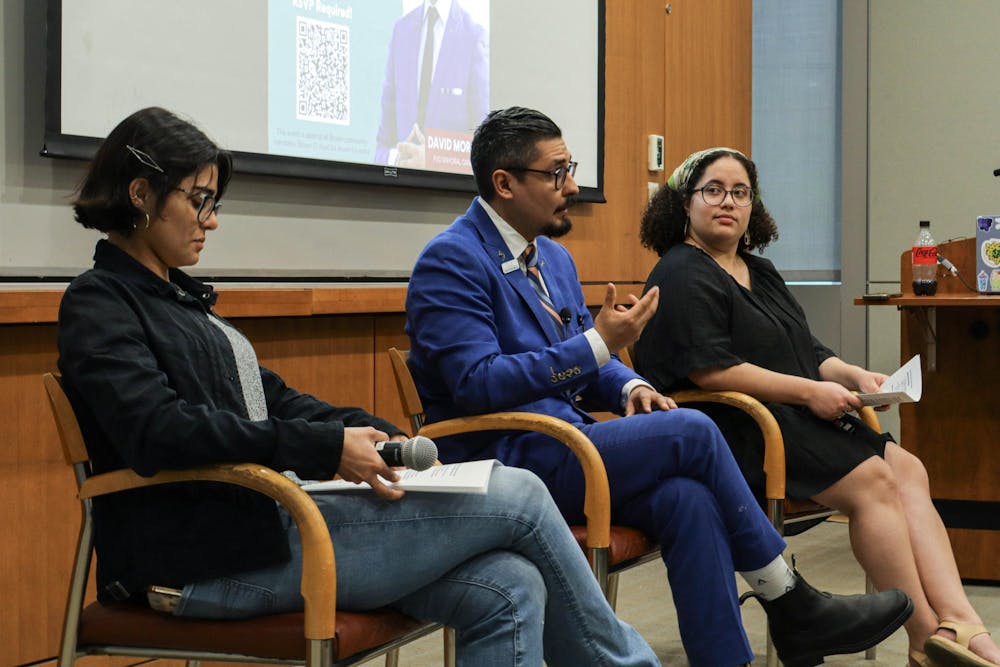
On Wednesday afternoon, the Latinx Graduate Collective and Brown for Science Diplomacy hosted Providence mayoral candidate state Rep. David Morales MPA’19 (D-Providence) for a moderated panel to discuss the impacts of research funding cuts and increased immigration policies on higher education.
A goal of Wednesday’s discussion was to “bridge that gap between scientists and policymakers,” Melanie Ortiz-Alvarez de La Campa GS, a co-founder of Brown for Science Diplomacy, said during the panel.
“People are worried about what the future of science holds,” Ortiz-Alvarez said in an interview with The Herald. “There was a need for grad students to have a space for them to voice their concerns.”
Alexxa Cruz-Bonilla GS, president of Latinx Graduate Collective, told The Herald that the group had initially contacted Rhode Island’s representatives in Congress to attend the panel, since funding cuts and immigration policies have primarily occurred at the national level.
Cruz-Bonilla said that, despite offering several dates and taking care to ensure that Congress was not in session at those times, each legislator declined the invitation, saying that they were too busy to attend.
Chip Unruh, a press secretary for U.S. Sen. Jack Reed (D-R.I.), wrote in an email to The Herald that “it would be great if Senator Reed could go to every event he’s invited to.”
“He attended three events on Brown’s campus last week where he discussed these types of topics and more with students and faculty,” Unruh added.
None of the other members of Congress representing Rhode Island responded to a request for comment.
After shifting to a state and local politics lens, the group was connected with Morales by one of the Latinx Graduate Collective’s previous speakers from the Latino Policy Institute of Rhode Island, Cruz-Bonilla said.
Morales joined the Rhode Island State House in 2020 as the youngest Latino legislator in the country and announced his candidacy for Providence mayor last fall. Throughout his campaign, Morales has advocated for affordable housing, more funding for public schools and protection from increased immigration enforcement.
At the panel, Cruz-Bonilla explained to Morales that “when research funding gets cut, it’s often the early scientists like us in this room and students who are hit the hardest.” She emphasized that students’ primary question is how they can bring visibility to policymakers about “what (they’re) experiencing in the lab.”
The panel opened with a brief overview of how University research and the Providence community are linked. Morales said that many alums from the city’s higher education institutions — such as Brown and RISD — don’t end up staying in Providence after graduation.
Morales attributed this to a scarcity of promising job options for graduates in the state since many state agencies opt to hire private contractors instead of working with researchers. “If we were to start making those investments directly back towards workforce opportunities, back towards research, we would be able to capture and retain so much more talent that otherwise just leaves the state,” Morales said.
For Morales, mitigating the impact of funding cuts in higher education means being proactive in the state legislature — he explained that the Office of Postsecondary Commissioner “can help ensure that there is a pipeline of funding readily available when federal cuts are suspected to come.” Securing this funding first requires efforts to “raise the flag, draw attention” to the issue and then drafting the relevant legislation, Morales said.
Morales emphasized that Brown has a responsibility to invest in the surrounding community by supporting public schools. He added that an endowment tax would help direct funding to schools’ behavioral health services, including for social workers and counselors.
“I cannot tell you enough just how ironic it is that we have two world class institutions in our backyard, yet less than 20% of our students are reading at grade level,” Morales said.
Morales also discussed the rising presence of U.S. Immigration and Customs Enforcement in Providence, which Cruz-Bonilla said has led to many international students and students of color “living in fear right now about their visas, their status and their safety.”
The White House did not respond to a request for comment.
Ortiz-Alvarez noted that Brown’s graduate programs have a high concentration of international students. “Most of our fantastic talent comes from external countries that come in through visas that are no longer being accepted,” she told The Herald.
“My message to our immigrant community is that you have a community that cares about you,” Morales said. He specifically highlighted the Deportation Defense Line, a hotline run by several community organizations that sends volunteers to locations that report ICE activity.
“Here in Providence, we take care of one another,” Morales said.
Despite the ongoing challenges for researchers, Morales emphasized that in STEM fields, “we need more first-generation Americans. We need more first-generation students. We need folks from immigrant backgrounds.” He encouraged those who are considering leaving the field to stick with it.
“That level of representation goes such a long way,” he added.
Ortiz-Alvarez told The Herald that while the event was mainly advertised for graduate students, “it’s equally important that everyone in the Brown community gets involved in this sort of conversation.” Before the panel, members of the two host organizations distributed information on how to register to vote in Rhode Island.
“We should still be involved in the processes, regardless of what you’re studying,” Cruz-Bonilla told The Herald.

Zarina Hamilton is a university news editor covering activism and affinity & identity. She is sophomore from near Baltimore, Maryland and is studying mechanical engineering. In her free time, you can find her reading, journaling, or doing the NYT mini crossword.


