Although its blues and greens may appear tranquil, the ocean is chaotic in nature — there is perpetual movement across the world’s oceans. The motion, which includes ocean turbulence, ranges from a few centimeters to thousands of kilometers. But this turbulence can be difficult to measure, especially in the polar marginal ice zone, where ice can impede researchers’ ability to measure the ocean’s movement.
A new study by Brown researchers takes a different approach: focusing on the spinning motion of sea ice floes.
The study, which may have important implications for understanding climate change, examines how the rotation of individual ice floes influences the distribution of enstrophy — a measure of swirling motion and fluid turbulence — in surrounding ocean water.
“We wanted to see how that measure changes on average over larger and larger pieces of ice,” Daniel Watkins, an author on the paper and a senior research associate in the School of Engineering, said in an interview with The Herald. “One thing that we were glad to see is that we are able to see a clear relationship between the two.”
The study suggests that high sea ice concentration has weaker large-scale activity and stronger small-scale motion compared to low concentrations.
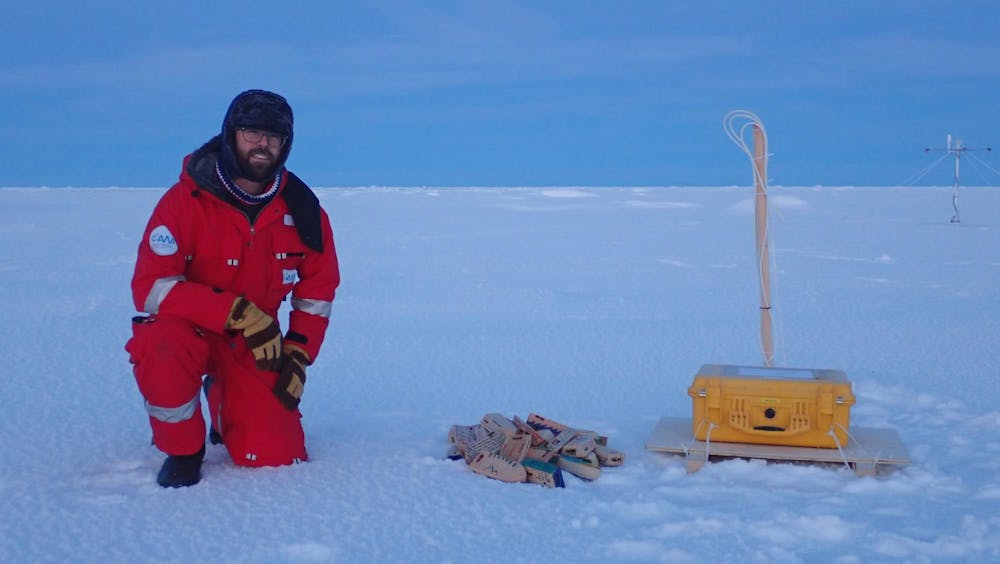
According to Watkins, there are not many observations of Arctic Ocean currents as it is a difficult location to reach.
Courtesy of Daniel Watkins
Watkins explained that satellites can offer a different method to measure the Arctic Ocean. The study took “advantage of a really long record of satellite photography of the Earth’s surface, where, by eye, you can see individual pieces of ice moving and rotating,” Watkins said.
The data can then be used with a software to identify and track the shapes of the ice floes, and measure their rotations. As the rotation of the ice floes is influenced by the rotation in the ocean, they can be used to trace the upper ocean’s currents.
Watkins explained that in order to ensure the researchers were collecting reasonable data, they compared the extracted individual ice floes’ shapes to the findings of an expert’s manual labeling. They then determined whether the inference on the ocean’s movements derived from this data was correct through a model that accounts for variability in the ocean.
Watkins noted that widespread simulations that have traditionally performed well with other ocean measurements were “actually estimating too strong of ocean eddies,” causing the ocean to seem like it had more variability than it should have.
“That tells us that we need to look at that model, that simulation, that we’ve used to try to understand future climates,” Watkins said.
Roberto Zenit, a professor of engineering who was not involved with the paper, said that “the importance of this paper is its possible relevance for understanding climate change.”
Arctic sea ice shrank to one of its lowest winter levels this season.
The paper’s models can be used to predict the motion of these floating pieces of ice, and infer the motion underneath, according to Zenit. That is “very important to understand how the climate is changing because of global warming,” he said.
Although ice floe data is not typically used to study ocean turbulence, the research suggests it can help trace changes in the Arctic Ocean, Watkins said.
“As a climate scientist, I’m really excited to see a long-term record from the same type of instrument, which lets us start to look at change over multiple decades consistently,” Watkins said.
Amrita Rajpal is a senior staff writer covering science and research.