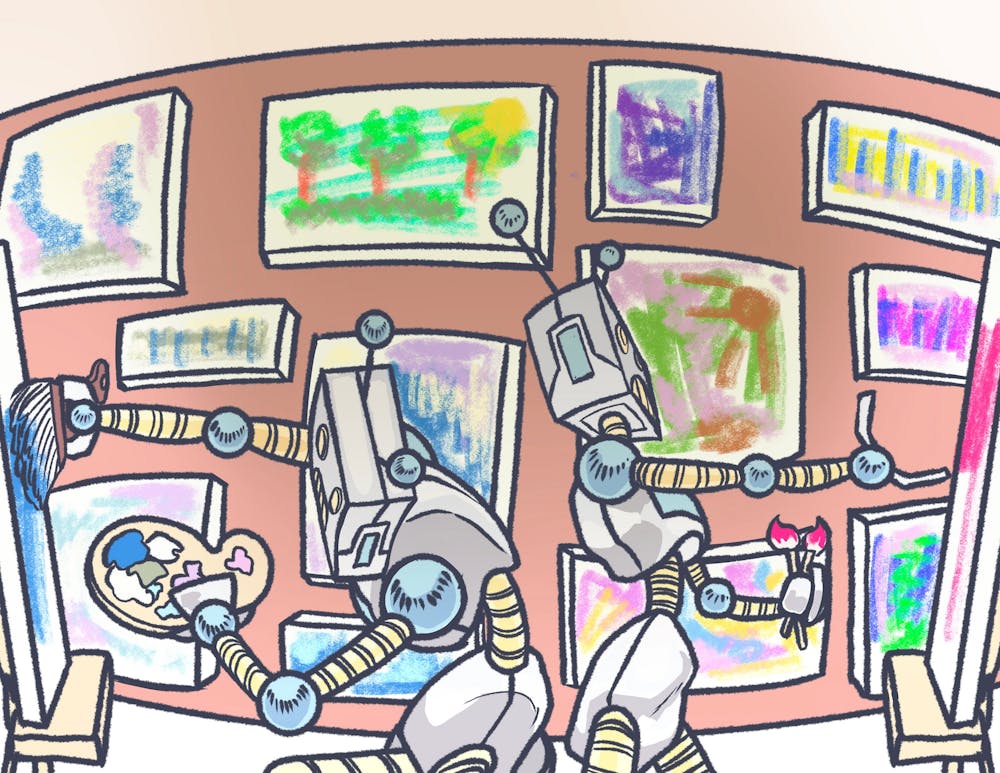
When applying to the Rhode Island School of Design, students are allowed to use artificial intelligence in their portfolio as long as the admissions committee is made aware of how it was used in the creation of the work.
But on campus, the RISD community is split on the role of AI in art.
While RISD has not published a formal institutional policy on AI, its Academic Code of Conduct prohibits the use of AI if it is not attributed properly or if it gives the student an “unfair academic advantage.”
“RISD embraces the ethical use of artificial intelligence (AI) in the creative process,” the school’s admissions page states.
Jeanne Alailima, a RISD first-year and prospective textiles major, said that allowing AI in admissions portfolios seems to demonstrate the school administration’s positive stance toward AI. But among students, she said that the general opinion was “slightly more negative.”
Alailima added she is “open to the possibility” of AI being used as a tool to make art more accessible. But “I kind of like the idea of using technology as a tool rather than doing the thinking for me,” she said.
As the Senior Instructional Designer at RISD’s Teaching and Learning Lab, Dimitris Papadopoulos provides workshops, resources and advice for faculty members to determine how they want to approach AI in the classroom.
“My main role is to think about pedagogy first, not technology,” Papadopoulos said. When helping faculty navigate how to implement AI, he encourages them to explore questions of how AI would impact learning objectives and students’ ability to find their own voice in the classroom.
Course policies range from “zero AI to fully exploring and engaging AI,” he said, and there have been more than a dozen RISD courses about AI and its implications on writing and art since ChatGPT was released.
In the Department of Computation, Technology and Culture, it is difficult to “ignore this kind of technology,” Papadopoulos explained. But in areas like the Division of Liberal Arts, “things tend to be a little bit more restrictive when it comes to the use of AI,” he added.
“It’s never the answer to redesign your whole course or teaching approach just because of AI. But there may be certain components worth reconsidering, including, most importantly, I would say, grading and assessment,” he explained.
Susan Solomon MA’09 PhD’13, a faculty fellow in the Teaching and Learning Lab for spring 2026 and a lecturer in the Department of Literary Arts and Studies, introduced a poem recitation and discussion assignment to her first-year seminar class this year, something she “would probably never have done” if not for AI tools making her question whether students had actually completed the course readings.
“I’m skeptical and concerned about the way (generative) AI tools can interfere with the kind of learning I want my students to do, and I know I'm not alone,” she said.
But Clement Valla, the head of the computation, technology and culture department and a professor at RISD, said that he allows students to use “as much AI as they want but to be completely transparent about it.”
Valla said that students in his classes typically use AI to expand the capabilities of Photoshop or build custom textures for video game production.
“Students get bored with (AI) quickly because it has such a recognizable style, so I actually don’t see that much image generation happening,” Valla said. “The really exciting stuff is happening in tool building, custom software building (and) custom product development.”
Valla said he can tell when students have used AI to revise their work instead of going through the project development themselves. While AI is good at ideation, it “isn’t good at refining or changing direction slightly,” and it constantly wants to jump to a final product, he added.
Naomi Zaro, a RISD junior in the illustration department, said she does not use AI because “there’s so much beauty in mistakes and something being human-made.” She said that in response to growing AI use, students are shifting away from technology toward traditional mediums, such as painting.
According to internal RISD documents obtained by The Herald, enrollment in the painting major has increased by 70% from 2023 to 2024.
Zaro said that in class critiques, students tend to appreciate work that is visibly handmade.
Athena Evans, a RISD first-year and prospective architecture major, said that she has seen AI be used for translation, given RISD’s large international student body, but that “socially, it’s very looked down upon to use AI” for conceptualizing or executing work.
In her role as a Teaching and Learning Lab faculty fellow, Solomon held a workshop with the liberal arts division on teaching and learning in the age of AI. As part of the workshop, they discussed “what kind of learning do we want our students to gain or carry out or practice, and what kind of activities can really ensure or really create space for them to do it,” she said.
Solomon explained that in light of RISD’s emphasis on amplifying artists’ voices, she thinks it is vital that students “believe in their voices” without feeling the need to use AI to “make their voices good enough.”
RISD’s Teaching and Learning Lab also holds a summer program for faculty to learn more about AI called the “Critical Thinking and Making with AI” Faculty Institute.
Papadopoulos said that some faculty “have very real and very legitimate concerns” about the environmental and ethical implications of using AI. The CTMAI Faculty Institute tries to address this by offering “localized versions of AI models” that do not require setting up accounts with corporate AI companies, Papadopoulos said.
This allows faculty to engage with AI in a way that gives them more control over their AI usage, he said. “I think that can help demystify the technology, but also open it up to all sorts of creative uses and ways of critically engaging with it.”
Valla said that fears that AI will replace humans can be placed in a broader historical discussion about the development of tools, noting that “photography was supposed to replace artists,” but that it instead “liberated” from striving for perfect likeness.
“I’m not pro or against,” Valla said. “It now exists. Let’s figure out what it does well, what it does really badly.”
But he did acknowledge that layoffs in certain industries are occurring as companies replace human artists with AI. Valla specifically cited layoffs of illustrators in the video game industry, calling those decisions “incredibly shortsighted.”
Unlike more physical mediums such as painting, sculpture or furniture design, Zaro says that her specialization — illustration — is at a greater risk of being replaced by AI since it can be done digitally.
AI “is a statistical machine that outputs the most likely outcome,” Valla said. “So is that really a way to build unique pieces of culture?”

Emily Feil is a university news and metro editor covering staff & student labor and RISD. She is from Long Beach, NY and plans to concentrate in English and international & public affairs. In her free time, she can be found watching bad TV and reading good books.
Izabella Piatkowski is a senior staff writer covering the Rhode Island School of Design.