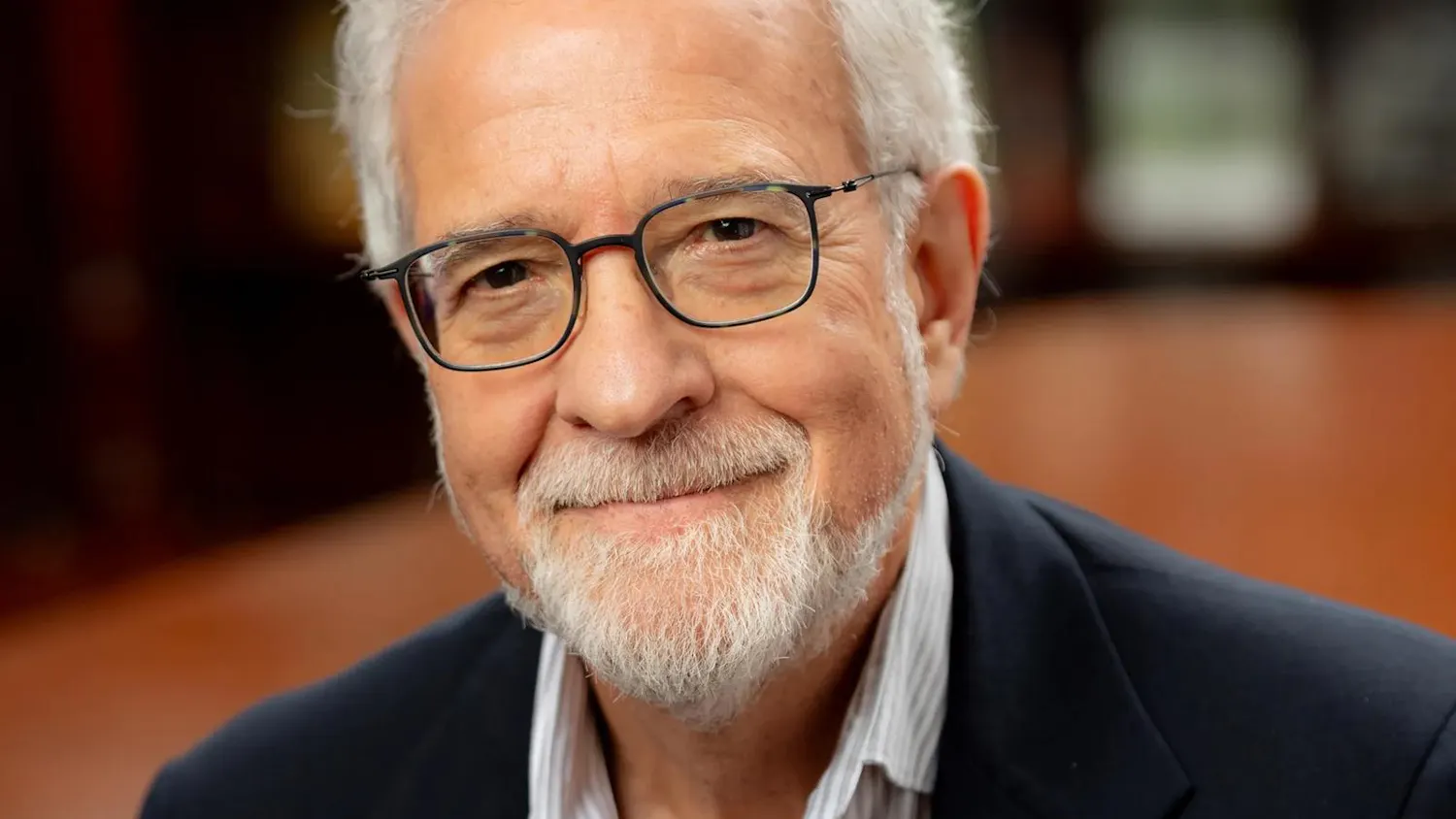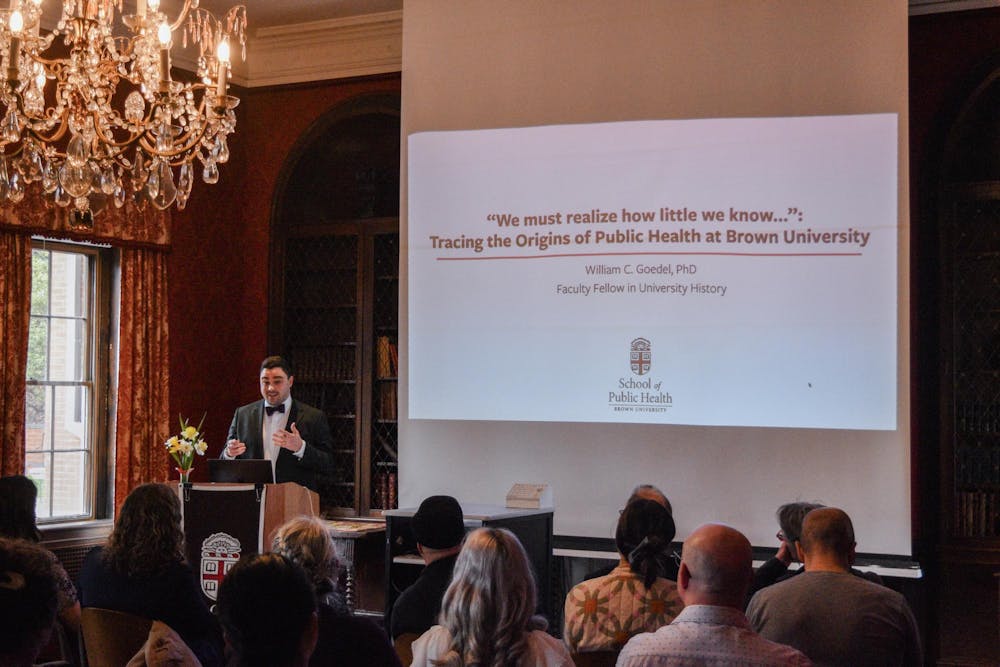
While the School of Public Health was not officially founded until 2013, public health has remained a pertinent topic since the University’s founding. On Monday, Associate Professor of Epidemiology and Faculty Fellow in University History William Goedel PhD’20 hosted a talk on the longer evolution of public health at the University, starting primarily in the 1800s.
The talk, titled “‘We must realize how little we know…’: Origins of Public Health at Brown University, 1834-1934,” was held in the Nightingale-Brown House.
Faculty have researched the department’s history in the past, Goedel said in an interview with The Herald. When celebrating the tenth anniversary of the SPH in 2023, faculty put together a piece on the history of public health at Brown from 1971 onward.
“We had an article that tried to at least trace the history of both the (SPH) proper and its immediate predecessor at the Department of Community Health that was founded under Albert Wesson in 1972,” Goedel said during the talk. “It made very minor mention to a degree program that had, or at least the approval of a course of study leading to the degree of Doctor of Public Health in the late 1910s.”
Goedel found the opportunity to study this degree through the Faculty Fellowship in University History, which is sponsored by both the John Nicholas Brown Center for Advanced Study and the Office of the Provost.
Through archive searches in the Providence Journal and The Herald, Goedel found one mention of the program — a 1917 recommendation by the Board of Fellows to establish the program.
As an epidemiologist, Goedel wondered about the connections between the program and the public health conditions of the time. “I hear years like 1917, 1918 — that’s another sort of historic moment that pricks a lot of our interests,” he told The Herald. From 1918 to 1919, an influenza pandemic killed millions worldwide. In 1917, the United States officially joined World War I.
During the 1918 pandemic about 1,400 of Providence’s 248,000 residents died due to influenza, according to Goedel. Around 700 of these deaths happened within a 30-day period when Brown’s campus was under a quarantine, according to Goedel. The only mention of influenza in the entirety of corporation or faculty meeting minutes was to say that the quarantine was successful, he added.
In the 1914-15 academic year, a seven-member committee was formed, charged with considering how the University could “meet the needs of the broader society,” especially as Brown was “preparing voters and men for the offices of life,” Goedel said.
A Doctor of Public Health became the committee’s “first and only recommendation,” he added.
Goedel emphasized the roles of two figures in Brown’s public health history: Frederic Poole Gorham, class of 1893 and 1894 master’s degree recipient, and Charles Value Chapin, class of 1876.
Gorham, who championed the discipline at Brown, is credited with proposing the public health degree program, Goedel said. From 1905 to 1916, Gorham — the first professor of bacteriology at Brown — supervised 13 of the 16 doctorate students who graduated from the Department of Biology. When Rhode Island’s health department was reorganized in the 1920s, one of Gorham’s students became its first director, Goedel said.
“Here in the state, there are 10 people who have served as the Director of Health for the state of Rhode Island, at least in a permanent capacity,” he said. “Seven of them were students or faculty at Brown prior to assuming the role.”
Goedel highlighted Chapin as “one of the most influential figures in the movement to transform public health into a modern science.”
“He’s actually rather controversial in the earlier parts of his career because he was so far against what the established sort of thought was,” Goedel said. “Primarily about germ theory, he really says we have to go after microorganisms and not just filth in general, and really kind of changes the way that public health operates.”
Goedel ended his talk with a callback to the title of the event. He derived the line “we must realize how little we know” from an address given by Chapin.
Event attendee and Assistant Professor of Epidemiology Shilo McBurney said that she came to the talk because “it’s just so important to understand where we came from (in order) to decide where we’re going, both as a school and our profession.”
Aiyah Josiah-Faeduwor ’13, who photographed Monday’s talk for the University, was interested in hearing how “the majority of the heads of the Department of Health here in Rhode Island have been Brown graduates.”
“I think that, in the most effective way, really speaks to the leadership opportunity and the relationship that Rhode Island has with the value for the Brown perspective,” Josiah-Faeduwor told The Herald.
“There’s a lot of public health history in Providence, we just didn't realize it. And (Goedel) just found it and just showed us, which I appreciated,” said attendee Arrianna Boyden MPH’26. “History is sometimes forgotten, and to be reminded of all the fun jewels that he found was really cool.”

Alice Xie is a section editor for Science and Research from Los Angeles, California. She studies Applied Mathematics and Biology, and enjoys reading gut wrenching literature in her free time.