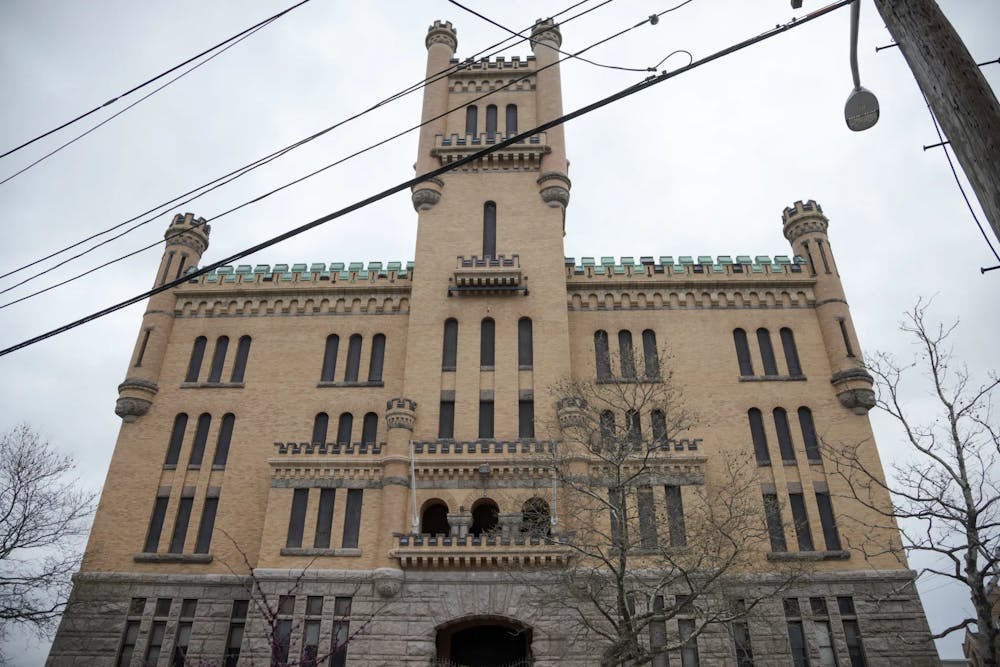
For decades, a century-old armory has stood practically vacant on the west side of Providence.
Originally built in 1907 and used by the National Guard for the next 90 years, the Cranston Street Armory hosted a variety of community events throughout the 20th century, including track meets, circuses and political inauguration balls, according to Marisa Angell Brown, executive director of the Providence Preservation Society.
In 1996, the state took ownership of the Armory, and a year later, the National Guard moved out. The castle has been mostly unoccupied ever since, and has frequently appeared on the Providence Preservation Society’s annual list of endangered buildings.
In 2019, Rhode Island requested proposals for the redevelopment of the Armory and eventually selected the design firm Scout Urban LLC’s proposal entitled “Open the Castle and the People Will Play.” The proposal envisioned repurposing the drill hall into a public center that would house turf fields, a cafe and spaces for small businesses.
But in 2023, Gov. Dan McKee canceled the contract due to a financial assessment that revealed the undertaking would not generate enough revenue in 15 years to recoup its costs.
Now, the PPS and West Broadway Neighborhood Association are attempting to regain momentum for the project.
In addition to jointly-held monthly community meetings, PPS is leading a sold-out tour of the Armory in April. Additionally, advocates plan to work with elected officials to put a redevelopment project back in motion, according to Angell Brown.
In 2023, McKee called the Armory a “local community project,” rather than the state’s responsibility. To Angell Brown this is “hard to see,” given its size of 190,000 square feet.
“This is a citywide, statewide project that has important ramifications,” Angell Brown said.
A spokesperson for McKee did not respond to a request for comment.
While Angell Brown said that Providence Mayor Brett Smiley has signaled interest in the project, though Angell Brown believes that redevelopment is only possible if an agreement is reached between the city and state.“The city can’t afford to do it all on its own with no help from the state,” she added.
According to City spokesperson Josh Estrella, “the administration continues to be in conversations with the state regarding ownership of the Cranston Street Armory. We anticipate this process to be ongoing and there are no updates at this time.”
For Siobhan Callahan, the executive director of the WBNA, the Armory’s cultural history is another key reason to revive the building.
“‘The Castle for the People,’ as it has come to be known, has special meaning not just for those of us living within its shadows, but also for Rhode Islanders from all over the state who have fond memories of attending events there,” Callahan wrote in an email to The Herald.
Providence is not the only city with a languishing castle. According to Angell Brown, large armories across the country built during the same historical period as the Cranston Street castle were also vacated at similar times.
But now, other states and cities are also looking to make use of their empty armories.
Just a few miles away in Massachusetts, Metro West Collaborative Development and Civico Development are in the process of revitalizing the West Newton Armory.
According to Taylor Bearden, a partner at Civico Development, the state of Massachusetts previously owned the Armory but sold it to the city of Newton in 2021 “on the condition it be used for 100% affordable housing.” Construction began in spring 2025.
Funding for the West Newton Armory project comes from a variety of sources, including state, city and local subsidies. “Alignment between stakeholders” — both the municipality and developers — is “critical” for a project like this, Bearden added.
Meanwhile in Providence, even as the Cranston Street Armory remains empty, the state has paid its upkeep costs. Between 2020 to 2025, Rhode Island spent about $1.4 million on maintaining the Armory, on top of initial payments to Scout for their designs.
According to Angell Brown, “Scout is still interested potentially in the project.”
“When plans were stopped in their tracks” in 2023, “it was devastating to everyone involved in the vetting process and to those who live here,” Callahan wrote.
Scout did not respond to The Herald’s request for comment.
“If and when the political landscape evolves, we want to be ready with thoughtful ideas and broad-based support that demonstrates the jewel that the Armory is and the potential it presents to be an economic driver for the whole state,” Callahan wrote.