
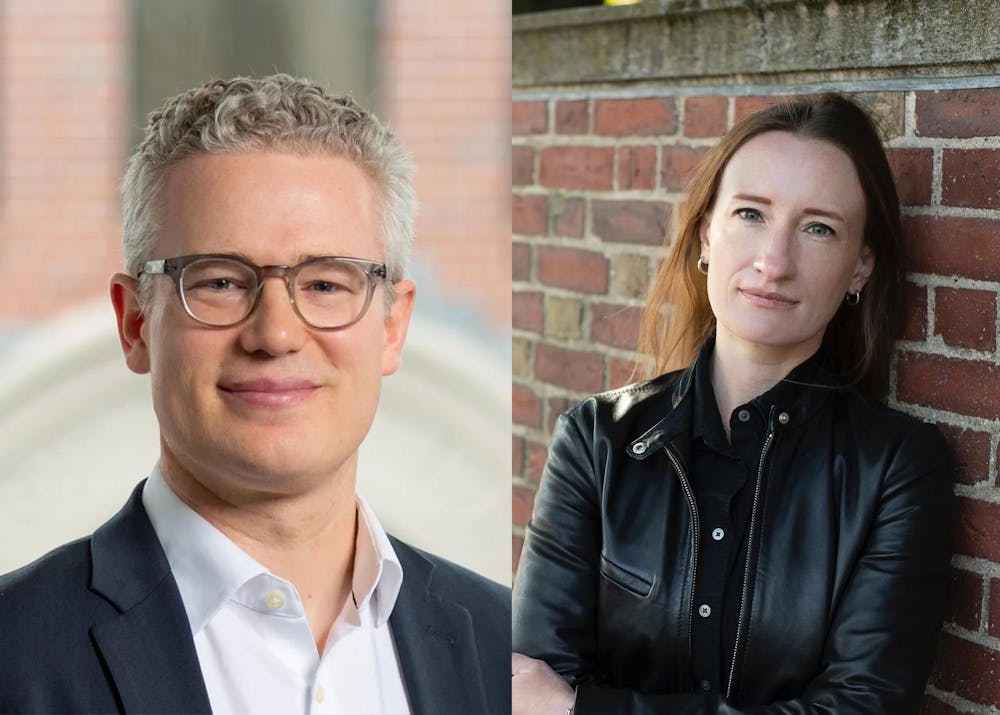
On Tuesday, Ieva Jusionyte, a professor of international security and anthropology and director of the Center for Human Rights and Humanitarian Studies, and Matthew Kraft, a professor of education and economics, were named recipients of the 2026 Guggenheim Fellowship.
This year’s fellows were selected from nearly 5,000 applicants. Applications in the Creative Arts and Humanities and the Sciences increased by 50% and 86%, respectively.
The fellowship is offered to scholars in any field and is determined based on past accomplishments and future potential, according to the foundation’s website. Jusionyte and Kraft are among 223 fellows who will receive a monetary stipend through the fellowship to pursue independent work. The value of the stipend is decided based on each researcher’s project.
Ieva Jusionyte
Jusionyte was holding her first annual board meeting for the Center for Human Rights and Humanitarian Studies when she saw the press release naming her as one of this year’s fellows. “I’m obviously extremely happy and honored and humbled and excited,” she said. “It’s very difficult to focus on meetings or other things when it’s such good news,” she said.
Jusionyte has written three books which focus on state violence through research centered on borders between nations, including the U.S.-Mexico border.
For the past several years, Jusionyte has been working on a book focused on organized crime members that are extradited from Mexico to the United States, and the “impact it has on justice on both sides of the border,” she said.
Jusionyte hopes to use the Guggenheim fellowship to complete the project. She plans to take more research trips to observe court hearings and trials in Mexico and the United States, and said she will begin writing the book over the course of the next year.
Jusionyte is also a recipient of the MacArthur grant and fellowships from the Harvard Radcliffe Institute, the Fulbright Program and the Rockefeller Foundation.
For Jusionyte, being selected as a Guggenheim fellow is a “meaningful recognition” of the value of her work beyond the “small circle” of scholars working in the field of legal anthropology.
Matthew Kraft
Kraft said he feels “overjoyed and deeply humbled” to receive the fellowship. His selection has left him “inspired to pursue things that may have otherwise been harder to do without the support and flexibility of this fellowship,” he added.
He hopes to “conduct new research that helps to shine a light on how we can revitalize the teaching profession,” he said, adding that this work would serve as an “extension of (his) longstanding research.”
Kraft’s research focuses on how school systems can adapt to address climate change and methods to improve the effectiveness of K-12 schools.
In navigating the application process, Kraft said that he was inspired by Tracy Steffes, a chair and professor of education and professor of history, who was selected as a Guggenheim fellow in 2025.
Kraft previously served as a senior economist on the White House Council of Economic Advisers and taught middle and high school humanities. He has also received numerous awards, including the American Educational Research Association Outstanding Public Communication Award.
“I thought that this was the time in my career to find ways to do something different, do something bigger, do something less traditional,” Kraft said. “I have an immense privilege to be a scholar, and I take that privilege seriously in aiming to make schools and our education system better for future generations.”
Seyla Fernandez is a senior staff writer covering faculty.


